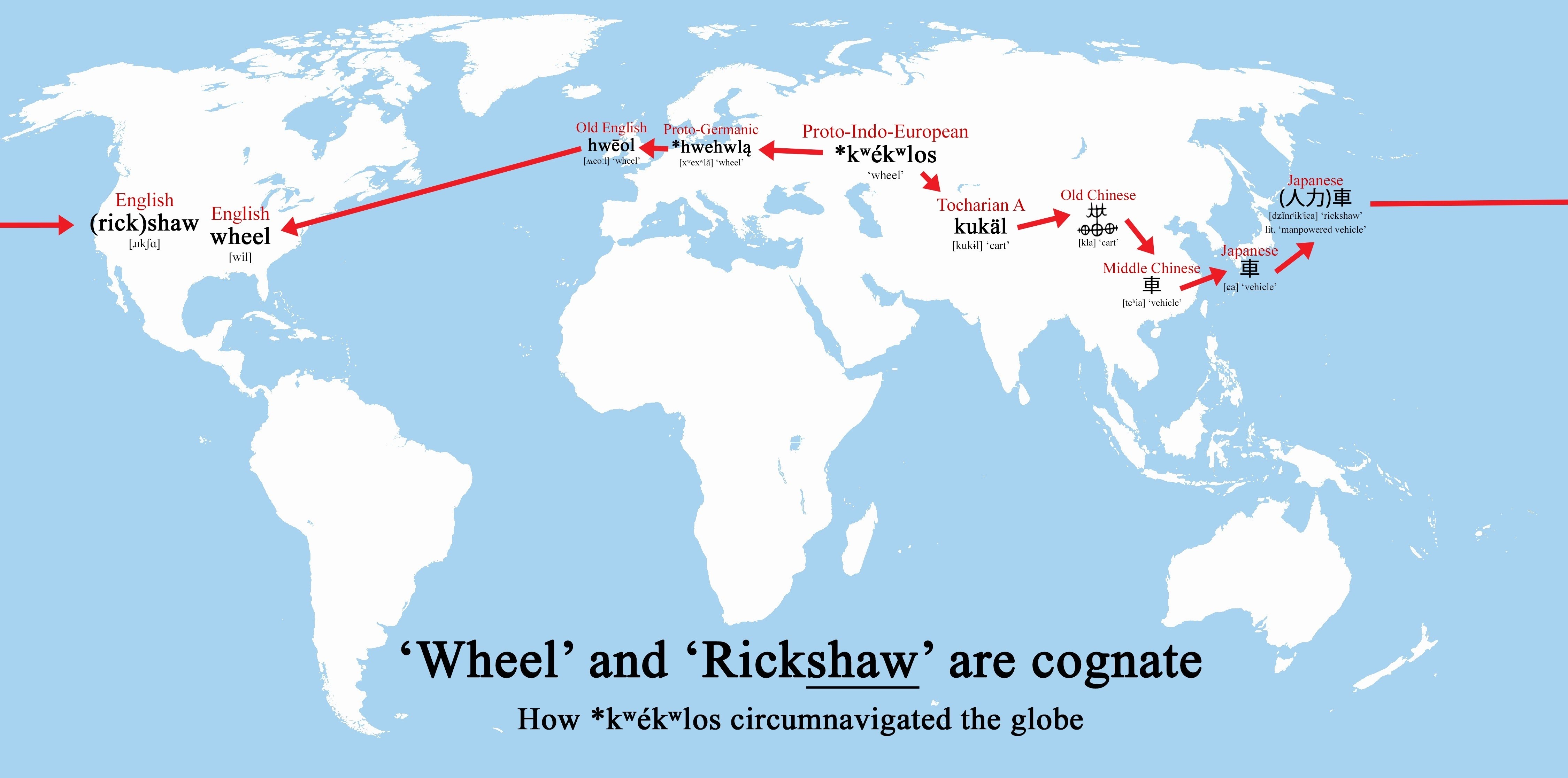
"Mead/honey" followed basically the exact same path, except for the final borrowing of the Japanese word back into English.
Proto-Indo-European *med^h^u > English "mead"
Proto-Indo-European *med^h^u > Tocharian B (not A) "mit" > Old Chinese "mit" > Japanese "hachi-mitsu" (bee-honey)
6 Comments
hakase@sh.itjust.works · 17 pts · 2y
"Mead/honey" followed basically the exact same path, except for the final borrowing of the Japanese word back into English.
Proto-Indo-European *med^h^u > English "mead"
Proto-Indo-European *med^h^u > Tocharian B (not A) "mit" > Old Chinese "mit" > Japanese "hachi-mitsu" (bee-honey)
IoSapsai@lemm.ee · 2 pts · 2y
In most slavic languages it's also "Med" or a cognate.
loputozirak@lemmy.ml · 1 pts · 2y
catalan: mel
IoSapsai@lemm.ee · 2 pts · 2y
Same as Latin!
danl@lemmy.world · 14 pts · 2y
Cool post though I’m not fully onboard with the map implying the modern words came into form in America.
deegeese@sopuli.xyz · 6 pts · 2y
Also the source of the word 'circle'