Since this is everyone's favorite example of telescoping sums, let's do it another way just for giggles.
::: spoiler Combinatorial proof
The denominator is P(n+1, 2) which is the number of ways for 2 specified horses to finish 1st and second in an n+1 horse race.
So imagine you're racing against horses numbered {1, 2, 3, ....}.
Either you win, which has probability 0 in the limit, or there is a lowest numbered horse, n, that finishes ahead of you.
The probability that you beat horses {1,2, ... , n-1} but lose to n is (n-1)! / (n+1)! or P(n+1, 2) or 1/(n^2^+n), the nth term of the series.
Summing these mutually exclusive cases exhausts all outcomes except the infinitesimal possibility that you win.
Therefore the infinite sum is exactly 1.
3 Comments
siriusmart@lemmy.world · 4 pts · 2y
Hint 1: ::: spoiler spoiler expand the expression :::
Hint 2: ::: spoiler spoiler partial fractions :::
Solution:
::: spoiler spoiler Link: https://gmtex.siri.sh/fs/1/School/Extra/Maths/Qotd%20solutions/2024-05-07_infinite-sum.html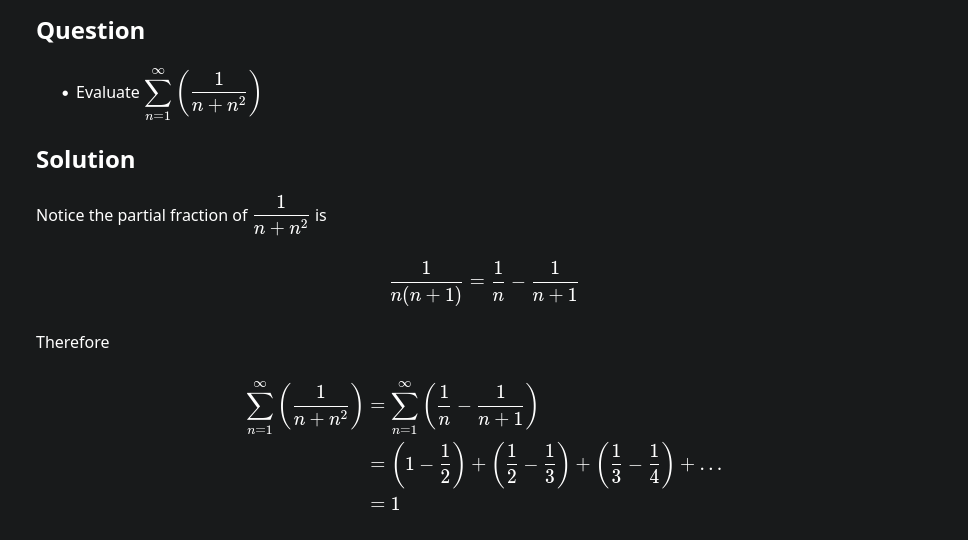 :::
:::
WhoresonWells@lemmy.basedcount.com · 4 pts · 2y
Since this is everyone's favorite example of telescoping sums, let's do it another way just for giggles.
::: spoiler Combinatorial proof The denominator is P(n+1, 2) which is the number of ways for 2 specified horses to finish 1st and second in an n+1 horse race. So imagine you're racing against horses numbered {1, 2, 3, ....}. Either you win, which has probability 0 in the limit, or there is a lowest numbered horse, n, that finishes ahead of you. The probability that you beat horses {1,2, ... , n-1} but lose to n is (n-1)! / (n+1)! or P(n+1, 2) or 1/(n^2^+n), the nth term of the series. Summing these mutually exclusive cases exhausts all outcomes except the infinitesimal possibility that you win. Therefore the infinite sum is exactly 1.
:::
zkfcfbzr@lemmy.world · 4 pts · 2y
::: spoiler solution With partial fractions:
1/(n + n²) = 1/(n(n+1)) = A/n + B/(n+1)
A(n+1) + Bn = 1
n = 0 gives A = 1, n = -1 gives B = -1
1/(n+n²) = 1/n - 1/(n+1)
Σ (n = 1 to ∞) 1/(n+n²) = Σ (n = 1 to ∞) 1/n - Σ (n = 1 to ∞) 1/(n+1)
= Σ (n = 1 to ∞) 1/n - Σ (n = 2 to ∞) 1/n
= 1/1 + Σ (n = 2 to ∞) 1/n - Σ (n = 2 to ∞) 1/n
= 1
Guessing this is the standard solution :::