It stands for "maximum dynamic pressure", and is a fluid dynamics concept. It's the moment when the spacecraft is under the most stress, and therfore where certain things are most likely to fall apart.
It's caused by a combination of atmospheric density and velocity. To avoid issues, there's a rough rule of "don't accelerate too much until you're high enough that the atmosphere thins out" during launch, and "don't hit the atmosphere too fast" during reentry.
Here's a chart for the IFT-3 launch. At one minute you can see that acceleration decreased for a few seconds, to minimize the strength of max-Q.
3 Comments
clothes@lemmy.world · 3 pts · 2y
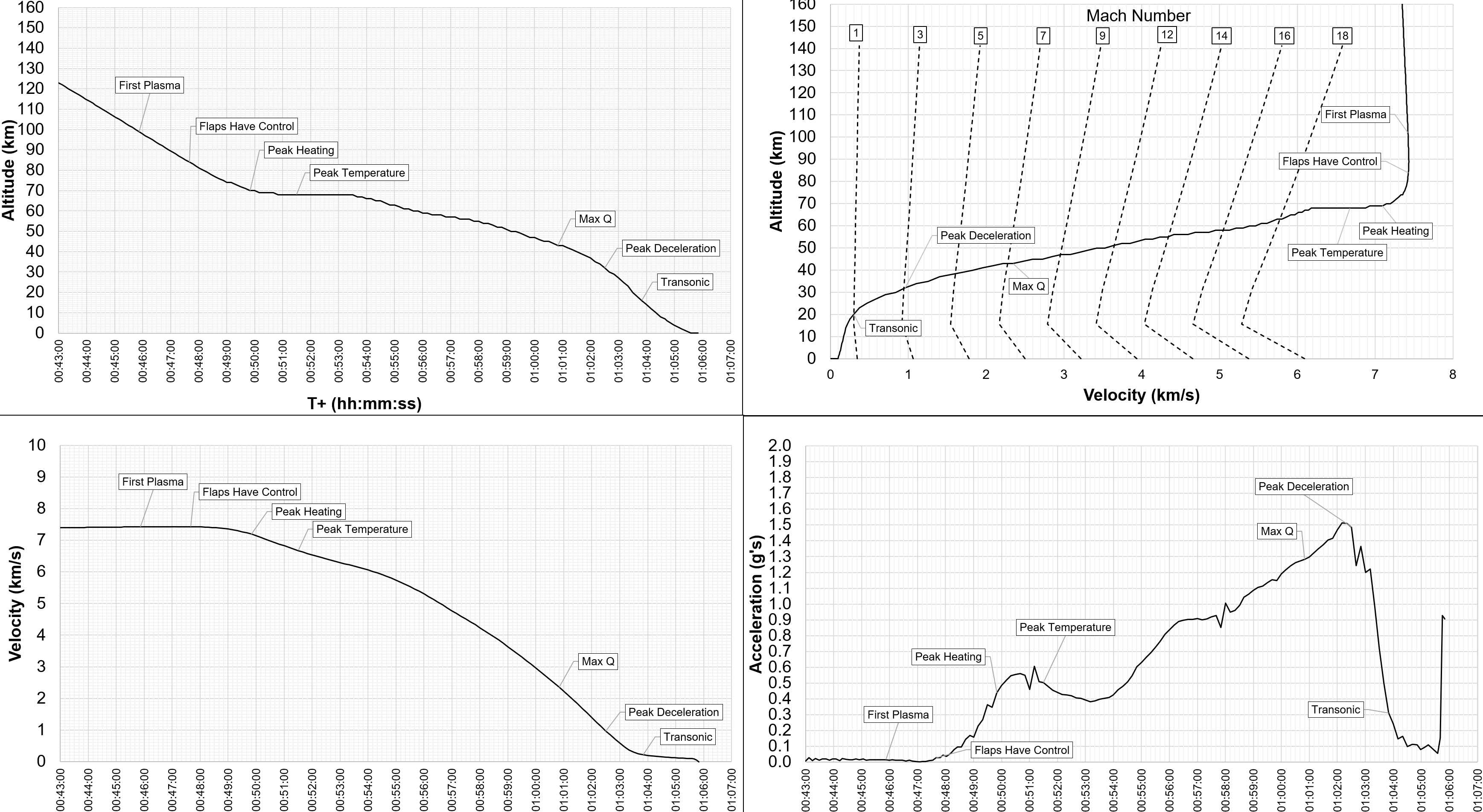
Interesting that there's nothing special about acceleration at max-Q, unlike during launch.
SuperSpruce@lemmy.zip · 3 pts · 2y
What is Max-Q?
clothes@lemmy.world · 4 pts · 2y
It stands for "maximum dynamic pressure", and is a fluid dynamics concept. It's the moment when the spacecraft is under the most stress, and therfore where certain things are most likely to fall apart.
It's caused by a combination of atmospheric density and velocity. To avoid issues, there's a rough rule of "don't accelerate too much until you're high enough that the atmosphere thins out" during launch, and "don't hit the atmosphere too fast" during reentry.
Here's a chart for the IFT-3 launch. At one minute you can see that acceleration decreased for a few seconds, to minimize the strength of max-Q.