Some of those roads are still there after thousands of years. Wonder if anything valuable could be gained by having a porous substrate for modern roads to sit atop.
Slaves were more often employed in agriculture and unskilled industry (some nightmarish conditions there - slaves in the mines had a life expectancy of six months). Roads were often constructed by the Legions and Auxiliaries. Good way to keep soldiers busy and out of trouble in peacetime.
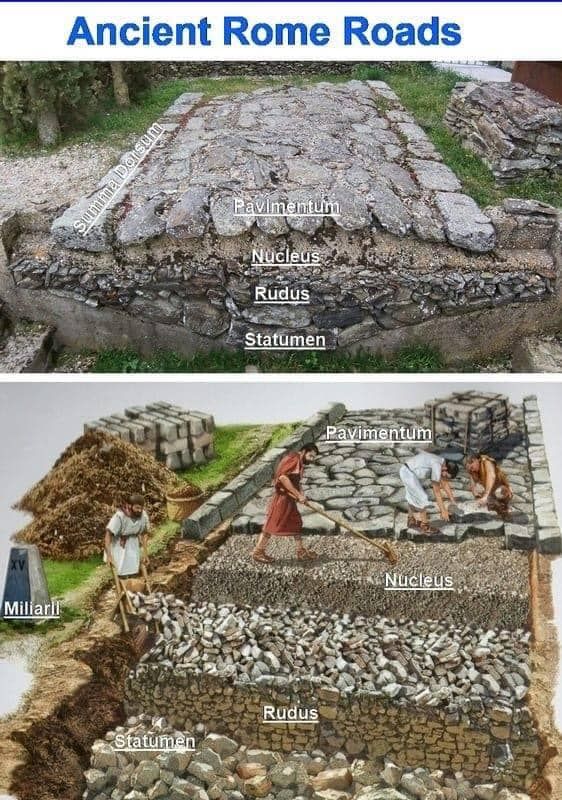
7 Comments
Tylerdurdon@lemmy.world · 9 pts · 2y
Some of those roads are still there after thousands of years. Wonder if anything valuable could be gained by having a porous substrate for modern roads to sit atop.
AProfessional@lemmy.world · 3 pts · 2y
They already do in many cases, like shown here https://www.britannica.com/technology/road/The-modern-road
Anticorp@lemmy.world · 5 pts · 2y
I can't even imagine the amount of labor that went into building these without machinery.
Illuminostro@lemmy.world · 0 pts · 2y
PugJesus@lemmy.world · 1 pts · 2y
Slaves were more often employed in agriculture and unskilled industry (some nightmarish conditions there - slaves in the mines had a life expectancy of six months). Roads were often constructed by the Legions and Auxiliaries. Good way to keep soldiers busy and out of trouble in peacetime.
NucleusAdumbens@lemmy.world · 2 pts · 2y
Why not put some extra nucleus on top of the pavimentum for a smoother ride? I'd think cobbles would be brutal in a suspensionless chariot
PugJesus@lemmy.world · 3 pts · 2y
Well, Roman roads were made primarily for foot-traffic.
NucleusAdumbens@lemmy.world · 2 pts · 2y
Oh I guess that makes sense then. Assumed all the effort to make them so durably flat was for wheels