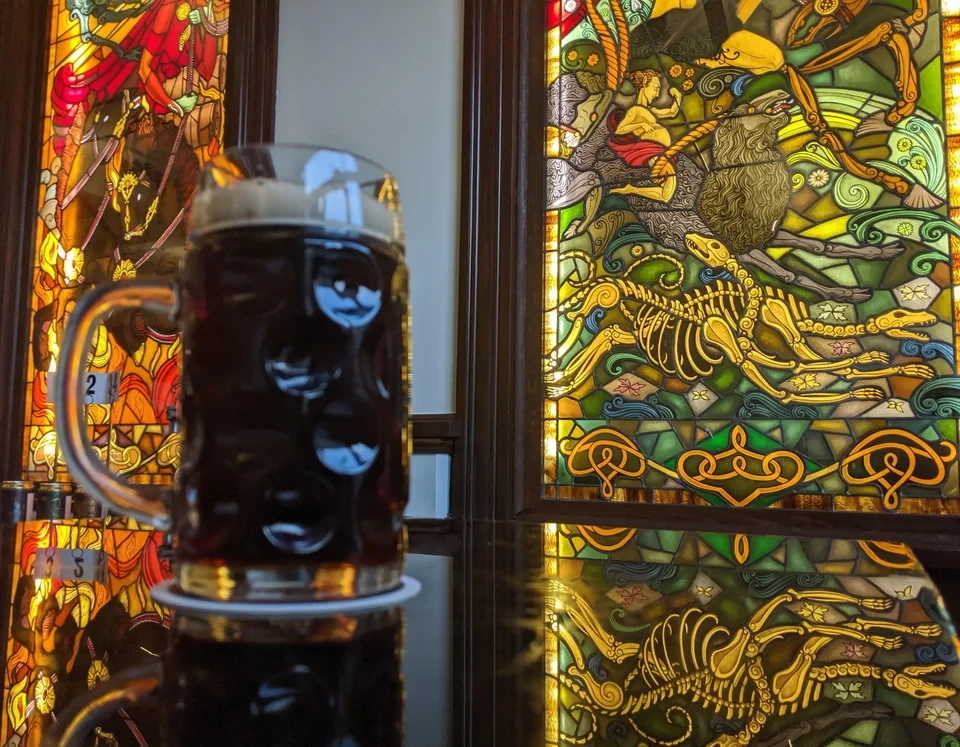
Let's get to know more about our host, shall we..?

So, first off-- that pic is from the interior of Gemüt Biergarten in Columbus, OH, and the theme is Viking art, from what I understand. Evidently, they have a bunch of these super-beautiful, Norse-themed windows to enjoy.

Now, me? #1, I'm a huge fan of stained-glass art, and #2, it depicts dang-ol' Pagan mythology, right?

Now, if you're in the area, here are some reviews:
https://www.beeradvocate.com/beer/profile/57194/?view=ratings&ba=West_Chester_Ale_Tester


But that's just the 'hook!' My ulterior mission here was more about learning about our young host, who I'm just learning to meet and understand, myself. Right then, let's see how he's described himself so far:

Professional Artist
Latin American / Spanish
Pagan Neoplatonist
Progressive Leftist

Myself, I've a bit of a background in 'paganist study' and I'm just always wanting to learn more. For one thing (hope this doesn't shock anyone too much), but modern humans (i.e., Homo sapiens. s.) have been around for ~300k years now, no doubt filled with all kinds of fun, interesting, crazy belief systems (mostly) to help us get along.

You know, so we kind of have to qualify loads of that-- i.e., "the thundering clouds are speaking... obviously this alliance is doomed!".

Then again, that's still just our modern, dumbass (movie/TV) interpretations of how it went with our ancestors. In reality, we moderns are just as much complete nincompoops in our understanding of our earlier kin, just as much as them being unlikely understanding our weirdo, suicidal, late-stage, high-tech capitalist society, already like a freight train headed over a cliff, seemingly.

And I don't even want to talk the predatory nature of televangelism, predatory religious indoctrination, and all that. *shudder*

In other words... I'd guess that there's a debate! There's a debate. There's a debate upon all kinds of things, when it came to the 'primitive life that genetically-modern humans lived, and so forth.'


Anyway, enough about my dumbarse self and views! 😅
(and you already know where I make a regular fool of myself, i.e. my EGN project)

Folks, if we can...?
Let's hear from our kind host upon any of these matters, mais non??

3 points · 4 comments · view on lemmy.world

4 Comments

ga_so_art@piefed.social · 1 pts · 1y (3 replies)

Can you be a bit more specific about what you'd like me to answer for you?

JohnnyEnzyme@piefed.social · 0 pts · 1y (2 replies)

Oh, okay!

  • How do you feel about Norse mythology, in general?
    (based on some recent scholarly articles, it seems we may be assuming "Thor & the gang" are way less established in Nordic history than we commonly assumed)

  • You've written an extremely dense and specific set of guidelines for this brand-new place, which I understand to be based on... essentially the mistakes of previous communities dedicated towards 'paganism.' I'm curious if you have anything to say about such matters? Like... where things went wrong, and how to fix them?

  • Just overall-- paganism, to me... err, how to say...?
    To me, it suggests all kinds of interesting things about a person. That they're willing to balance their traditional belief (like Catholic belief, which I was personally baptised in) with a curiosity towards how we naked apes used to deal with the concept of BELIEF upon 'the sky gods' and all that. Any personal thoughts or comments..?

Not trying to be disrespectful in any sense, but as a middle-aged man? I could talk almost endlessly about this stuff. In other words, I find paganism a fascinating subject, one which I'm embarrassed to say-- I haven't checked out nearly as much as I should, would and could!

ga_so_art@piefed.social · 1 pts · 1y (1 reply)

Alright I can answer these pretty well! Thanks for clarifying. I'll got point by point:

  • I don't know about Norse mythology nearly as much as I do about its Hellenic counterpart. The difficulty around Norse myths stems from the fact that the Germanic peoples did not leave a written record that we can consult. So their theology –if they even had a concept such as that, is loosely understood compared to the concrete Greco-Roman canon. The Norse, however, still fall within the Indo-European family, so we still find aspects of their myths that point to a theological system. A good example is their creation myth involving Ginnungagap, the primordial magical void from which the first principles of their world arose. There's a parallel to that in both Hellenic and even Vedic stories. Does that mean that the Norse had a systematized theological structure around their myths? I don't know. You'll have to wait for a Norse pagan to join and contribute to ask them. I can't speak on that with confidence.
  • Paganism isn't 'Paganism', first of all. It's a spiritual tradition, and its adherents don't put quote marks on it. It stands on its own. As a tradition, however, Paganism is much more loose than Abrahamic religions. We don't have a universal canon of texts, and we also don't have the structure and state-sanctioned adherence that the ancient people had. This means that Paganism today is reconstructed. Modern adherents are piecing together the historical pieces left by the people who originally practiced, and we are building a religious canon for ourselves. There's no strict universal authority over this, so groups, covens, and temple communities will largely differ from each other. What I have seen in other communities is mainly the presence of far-right elements, which do have organizations within the Pagan sphere. A good example is the Asatru Folk Alliance (AFA), which is a white nationalist organization that uses Norse paganism as a "national story" to justify their racism. The rules in this community is essentially me telling those guys "hey, this isn't your space, fuck off". Another big issue I saw on reddit's r/hellenism is that a lot of teenagers will get into Paganism, but without structural guidance, they adopt just about anything that sounds cool to them, including things that may not be good for their mental health. They will also mainly talk about "how annoying it is that their mom is making them go to church". There has also been the issue of teenagers sharing details about sexual acts "done in a ritual setting", which is very unsafe to do online. So I've included mental health resources, and put guidelines in the rules that say "hey, if you post before you think, I will take it down for your own safety". And I've also added a rule about posting verified sources because as Pagans building a reconstructed faith and practice, historical accuracy is important. You don't want to just come up with stuff willy-nilly. There's a lot of history to draw from, and pseudo-history like New Age only obscures the picture.
  • I'm a Pagan. I have icons to Apollo, Dionysus, and Rhea at my home altar. I have an altar to Saturn in my office. These are not just aesthetic or symbolic. I take their reality seriously. I also have pagan scripture. I have the Chaldean Oracles, Plato's entire works, Proclus' "Elements of Theology", and Iamblichus' "On the Mysteries", and Orpheus' hymns in my home library. These are all scriptural to me. I'm a Pagan because I'm a Neoplatonist. I believe in an underlying principle which is the source of all being, and I believe in a layered reality in which my consciousness is a real, active and essential part of. Neoplatonism comes in all flavors. There's Christian, Jewish, and Islamic Neoplatonism, and the Vedic tradition shares a lot of commonalities with it. Importantly, these Abrahamic Neoplatonisms all draw their philosophy from a Pagan tradition. The Catholic church, for example, draws heavily from Pagan theurgy and ritual. I chose Pagan Neoplatonism because it was interesting to me, and it seemed to me as the most honest way for me to practice Neoplatonic spirituality. Like I said above, Pagans today vary greatly in beliefs and attitudes, so I will certainly share more commonalities with a Neoplatonic Christian or a Sufi mystic than I will with some other pagans, like the AFA for example.
  • I don't believe in "sky gods". The gods in Neoplatonic paganism are Henads, unities beyond being and non-being that are the causal origin of the world. They're at the top of "the chain of Being" and are the first manifestation of the formless, groundless Source, often referred to as The One of The Good. These gods are not male or female, and don't have anthropomorphic "personalities" in any way that we would recognize. They lie outside of space-time, so any predicate used to describe them will fall short. Worship of the gods is therefore not an appeasement or supplication of them, but an active participation in their reality. It's a contemplative remembering of them, and a spiritual ascent towards The One. This is not just a modern interpretation. Ancient Hellenic theologians made a clear distinction between the fabulae (the myths and stories that depict gods as characters), and the gods as metaphysical reality. This obviously is not universal. There were plenty of people that took the myths literally. But Neoplatonism does approach the gods in more philosophical, systematic way.
  • On your point about naked apes, I think that spirituality in general represents a certain humility about the universe and existence. It's an acknowledgement that we're small and kinda ignorant, and it's a large and strange reality that we live in. Religion can be very limiting in its scope and institutional enforcement, but so can be a strict materialist worldview. I think spirituality and most religions trace their origins to ecstatic/mystical experiences that people had (and still have), and it has been a process of personal, subjective understanding about our nature and the nature of existence since then.
JohnnyEnzyme@piefed.social · 1 pts · 1y

Sorry... late-late-late catch-up attempt...

Ginnungagap, the primordial magical void from which the first principles of their world arose. There's a parallel to that in both Hellenic and even Vedic stories.

Wow... that's... wow!


This means that Paganism today is reconstructed. Modern adherents are piecing together the historical pieces left by the people who originally practiced, and we are building a religious canon for ourselves.

Such a good point!

In a 'doctrinaire' sense, we moderns tend to be... well... complete nincompoops about judging and understanding our previous set of belief systems.

This is why, for example, that geniuses like Joseph Campbell helped me understand, literally, 'what KIND of animals we are'...?

(because no matter who & where, that's our 'lens & legacy' mais non?)