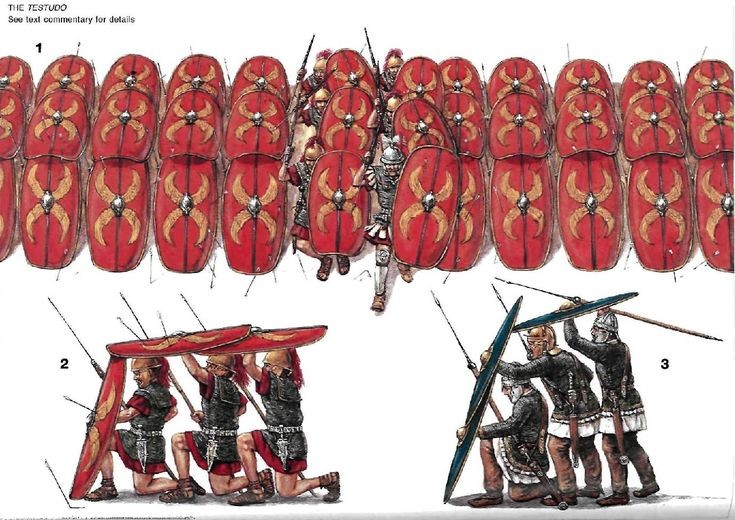
This is beautiful evidence of perfection of technique. You start with a good idea and then you realize that there's another way that you can do it that gives you... In this instance more standing room a little more protection from the interleaving of the first and second shield .... It's probably even easier to brace and hold and granted it didn't save anything resource-wise but it didn't cost more either.
Seems to me a degradation. Needing the back rows to stand instead of enabling them to kneel is more exhausting for the troops, and exposes more of themselves to any potential gaps in coverage. The second shield over the first probably doesn't improve the protection granted to the frontmost man, at least not against the kind of threats the testudo is meant to protect from - projectiles.
The oval shields were more suited to tightly-clustered shieldwalls of standing infantry rather than the testudo, but that itself is a repudiation of the earlier, highly-motivated and aggressive behavior of the Legions of the Principate, wherein each shield is made both for formation-protection (as in a testudo) as well as individual hand-to-hand combat (as legionaries were expected to aggressively engage the enemy). The change to an oval shield preferenced a defensive and passive infantry, tightly clustered to discourage unmotivated troops from breaking.
3 Comments
this_1_is_mine@lemmy.world · 5 pts · 329d
This is beautiful evidence of perfection of technique. You start with a good idea and then you realize that there's another way that you can do it that gives you... In this instance more standing room a little more protection from the interleaving of the first and second shield .... It's probably even easier to brace and hold and granted it didn't save anything resource-wise but it didn't cost more either.
PugJesus@piefed.social · 7 pts · 329d
Seems to me a degradation. Needing the back rows to stand instead of enabling them to kneel is more exhausting for the troops, and exposes more of themselves to any potential gaps in coverage. The second shield over the first probably doesn't improve the protection granted to the frontmost man, at least not against the kind of threats the testudo is meant to protect from - projectiles.
The oval shields were more suited to tightly-clustered shieldwalls of standing infantry rather than the testudo, but that itself is a repudiation of the earlier, highly-motivated and aggressive behavior of the Legions of the Principate, wherein each shield is made both for formation-protection (as in a testudo) as well as individual hand-to-hand combat (as legionaries were expected to aggressively engage the enemy). The change to an oval shield preferenced a defensive and passive infantry, tightly clustered to discourage unmotivated troops from breaking.
teft@piefed.social · 3 pts · 329d
Middle Roman Empire: