They were fairly effective. The two big advantages were range when using larger projectiles, and ease of use - an ordinary sling takes a lot of training to truly master.
On the other hand, they lacked precision/accuracy and speed compared to ordinary slings.
Staff slings actually lasted a bit longer in military usage than ordinary slings because they can throw much heavier projectiles, but that's a double-edged sword (ha) - projectiles are something that have to be carried on the march. So they remained mostly in specialist applications, like naval and (defensive) siege warfare, where stores of ammunition didn't have to be carried by hand or pack animal, and in regional contexts (like Spain).
two big advantages were range when using larger projectiles, and ease of use - an ordinary sling takes a lot of training to truly master.
Honestly, getting staff-sling accuracy out of a sling is not all that hard. If your target is "those 50 guys in formation", you can learn to hit it in a week*. If your target is "that guy, and he's moving", that's going to take months to years of training.
One big advantage is that a sling has civilian uses. It's small enough to fit your pocket and great for keeping predators away from your sheep or for small game hunting. So there will be lots of people who have spent years learning how to use it, meaning you can just put those people in your army, and not have to train anyone.
A staff sling is basically a rocket launcher, it has pretty much zero civilian uses, so nobody comes with free training on them.
*Though I wouldn't want to be next to me when I'm trying, there's a nonzero chance the rock will end up behind me anyway
One big advantage is that a sling has civilian uses. It’s small enough to fit your pocket and great for keeping predators away from your sheep or for small game hunting. So there will be lots of people who have spent years learning how to use it, meaning you can just put those people in your army, and not have to train anyone.
5 Comments
inspiddivision@piefed.social · 5 pts · 125d
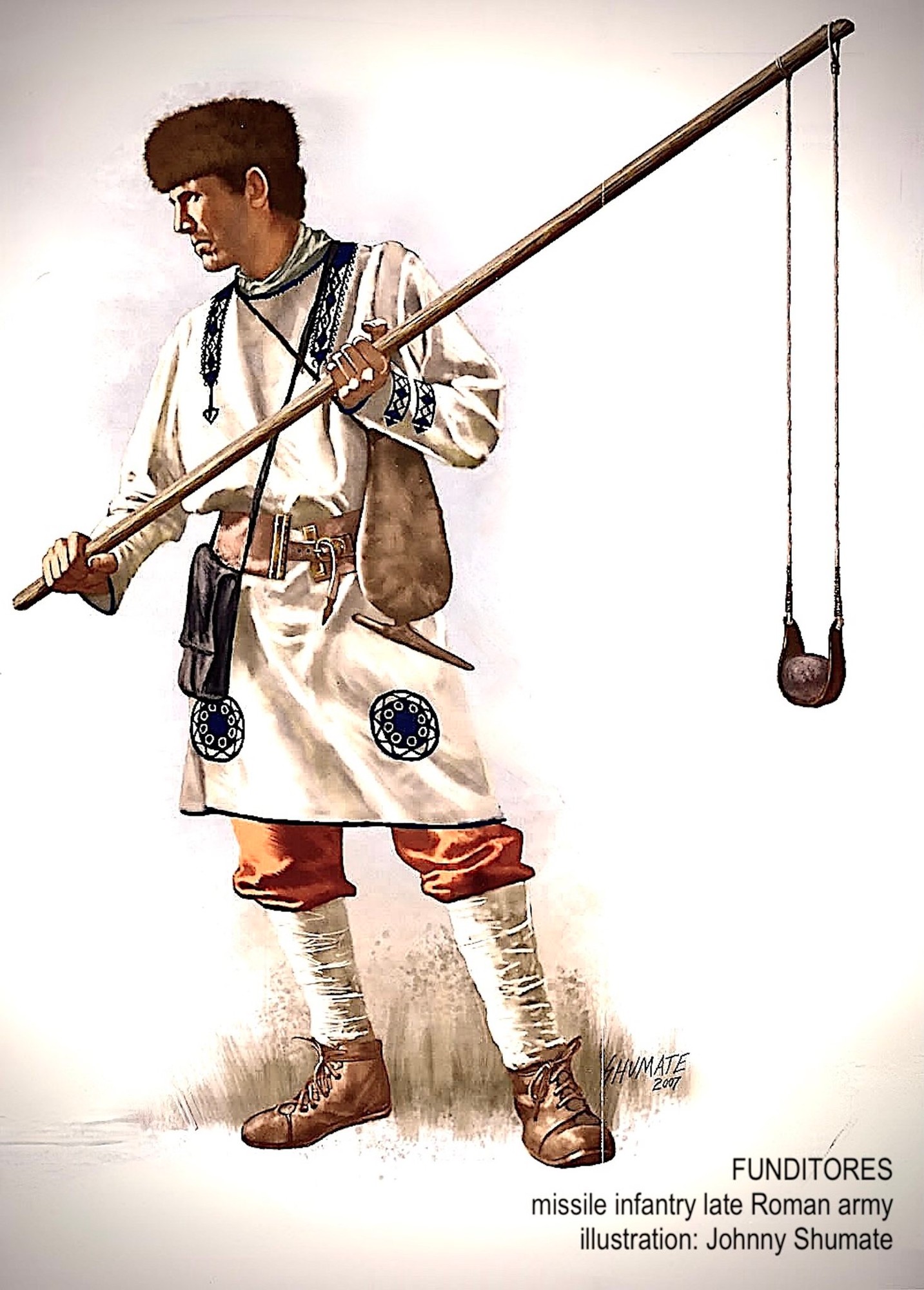
Thanks for the picture. Can anyone explain in detail how the staff sling works and how effective they were? Just curious.
PugJesus@piefed.social · 9 pts · 125d
They were fairly effective. The two big advantages were range when using larger projectiles, and ease of use - an ordinary sling takes a lot of training to truly master.
On the other hand, they lacked precision/accuracy and speed compared to ordinary slings.
Staff slings actually lasted a bit longer in military usage than ordinary slings because they can throw much heavier projectiles, but that's a double-edged sword (ha) - projectiles are something that have to be carried on the march. So they remained mostly in specialist applications, like naval and (defensive) siege warfare, where stores of ammunition didn't have to be carried by hand or pack animal, and in regional contexts (like Spain).
Tar_alcaran@sh.itjust.works · 3 pts · 124d
Honestly, getting staff-sling accuracy out of a sling is not all that hard. If your target is "those 50 guys in formation", you can learn to hit it in a week*. If your target is "that guy, and he's moving", that's going to take months to years of training.
One big advantage is that a sling has civilian uses. It's small enough to fit your pocket and great for keeping predators away from your sheep or for small game hunting. So there will be lots of people who have spent years learning how to use it, meaning you can just put those people in your army, and not have to train anyone.
A staff sling is basically a rocket launcher, it has pretty much zero civilian uses, so nobody comes with free training on them.
*Though I wouldn't want to be next to me when I'm trying, there's a nonzero chance the rock will end up behind me anyway
PugJesus@piefed.social · 1 pts · 124d
Balearic Isles hours!
squeeblade77@fandom.ink · 2 pts · 125d
@PugJesus Portable catapult or big ass slingshot