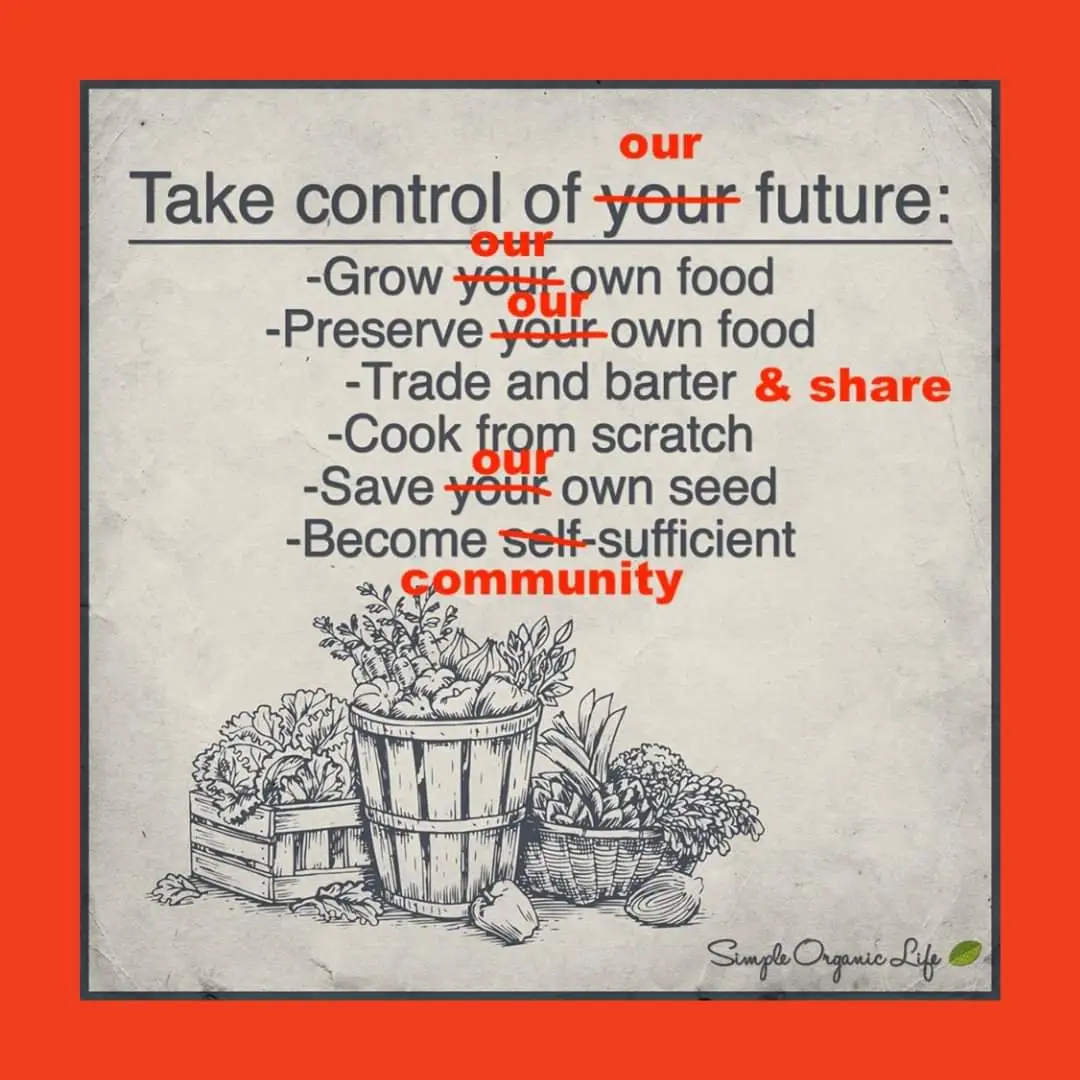
Don't get me wrong, having a vegetable garden is still a great thing and far better than buying the monoculture produce shipped from halfway around the world at the store, even if your garden is just for your own family. I don't want to knock that. But to break our reliance on extractivist agriculture as a society requires more than just people with the resources to do it building private homesteads on their private property. Communities providing for each other through the commons is a foundational element of a solarpunk society.
How do we encourage this shift in thinking and doing? What would it take to break down the expectations of private property and that something you've grown is just for you, and create community mindsets where something you've grown can feed people who need it?
Where I live, there are a lot of (mostly retired, suburban, well-off) people with gardens, especially in the summer, but most of them are not involved in FNB or anything like it. It's also not common to emphasize native species. We have a wonderful public market, but most of the people even with veggie gardens don't sell there and only buy there on occasion. The way I've been trying to encourage the public market over grocery stores more has mostly been talking about how great the produce is, how many different things they have, and how convenient it is that the bus runs there. It's still a market, but at least it's small, local growers, and a local org recovers what doesn't get sold for our FNB branch to use (and composts what isn't good, for the local community garden to use) instead of throwing it away. But the only way I can think of to get the idea out there that people should share what they grow is to flat-out say, "you should share what you grow", which doesn't seem like it would win many people over.
15 Comments
LibertyLizard@slrpnk.net · 11 pts · 2y
I’ve been thinking about this a lot actually. I think one possibility is to build networks of people to help grow and distribute this food communally. In my area there are a lot of fruit trees but much of it goes unharvested, is wasted, and can even be a nuisance since it attracts rats. This is a problem to the extent that most public land managers won’t allow fruit trees to be planted. So the solution is to get some friends together and pick the fruit. Then it can be distributed to the community. I heard there is someone in my city doing this already but in a different neighborhood—I may reach out to them to see how they got the ball rolling.
I think that would be an easy way to start but the idea could be expanded to include foraged foods and gardens that people don’t have time to maintain. I think it’s important for people to first see the benefits of what you’re doing before going too far outside of what is considered normal. Once you have that reputation as helpers, you can push for more radical ideas like communal gardens, food forests, etc.
wolfyvegan@slrpnk.net · 2 pts · 308d
Did you ever reach out to them?
LibertyLizard@slrpnk.net · 2 pts · 308d
Yes but I haven't really heard back in a meaningful way. I met them at an event not long ago and apparently I offended them in the way I reached out? I don't know, they seemed kind of weird and off-putting frankly.
I'm still open to working with him but I decided not to push further for now, so we'll see what happens. He said he mainly focuses on the program in winter...
wolfyvegan@slrpnk.net · 3 pts · 306d
Yeah, people are strange. Not sure how to get around that barrier when it comes to uniting against the capitalist system.
Winter is the wet season there, right? Is that when there is more fruit available? Citrus produces in winter...? Or maybe that's when people are in most need of fresh produce...?
LibertyLizard@slrpnk.net · 3 pts · 306d
Citrus season is winter yes, and he said that’s the kind of fruit that people most often have excess of. Also I’m guessing the cool weather makes it easier to get unwanted fruit before it spoils.
jadero@slrpnk.net · 7 pts · 2y
I think the best way is to grow a surplus of something yourself. Most people are shocked by how much of something can be grown in a few used plastic buckets.
I always get gifts of a wide variety of fruits, vegetables, preserves, venison and other hunted meats, etc when I'm out gifting fruits, vegetables, and preserves.
I've always got way more tomatoes, Nanking cherry jelly, raspberry jam (and fresh!), and crabapple jelly than we could possibly use. I just give it away, no strings attached. Most of it comes back in the form of string beans, cucumbers and pickles, Saskatoon berry jelly and pie, chokecherry jelly and syrup, salsa, onions, corn, etc. All of it comes back in the form of good will and general neighbourliness.
Over time, it's evolved into a pretty big community of sharing that goes beyond mere produce. Pick something, grow a surplus, and spread it around.
fireweed@lemmy.world · 4 pts · 2y
If you're in an area with a lot of gardeners, maybe a weekly food swap would work. A place where people can bring their excess harvest to give away or trade for someone else's excess harvest. But you might end up with supply/demand problems (e.g. everyone showing up with too many zucchini and hoping to trade for tomatoes... and then leaving with too many zucchini and no tomatoes). Also, I feel like most excess produce is left unharvested, because harvesting it all would be too much work (especially fruit), or because it is kept around in the garden until it goes bad (I do this with radishes: I take a few every day until they become too pithy then in the compost the remainder goes), so people would have to be motivated and organized enough to harvest excess crops. And then you have the trade problem of making sure everyone feels they benefited from the swap and didn't get taken advantage of ("I harvested my entire fig tree and Sharon shows up with five maggot-riddled beets and that's supposed to be a fair exchange!?")
What you describe is at its core society's under-valuing land: a lack of recognition that arable land in particular is too valuable to society to be held by individual property owners to do whatever the fuck they want with it (including nothing, like using it for lawn, or worse yet degrading the land so it's no longer arable, like paving it or poisoning it with Round-up, garbage, etc). But changing that requires a fundamental shift in our perception of property rights that would take either moving to a commune of like-minded folks who intentionally forgo front yards for a community garden or whatever, or a major crisis like a famine resulting in the government's eminent-domain'ing of underutilized private property.
pseudo@slrpnk.net · 4 pts · 2y
What is FNB?
Have you tried the following?
"That would make great gift!"
"You don't have to worry about finding present idea!"
"your [insert family member from a different household]/neighbour must love them!"
"I wish I had such a production. I could give some to [insert charity] they always need some."
"Your friend must love you (^_-)" ~ Ok, that one is a bit rude, but you can reformulate.
People don't become in one day generous people that are open to give away and share there private property. It happened over time, starting with sharing within the most intimate circle and slowly spreading away until reaching strangers. Something like family>friend>neighbour>college>extended family> local community> anyone that could need it.
You could also mention how they could benefit from being part of community that share and how just a few people starting to share come make it possible.
Nemo@midwest.social · 5 pts · 2y
Food Not Bombs, it's an organization that takes surplus good that would go to waste and redistributes it. In my (urban) area they mostly take unsold items from grocery stores, including damaged produce and almost-out-of-date dairy and prepared food, but I know they work with CSAs too.
poVoq@slrpnk.net · 2 pts · 2y
Lend out tools and ask in return for a share of the harvest?
AstroMancer5G@slrpnk.net · 1 pts · 2y
I'm trying to shift away from transactional approaches. I don't want to replicate markets and debt in my community, and I worry that asking for a share of the harvest as a "price" for lending out tools could perpetuate that instead of breaking away from it.
schmorpel@slrpnk.net · 4 pts · 2y
Interestingly I find that many of people around me who do start to engage in sharing activities still like holding on to some transactional approach - giving out tokens, noting down hours of work ... It's like people feel freaked out by just receiving something out of a void, or giving it away into a void, where the only thing between oneself and misery is the kindness of others. Even though a gift economy creates less overhang by not having to register transactions it might take one or two more generations of casual trade and barter and getting annoyed with token systems before people start feeling comfortable.
I like that you make a conscious effort to break that scheme, but it might ease some people into sharing their excess.
poVoq@slrpnk.net · 2 pts · 2y
There are some ways to make it less obviously transactional. For example in the rural town where my parents live there is an annual event where people can bring apples and other fruits to make juice from (with a professional juice making machine) and it is encouraged to bring excess fruits and share them.
wolfyvegan@slrpnk.net · 2 pts · 308d
I think that the most practical approach is (1) to create such an abundance that no one could possibly eat it all, and (2) to get the people growing this abundance living in close enough proximity to each other that the only transportation infrastructure that an able-bodied grower would need in order to share their excess harvest is a wheelbarrow.
When people have way too much of something, they are much more likely to share / give it away than when they have barely enough for themselves. The Earth can produce more than enough for everyone's need; it's just a matter of finding people to take the first steps and get things growing. I know someone with a small but highly productive fruit forest planted ~10 years ago, and now he often has so much food that he cannot even give it all away, and not for lack of trying.
Sharing food effectively requires that the people interested in sharing their harvest and the people interested in eating the food that is harvested live in the same area. If Carlos has too much guanábana in Costa Rica and Rajib has too much jackfruit in Bangladesh, no matter how willing they may be to adopt a "what's mine is yours if what's yours is mine" approach to their harvests, it just isn't practical. If however Rajib and Carlos live 1 km away from each other and can simply load some fruits in the wheelbarrow and distribute the harvest among the two of them and their other neighbours each day (or each week, or whatever), then that is a practical solution. If someone is growing an abundance but none of the neighbours want to eat it and would rather subsist on processed junk, then sharing isn't possible; the people interested in growing and sharing must live near each other, and the people living near each other must be interested in growing and sharing.
Fully communal management of an entire region's food production is not really feasible due to the number of people involved who would need to agree on everything; you'd run into all of the issues of starting an intentional community or commune and all of the inefficiencies that come with that. Having many people independently growing an abundance in the same area and freely sharing whatever they have in excess makes much more sense to me. I think that fruiterrarist projects like this are the way forward.
schmorpel@slrpnk.net · 2 pts · 2y
Sometimes it comes down to effort and people not knowing how to do things. We asked other market people how to run a stand on the farmer's market, for most people it's not common knowledge and there's no info online. It's not too expensive but not worth having the work, for the little surplus we have. Getting together with others to sell on the market is a solution we are studying, but that's already beyond what most suburban retirees are willing to do.
In your case, maybe setting up or suggesting an easy way to share surplus produce (public or private sharing box) can help, or setting up a group willing to collect and redistribute it (and give your gardeners the good feeling that they are supporting a good project).