c/science_memes · by fossilesque@mander.xyz · 2yfunny title goes here 66 points · 6 comments · view on lemmy.world

6 Comments
Dave@lemmy.nz · 53 pts · 2y
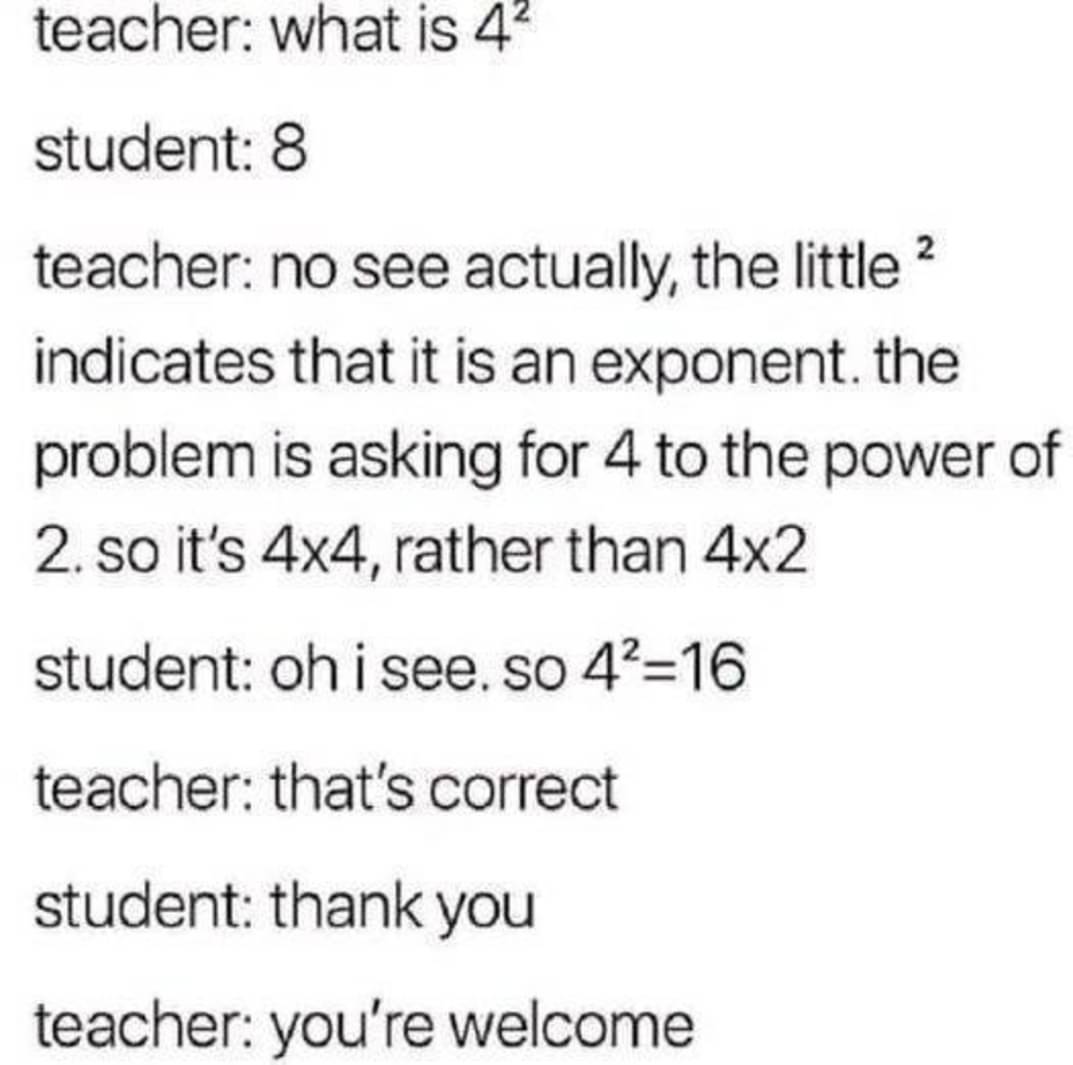
Can someone explain this to me? Not the maths, the joke.
fossilesque@mander.xyz · 39 pts · 2y
Rolando@lemmy.world · 11 pts · 2y
Calling !peterexplainsthejoke@lemmy.world....
CubbyTustard@reddthat.com · 10 pts · 2y
OpenStars@startrek.website · 52 pts · 2y
Hrm, it sounds like the teacher already knew the answer.
Maybe stop wasting the time of the student then!?
You're welcome.
driving_crooner@lemmy.eco.br · 17 pts · 2y
The test:
Solve e^{int_0 1 x2+x+1 dx}^
Usernamealreadyinuse@lemmy.world · 2 pts · 2y
No, copilot solve this test
Answer:
To solve the expression ( e^{\int_0^1 x^2+x+1 , dx} ), we first need to calculate the integral of ( x^2+x+1 ) from 0 to 1.
The integral of ( x^2+x+1 ) is: [ \int x^2+x+1 , dx = \frac{x^3}{3} + \frac{x^2}{2} + x + C ]
Evaluating this from 0 to 1 gives us: [ \left[ \frac{x^3}{3} + \frac{x^2}{2} + x \right]_0^1 = \left( \frac{1}{3} + \frac{1}{2} + 1 \right) - \left( 0 + 0 + 0 \right) = \frac{11}{6} ]
Now, we raise ( e ) to the power of this result: [ e^{\frac{11}{6}} ]
This is the solution to the given expression. If you need a numerical approximation, ( e^{\frac{11}{6}} ) is approximately 4.953.
AtomfriedMegaforce@lemmy.world · 4 pts · 2y
...and this student was Albert Einstein