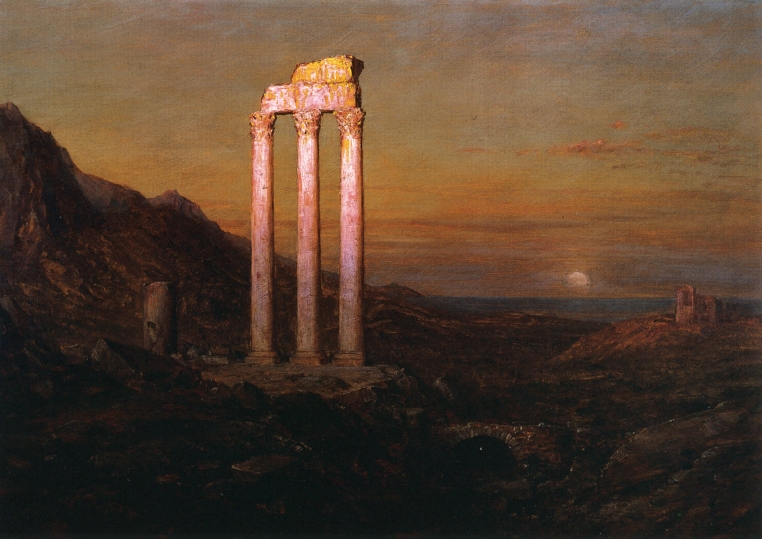
I’m always interested to know the scaled of these 19th C works, because some can be quite enormous. Turns out this is a small oil on canvas, on exhibit at the Santa Barbara Art museum, which lists the size as: 14 1/8 x 20 1/4 in. (35.9 x 51.4 cm).
Me too. I went to a Dali exhibition that did a really good job of drawing together most of his significant works, many of which I knew from books etc ... and I was blown away at how I could not predict which were physically big and which were physically small or even tiny pieces, so good was his technique.
8 Comments
darmabum@lemm.ee · 5 pts · 3y
I’m always interested to know the scaled of these 19th C works, because some can be quite enormous. Turns out this is a small oil on canvas, on exhibit at the Santa Barbara Art museum, which lists the size as: 14 1/8 x 20 1/4 in. (35.9 x 51.4 cm).
maegul@lemmy.ml · 3 pts · 3y
Me too. I went to a Dali exhibition that did a really good job of drawing together most of his significant works, many of which I knew from books etc ... and I was blown away at how I could not predict which were physically big and which were physically small or even tiny pieces, so good was his technique.
456c737465720a@discuss.tchncs.de · 1 pts · 3y
Nice quiz idea: Guessing the scale of artworks.
NabeGewell@lemmy.world · 3 pts · 3y
One of the reasons to create a Lemmy account is to follow this community
niktemadur@lemmy.world · 3 pts · 3y
I reckon that's the full moon setting in the horizon, as the sun rises on the other side, behind the painter.
HellAwaits@lemmy.world · 2 pts · 3y
UdeRecife@literature.cafe · 2 pts · 3y
Purely out of ignorance, but the title is really sunrise? The motif of the ruins would probably evoke a sunset, a world fading away.
NexiusLobster@lemmy.world · 2 pts · 3y
I was just as confused as you were and double checked it, and it definitely is called moonrise.
UdeRecife@literature.cafe · 2 pts · 3y
Thank you!
Moonrise makes so much sense. Not only for having the moon actually 'moonrising' there, but also for the ruins fading with the sunset.