Eu como não tenho acesso a ip público pois os provedores daqui não permitem por preços não abusivos e meu servidor é bem fraco, só tenho:
Urbackup: backup dos computadores windows e linux da casa.
Pi-hole: Bloqueador de anuncios ao nivel do roteador.
Samba: pasta de arquivos na rede acessível 24/7 uso para compartilhar arquivos entre pcs.
Transmission: Seedar torrents. Uso principalmente para seedar alguns livros do annas archive enquanto nao estou usando o espaço dos hds. Torrents geralmente baixo direto nos computadores normais.
great article, i also think "community clouds" are the way to go. it much more efficient, the ideal would be a cloud for each city, so if the internet goes out you could go to the phisical place.
I make an isolated note with questions i want to answer (that can change in the process) and an item note with what i learned that answers the questions in the item.
Eu diria que a melhor opção atualmente é o PopOS, linux mint tem o problema que é instável em certos casos de uso, Ubuntu força muito snaps, debian é ruim com drivers, zorin é instável e pior que o Mint.
Fedora é instável em bastantes casos de uso e usa pacotes rpm que não são tão aceitos quanto os deb.
Arch é rolling release e sujeito a quebras, distros baseadas nele são piores ainda.
Nixos ainda vai ser a melhor distro mas atualmente não está pronta pois ainda falta pacotes e coisas como lojas de pacotes gráficas.
legal! as melhores plataformas para doação existentes.
poderia considerar abrir no github sponsors tbm. nao tem taxas, apenas conversão de doláres para real (IOF)
i think i found a solution to my problem: you add 3 more collumns, social unit val, calculated proportion and total adjacent, like the picture. with them, you put the average social prices of items you produced in "social unit val", that will result in proportions in "calculated proportions", which are the maximum values you should put in "proportion"; then you look at the "total adjacent" which should inform you what value of proportion you can deduct from your proportions in order to get prices to go down and the total sum still be your "total added" (you can deduct only that value for all items, not for each item, so you may divide that between all type of items if you want to lower the price of all items). if the value is negative you cant produce at an socially average value (you cant produce the items and you be better buying from others who have the lower price).
in that example i worked for 6,43 minutes which should give me a total of $7720,00 (6,43x1200 which is the average rate), in that time i produced, with my specific technique, diamonds, redstone, iron, gold, andesite, gravel, etc. what im trying to accomplish is divide that 7720 in value between the diverse types of items so i can put a price tag in them.
if i do as you said, with proportion based on the amount of items acquired compared to the total amount of items the diamonds would be really cheap, and things with a lot of items acquired like redstone would be expensive.
i currently set my own proportions manually so the value is distributed more to the rare items and less to the common items like gravel. I need to sell them after all, no one will buy redstone with 5x the price of a diamond.
i would usually put the pickaxe at "costs" with the cost of 4 diamonds to repair the entire pickaxe in the anvil (not the full cost of 4 diamonds but the full cost divided by the quantity wasted on production) but the pickaxe has mending, which means it repairs itself when i get XP and as i got a lot of redstones and such it doesnt count as a cost.


Eu como não tenho acesso a ip público pois os provedores daqui não permitem por preços não abusivos e meu servidor é bem fraco, só tenho:
great article, i also think "community clouds" are the way to go. it much more efficient, the ideal would be a cloud for each city, so if the internet goes out you could go to the phisical place.
zotero all the way.
I make an isolated note with questions i want to answer (that can change in the process) and an item note with what i learned that answers the questions in the item.
Eu diria que a melhor opção atualmente é o PopOS, linux mint tem o problema que é instável em certos casos de uso, Ubuntu força muito snaps, debian é ruim com drivers, zorin é instável e pior que o Mint. Fedora é instável em bastantes casos de uso e usa pacotes rpm que não são tão aceitos quanto os deb. Arch é rolling release e sujeito a quebras, distros baseadas nele são piores ainda. Nixos ainda vai ser a melhor distro mas atualmente não está pronta pois ainda falta pacotes e coisas como lojas de pacotes gráficas.
Nos meus livros, CompTIA Network+ e Cabling: the complete guide (2014), não achei nada sobre. Recomenda alguma outra fonte?
legal! as melhores plataformas para doação existentes. poderia considerar abrir no github sponsors tbm. nao tem taxas, apenas conversão de doláres para real (IOF)
i think i found a solution to my problem: you add 3 more collumns, social unit val, calculated proportion and total adjacent, like the picture. with them, you put the average social prices of items you produced in "social unit val", that will result in proportions in "calculated proportions", which are the maximum values you should put in "proportion"; then you look at the "total adjacent" which should inform you what value of proportion you can deduct from your proportions in order to get prices to go down and the total sum still be your "total added" (you can deduct only that value for all items, not for each item, so you may divide that between all type of items if you want to lower the price of all items). if the value is negative you cant produce at an socially average value (you cant produce the items and you be better buying from others who have the lower price).
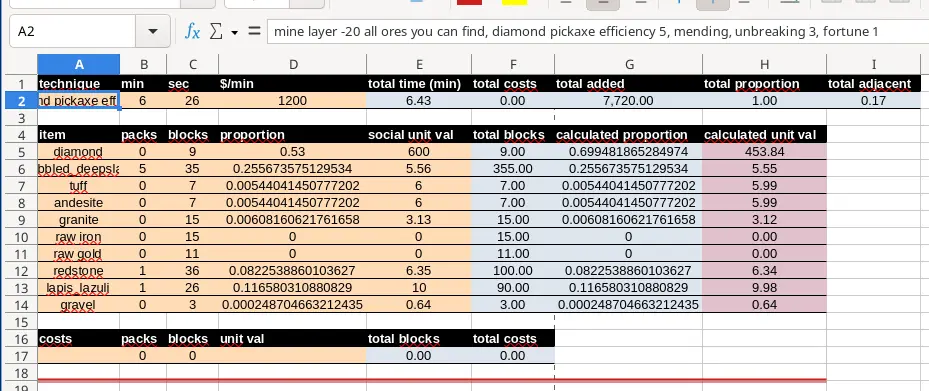
in that example i worked for 6,43 minutes which should give me a total of $7720,00 (6,43x1200 which is the average rate), in that time i produced, with my specific technique, diamonds, redstone, iron, gold, andesite, gravel, etc. what im trying to accomplish is divide that 7720 in value between the diverse types of items so i can put a price tag in them.
if i do as you said, with proportion based on the amount of items acquired compared to the total amount of items the diamonds would be really cheap, and things with a lot of items acquired like redstone would be expensive. i currently set my own proportions manually so the value is distributed more to the rare items and less to the common items like gravel. I need to sell them after all, no one will buy redstone with 5x the price of a diamond.
i would usually put the pickaxe at "costs" with the cost of 4 diamonds to repair the entire pickaxe in the anvil (not the full cost of 4 diamonds but the full cost divided by the quantity wasted on production) but the pickaxe has mending, which means it repairs itself when i get XP and as i got a lot of redstones and such it doesnt count as a cost.
entendo, mas ta bom por enquanto. vlw
eu me subscrevi, no entanto, as publicações continuam sem aparecer...
é acredito que seja essa intancia mesmo minecraft@lemmy.ml vou me inscrever então.