The same reason people drive their car to buy groceries.
You bought it for something where it was the only option, driving 30km to work everyday. But ever since you got it, the trip to the super market is kinda too hot in the summer and too cold in the winter and what if you spontaneously need to buy more than expected?
People learn it for front end dev, and then they use what they know for back end too.
The short answer is that your language needs === when it fucked up the semantics of ==, but it's also too popular and you can't fix it without breaking half the web.
It's also important if you're checking hashes (at least, it was - if you're using correct hashing algorithm that isn't ancient, you will not have this problem).
Because if you take for example "0e462097431906509019562988736854" (which is md5("240610708"), but also applicable to most other hashing algorithms that hash to a hex string), if("0e462097431906509019562988736854" == 0) is true. So any other data that hashes to any variantion of "0e[1-9]+" will pass the check, for example:
I did use md5 as an example because the strings are pretty short, but it's applicable to a whole lot of other hashes. And the problem is that if you use one of the strings that hash to a magic hash in a vulnerable site, it will pass the password check for any user who's password also hashes to a magic hash. There's not really a high chance of that happening, but there's still a lot of hashes that do hash to it.
One neat feature is you can compare to both null and undefined at the same time, without other falsey values giving false positives. Although that's not necessary as often now that we have nullish coalescing and optional chaining.
I just tested and Terser will convert v === null || v === undefined to null==v. Personally I would prefer to read the code that explicitly shows that it is checking for both and let my minifier/optimizer worry about generating compact code.
Like == but more strict. The == operator will do type conversion, so 0 == '' will actually be true, as an example. Sometimes (honestly, most times) you may want to compare more strictly.
60 Comments
Buttons@programming.dev · 71 pts · 2y
https://programming.dev/post/7789832
BaardFigur@lemmy.world · 19 pts · 2y
schnurrito@discuss.tchncs.de · 16 pts · 2y
by not ever using == and !=, but only === and !==
FooBarrington@lemmy.world · 10 pts · 2y
Typescript :)
ByteJunk@lemmy.world · 3 pts · 2y
Yep. It's the only reason I'm still somewhat sane.
fidodo@lemmy.world · 2 pts · 2y
I got by without it for years, but not that I have it I have no idea how I did it back then.
blackn1ght@feddit.uk · 10 pts · 2y
Because in reality you're not doing stupid stuff like that in the image. And using Typescript definitely helps.
However I'm always annoyed that the month parameter when constructing a date object is 0 based. So 1st of Jan is
BaardFigur@lemmy.world · 8 pts · 2y
JaddedFauceet@lemmy.world · 1 pts · 2y
Looks confusing at first, but I found it nice for accessing a month array.
JaddedFauceet@lemmy.world · 7 pts · 2y
By banishing the bad part of the language with linter.
For instance, standard eslint preset has rules that enforce usage of
===, https://eslint.org/docs/latest/rules/eqeqeqThese rules often come with project starter template
fidodo@lemmy.world · 4 pts · 2y
And typescript is basically just a linter on steroids
darcy@sh.itjust.works · 7 pts · 2y
almost forced to for web front end. why you would use it anywhere else, however, i will never know
Turun@feddit.de · 4 pts · 2y
The same reason people drive their car to buy groceries.
You bought it for something where it was the only option, driving 30km to work everyday. But ever since you got it, the trip to the super market is kinda too hot in the summer and too cold in the winter and what if you spontaneously need to buy more than expected?
People learn it for front end dev, and then they use what they know for back end too.
FrostKing@lemmy.world · 3 pts · 2y
Ikr? English is hard /s
backhdlp@iusearchlinux.fyi · 40 pts · 2y
I still don't understand the
===operatorEdit: I think a more type strict
==? Pretty sure I understand the point of typescript now.SzethFriendOfNimi@lemmy.world · 125 pts · 2y
So in JavaScript there’s the assignment
and the comparator is
Since there’s no types JS will do implicit conversion before comparison when using == in a case like this
But with === it doesn’t. It means literally compare these
But this, however, will
runswithjedi@lemmy.world · 70 pts · 2y
idunnololz@lemmy.world · 23 pts · 2y
Np. closed as duplicate
QuazarOmega@lemy.lol · 54 pts · 2y
(from node REPL)
Basically it's the real equals sign
frezik@midwest.social · 41 pts · 2y
The short answer is that your language needs === when it fucked up the semantics of ==, but it's also too popular and you can't fix it without breaking half the web.
marcos@lemmy.world · 2 pts · 2y
Or when it is something like Prolog, where equality is inherently a messy and complex concept.
SmoothIsFast@lemmy.world · 28 pts · 2y
It's like the ==, but there's one more =
Mikina@programming.dev · 17 pts · 2y
It's also important if you're checking hashes (at least, it was - if you're using correct hashing algorithm that isn't ancient, you will not have this problem).
Because if you take for example "0e462097431906509019562988736854" (which is md5("240610708"), but also applicable to most other hashing algorithms that hash to a hex string), if("0e462097431906509019562988736854" == 0) is true. So any other data that hashes to any variantion of "0e[1-9]+" will pass the check, for example:
I did use md5 as an example because the strings are pretty short, but it's applicable to a whole lot of other hashes. And the problem is that if you use one of the strings that hash to a magic hash in a vulnerable site, it will pass the password check for any user who's password also hashes to a magic hash. There's not really a high chance of that happening, but there's still a lot of hashes that do hash to it.
darcy@sh.itjust.works · 10 pts · 2y
that is terrifying
frezik@midwest.social · 1 pts · 2y
If you're checking passwords, you should be using constant time string checking, anyway.
More likely, you should let your bcrypt library do it for you.
kevincox@lemmy.ml · 16 pts · 2y
JS's
==has some gotchas and you almost never want to use it. So===is what==should have been.All examples are true:
It isn't that insane. But some invariants that you may expect don't hold.
Feathercrown@lemmy.world · 5 pts · 2y
One neat feature is you can compare to both null and undefined at the same time, without other falsey values giving false positives. Although that's not necessary as often now that we have nullish coalescing and optional chaining.
kevincox@lemmy.ml · 2 pts · 2y
I just tested and Terser will convert
v === null || v === undefinedtonull==v. Personally I would prefer to read the code that explicitly shows that it is checking for both and let my minifier/optimizer worry about generating compact code.SzethFriendOfNimi@lemmy.world · 0 pts · 2y
Try changing to const === variable. That’s most likely what’s it doing to minimize the risk of accidental assignment.
kevincox@lemmy.ml · 3 pts · 2y
Wut? This is an automated optimizer. It is not worried about accidental assignment.
SzethFriendOfNimi@lemmy.world · 1 pts · 2y
I agree it shouldn’t. But I’ve seen linters that automatically change it since they seem to be forcing practical conventions sometimes.
kevincox@lemmy.ml · 3 pts · 2y
Linters and minifers are completely different tools.
Limitless_screaming@kbin.social · 14 pts · 2y
==but for JavaScript. What you don't understand is the==of JavaScript.Bougie_Birdie@lemmy.blahaj.zone · 6 pts · 2y
The other comments explains it in pretty good detail, but when I was learning my teacher explained it sort of like a mnemonic.
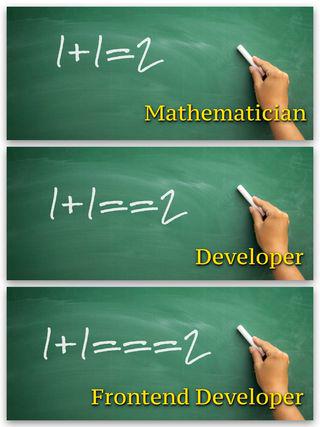
1 + 1 = 2 is read "one plus one equals two"
1 + 1 == 2 is read "one plus one is equal to two"
1 + 1 === 2 is read "one plus one is really equal to two"
And you hit the nail on the head, is that === is type explicit while == is implicit.
bobbykjack@programming.dev · 3 pts · 2y
I'd use something like:
= becomes
== equals
=== is identical to
It's funny how everyone thinks "equals" in this context should be "identical to" when, in normal language, it doesn't really mean that at all!
ShortFuse@lemmy.world · 4 pts · 2y
You don't need Typescript, you need an linter (eslint).
===is your basic equality like most languages.==will implicitly cast type.The breakdown is here: https://262.ecma-international.org/5.1/#sec-11.9.3
Modern JS says to never use
==unless you're comparing againstnullorundefined.clb92@feddit.dk · 3 pts · 2y
Like
==but more strict. The==operator will do type conversion, so0 == ''will actually be true, as an example. Sometimes (honestly, most times) you may want to compare more strictly.See this StackOverflow answer: https://stackoverflow.com/questions/359494/which-equals-operator-vs-should-be-used-in-javascript-comparisons
Assman@sh.itjust.works · 1 pts · 2y
Blackmist@feddit.uk · 12 pts · 2y
JS devs should have a font that turns == into ≈.
xedrak@kbin.social · 11 pts · 2y
cries in PHP
xmunk@sh.itjust.works · 3 pts · 2y
I also came to represent my php breathren.
DrunkenPirate@feddit.de · 10 pts · 2y
ChatGpt: 1+1≈2
OpenStars@startrek.website · 2 pts · 2y
Reddit: 1+1=your muther (sic, x2)
X: 1+1≈we should violently overthrow the government
4chan: nvm, I don't want to get banned for saying this one
Darkaga@kbin.social · 2 pts · 2y
4chan: "Gamer words"
OpenStars@startrek.website · 3 pts · 2y
No, that's Discord 🙃
callyral@pawb.social · 9 pts · 2y
1+1====2!← dreamberd developergandalf_der_12te@feddit.de · 9 pts · 2y
Basically Java in a nutshell
jenny_ball@lemmy.world · 7 pts · 2y
it depends on what your definition of is is
gandalf_der_12te@feddit.de · 1 pts · 2y
it depends on what your definition of is is
GiM@lemmy.world · 5 pts · 2y
parseInt(0.00000000005)
pftbest@sh.itjust.works · 1 pts · 2y
classic
majestic@sh.itjust.works · 4 pts · 2y
As a backend developer i still dont know a shit what that means
UndercoverUlrikHD@programming.dev · 9 pts · 2y
In javascript, === does not perform type coercion when checking for equality
blackn1ght@feddit.uk · 5 pts · 2y
Because in JS:
mumblerfish@lemmy.world · 4 pts · 2y
Mathematica also has an
===operator. And:=.lurch@sh.itjust.works · 8 pts · 2y
It's also very language specific, like Pascal/Delphi also have ":=" for assignments and "=" for comparison, etc
zarkanian@sh.itjust.works · 3 pts · 2y
That makes much more sense than the other way.
Agent641@lemmy.world · 1 pts · 2y
What does the walrus operator do?
mumblerfish@lemmy.world · 1 pts · 2y
I think it's called 'delayed assignment'. So it is almost like
=, but you can use arguments to define functions,f[a_]:=a+2.Tyfon@programming.dev · 2 pts · 2y
I'm JavaScript developer. I love coding WebApps. JS sucks💩.
ICastFist@programming.dev · 1 pts · 2y
Don't forget that
_.isFinite('1')returns true ;)thericcer@reddthat.com · 1 pts · 2y
Any Verilog devs?
tiredofsametab@kbin.social · 1 pts · 2y
1 + false ? (I have no idea in which order JS would evaluate things as I rarely have to touch that language much anymore)