We're not entirely sure, but the theory I've read goes as follows:
You move the obelisk around while it is lying down, like in the photo, by rolling it along logs. To erect it, you build a large two-sided ramp with a very shallow slope on one side and a very steep one on the other. You can then drag the obelisk, base first, up the shallow side until it gets to the top and tilts over on to the steep part. If you got everything right, your obelisk is now resting against the steep ramp mostly upright. You just need to haul it for the last and easiest part of the rotation, and due to your ramp you have a sort of scaffold to attach ropes to the top
There's also an extension of this theory based on how almost every known ancient Egyptian obelisk is part of a pair. We know that the Egyptians had pulleys back then, and if you connect two matched obelisks together with ropes and pulleys then you can use each one to help raise the other
It should be noted that this one is in Aswan, which was one of the main sites (maybe the main site, I'm not sure) for quarrying the stone for ancient Egyptian monumental architecture. Aswan is a fair way up the Nile, so anything coming from Aswan had a barge journey downstream to take first
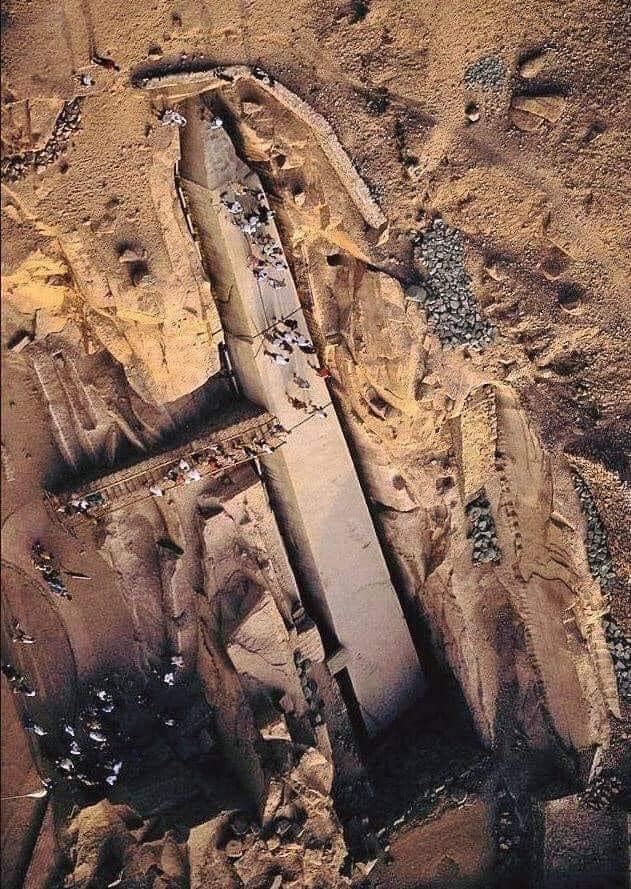
I assume that this photo shows the famous unfinished obelisk at Aswan. It cracked before the workers finished carving it. If finished and erected, it would have been the largest obelisk by far, well over twice the weight of the biggest one we know actually did get erected. It's quite possible that their techniques would have needed adaptation to work with such a huge one, but they never had to find out
Would love to read the story of why this great work was left unfinished. I'm sure it amounts to "the money ran out" but the colour in between would make for an interesting story
7 Comments
SineIraEtStudio@midwest.social · 7 pts · 1y
Looks like you added the wrong image.
PugJesus@piefed.social · 9 pts · 1y
Fuck. Fixed.
paraphrand@lemmy.world · 6 pts · 1y
I wonder how they planned to stand it upright 🤔.
Skua@kbin.earth · 17 pts · 1y
We're not entirely sure, but the theory I've read goes as follows:
You move the obelisk around while it is lying down, like in the photo, by rolling it along logs. To erect it, you build a large two-sided ramp with a very shallow slope on one side and a very steep one on the other. You can then drag the obelisk, base first, up the shallow side until it gets to the top and tilts over on to the steep part. If you got everything right, your obelisk is now resting against the steep ramp mostly upright. You just need to haul it for the last and easiest part of the rotation, and due to your ramp you have a sort of scaffold to attach ropes to the top
There's also an extension of this theory based on how almost every known ancient Egyptian obelisk is part of a pair. We know that the Egyptians had pulleys back then, and if you connect two matched obelisks together with ropes and pulleys then you can use each one to help raise the other
It should be noted that this one is in Aswan, which was one of the main sites (maybe the main site, I'm not sure) for quarrying the stone for ancient Egyptian monumental architecture. Aswan is a fair way up the Nile, so anything coming from Aswan had a barge journey downstream to take first
I assume that this photo shows the famous unfinished obelisk at Aswan. It cracked before the workers finished carving it. If finished and erected, it would have been the largest obelisk by far, well over twice the weight of the biggest one we know actually did get erected. It's quite possible that their techniques would have needed adaptation to work with such a huge one, but they never had to find out
bdot@lemmy.world · 3 pts · 1y
well - if someone figures that out, it may give us a little more insight to how the pyramids were built
fubarx@lemmy.world · 2 pts · 1y
Amazing how motivational a stream full of crocs can be.
awaysaway@sh.itjust.works · 3 pts · 1y
Would love to read the story of why this great work was left unfinished. I'm sure it amounts to "the money ran out" but the colour in between would make for an interesting story