Now, it's been a long time since I read the book, and I've never delved anywhere beyond the original novel, so treat this accordingly, but I think completely writing off the "science" of Dune is doing it a minor disservice. However, I'll grant you that it isn't "hard" sci-fi as that genre might typically be defined, either. Rather, the sciences that Herbert applied to his space opera were the social sciences, e.g. geography, sociology, history, and political science. I recall frequent digressions in the text talking about the ecology of Arrakis and how that has influenced interstellar politics, the most prominent example of this of course being the spice melange. Heck, the Liet-Kynes character was explicitly an Imperial Planetologist stationed there to learn about the Arrakis environment.
In fact, while checking my memory against the wiki article to make sure I wasn't forgetting something, I saw this quote, which succinctly sums up my argument here: "the attention to ecology is hard, the anthropology and the psychic abilities are soft".
All of which is to say, I agree with your main point: different stories require different approaches to scientific faithfulness. I liked all of the hard science of The Martian because, despite the fictional premise of an astronaut being stranded on Mars, I would largely expect an astronaut in that situation to think in terms of physics and biology and so on. I do not feel similarly about Han Solo. Right or wrong, I feel like authors with rigidly-held ideas about the value of hard vs soft science fiction tend to be insufferable pedants, and they write accordingly.
Interesting! I know Dark Sun is a well-regarded setting in many circles. I read one of the novels set there a long time ago, though I hadn't quite wrapped my head around the different DnD settings at that time. I was confused that Drizzt was nowhere to be found, let alone the other Forgotten Realms touchstones that I had conflated with DnD proper. I'm curious how the setting will be adapted for the modern era. Proclaiming its release window as the "Season of Survival" is kind of interesting. Seems like they could be encouraging people to engage with the most often neglected pillar of the DnD system (at least, in my experience playing with folks who largely started with 5e).
Seems like this question screams for pictorial examples, otherwise this is all just a bunch of nonsense words to people without Art History degrees. To that end, I present (in no particular order), a series of images which I find aesthetically pleasing. I do not know if they are emblematic of any particular movement, but I just think they look neat, and that's enough.
Judith I by Gustav Klimt. Probably he is best known for his later work, The Kiss, but this features the beginnings of the opulent detail that he would continue to develop over time.
The Peacock Skirt by August Beardsley. I love how he plays with negative space. Large swaths of his illustrations are intentionally blank, in either pure white or pure black, but these expanses of nothingness exist next to incredibly fine detail work. I find the juxtaposition appealing.
Stephen Gammell's illustrations for Scary Stories to Tell in the Dark. It was a close call between this and the illustrations of Edward Gorey, but Gammell wins out for how striking his work is. I reckon some of these images are irrevocably ingrained in the brains of folks of a certain age. I know they are in mine. I especially appreciate his penchant for having streaky, inky bits trailing off of his subjects. In contrast to the controlled precision of Beardsley, the free-flowing sketchiness of parts of Gammell's illustrations is also impactful.
Since I brought him up, an example of Edward Gorey's work.
Also, just for funsies, since I'm talking about illustrations which accompany texts, a special mention for the illustrations of Gustave Dore. In particular, his visualizations which accompany Dante's Inferno may as well be canon.
Paradiso, Canto 34
Recently, I've been learning about the history of Tibet and the Himalayan region, ostensibly for DnD purposes, but also because it's an area of the world that I simply know almost nothing about. In doing so, I've come across the work of Nicholas Roerich, who was a Russian painter who traveled Central Asia extensively in the 20's and 30's. I find his color choices to be incredibly evocative, even if he is often unconcerned with realism or detail. Here's a link to a gallery with a collection of his paintings. Some of these remind me of concept art for Tatooine or Jodorowsky's Dune.
Rocks of Ladakh
Dorje, The Daring One
Speaking of concept art for Star Wars and Dune, I'll round this out by saying I've always loved classic science fiction and fantasy art. John Howe, Frank Frazetta, Ralph McQuarrie, and countless others all deserve a mention, but I'm running late for a volleyball game as I type this so I have to make it snappy. As a stand-in for all of the talented artists who contributed to the aesthetics of genre fiction over the decades, I'll nominate Jean Giraud (aka Moebius) as my aesthetic champion of choice.
Hah! I didn't think about the Star Trek comparison, but, now that you mention it, the Galapagos sequences very much have that vibe! The conflict between their military duty versus Maturin's scientific interests, not to mention the conversations about leadership in the Captain's quarters, it is all very Trek-coded.
I've heard that Maturin is practically a card-carrying anarchist in the books, in spite of his service to the Crown. The movie touches on that in a few places, but doesn't fully explore that dynamic. Given what this article says about O'Brien's lack of aptitude for capturing characters' inner lives, do you feel like Maturin's inherent contradictions are well-explored?
Man, I knew that the naval jargon in these books would be impenetrable, but I didn't expect quite the same sesquipedalian loquaciousness from the rest of the text. I'm a fan of the movie, and have heard folks speak highly of the novels, but my drive to read them has been chilled somewhat. Also, boy howdy the author sounds like a jerk
For anyone passing through with nostalgia for CnC Renegade' multiplayer mode (which was a first-person take on the parent series' base building) give the fan made remake Renegade X a look. I played several games with full servers when 1.0 launched and it scratched my nostalgia itch like no one's business. They have the link to the download in the description of the video.
I don't know if its validating or disappointing to be seen so thoroughly by an article like this. On the one hand, I absolutely identify with the memes that are like "men will live like this without issue" and it's just an arm chair and TV in an otherwise empty room. Aesthetics, while noticeable to me, are simply never much of a priority. However, at the same time, I also feel like taking ownership of your living space and having the confidence to imprint aspects of your personality on it is a mark of maturity in some ways.
So, I find myself stuck in an increasingly silly feedback loop of not caring about aesthetics -> feeling bad for not caring -> trying to brainstorm some ideas for how to spruce things up -> having anxiety over the infinite combinations of possibilities without a "correct" answer -> throwing my hands up and returning to not caring.
Shared with my godfather, a mathematician at a Catholic university with a calculator collecting hobby. The only way this could be any more up his alley is if there was a Star Trek joke in there somewhere. XD
Thank you! I'm mostly very happy with how they turned out. I'm not 100% satisfied with the tumorous forearms, but I'm also not sure what exactly I would do differently, so it will just have to do for now. Maybe I'll discover a technique in the future which can inform other attempts.
Wasn't Beni buried alive under Hamunaptra at the end of the first movie? With flesh-eating scarabs closing in around him as the lights went out? I suppose anything's possible in lega-sequel land, but seems odd to bring him back.
Love me some O'Conner though, so I can't be that upset.
Yeah, Statham had several roles of various sizes under his belt by the time Collateral was coming out. The Transporter came out in 2002, so he had already been the face of an action franchise by that point, not to mention his prior work with Ritchie.
Is SR3, ShadowRun 3rd edition? I've never played, beyond the tutorial of the revival cRPG from years ago, but I recall being similarly aghast at the plethora of options in the character creator. It's a shame, because the premise is awfully enticing. Ah well, as someone else in here mentioned, it seems like learning new systems has some inertia to it. The more you learn, the easier it is to learn more, since there only so many ways to roll a die lol. Maybe Shadowrun can be a project for future me.
Your points about getting a baseline understanding of the flow and adding crunch in as GM and players get comfortable is well taken. My initial strategy was to focus on only one mechanic (in this case, firing a ranged weapon), but to know that mechanic absolutely front to back. However, in this system, firing a ranged weapon interacts with almost every mechanic in the game, so I was still trying to drink from the firehose. Thank you for taking the time and sharing your input.
Could be I'm just dumb and unfamiliar with crunchier RPG systems, I'll freely allow for that, but man, I feel like you and I have a different definition of "simple" lol. Considering this is a flowchart for adjudicating a single Ranged Combat roll, to say nothing of any other mechanic in the game. Granted, this is particularly egregious, but it's also the main thing most characters will be doing in combat.
I suppose the old adage holds true. How do you get to Carnegie Hall? Practice, practice, practice.
Aye, I've been following their uploads and it has been helpful from a general observation perspective. I wish they were a little clearer about the rules they are navigating, but I recognize it's not a teaching cast either. I will say it's been illuminating how free-wheeling the Ref is with the NPC rules, which has helped me conceptualize the flow a bit better.
I mean, there's a pretty critical casting of minor illusion that he's responsible for. And, it was pointed out to me, that the various instances of him cajoling the party along, especially when the flashier members are having doubts, is basically Bardic Inspiration. Which I think is a neat way of handling it.


Now, it's been a long time since I read the book, and I've never delved anywhere beyond the original novel, so treat this accordingly, but I think completely writing off the "science" of Dune is doing it a minor disservice. However, I'll grant you that it isn't "hard" sci-fi as that genre might typically be defined, either. Rather, the sciences that Herbert applied to his space opera were the social sciences, e.g. geography, sociology, history, and political science. I recall frequent digressions in the text talking about the ecology of Arrakis and how that has influenced interstellar politics, the most prominent example of this of course being the spice melange. Heck, the Liet-Kynes character was explicitly an Imperial Planetologist stationed there to learn about the Arrakis environment.
In fact, while checking my memory against the wiki article to make sure I wasn't forgetting something, I saw this quote, which succinctly sums up my argument here: "the attention to ecology is hard, the anthropology and the psychic abilities are soft".
All of which is to say, I agree with your main point: different stories require different approaches to scientific faithfulness. I liked all of the hard science of The Martian because, despite the fictional premise of an astronaut being stranded on Mars, I would largely expect an astronaut in that situation to think in terms of physics and biology and so on. I do not feel similarly about Han Solo. Right or wrong, I feel like authors with rigidly-held ideas about the value of hard vs soft science fiction tend to be insufferable pedants, and they write accordingly.
Interesting! I know Dark Sun is a well-regarded setting in many circles. I read one of the novels set there a long time ago, though I hadn't quite wrapped my head around the different DnD settings at that time. I was confused that Drizzt was nowhere to be found, let alone the other Forgotten Realms touchstones that I had conflated with DnD proper. I'm curious how the setting will be adapted for the modern era. Proclaiming its release window as the "Season of Survival" is kind of interesting. Seems like they could be encouraging people to engage with the most often neglected pillar of the DnD system (at least, in my experience playing with folks who largely started with 5e).
Seems like this question screams for pictorial examples, otherwise this is all just a bunch of nonsense words to people without Art History degrees. To that end, I present (in no particular order), a series of images which I find aesthetically pleasing. I do not know if they are emblematic of any particular movement, but I just think they look neat, and that's enough.
Judith I by Gustav Klimt. Probably he is best known for his later work, The Kiss, but this features the beginnings of the opulent detail that he would continue to develop over time.
The Peacock Skirt by August Beardsley. I love how he plays with negative space. Large swaths of his illustrations are intentionally blank, in either pure white or pure black, but these expanses of nothingness exist next to incredibly fine detail work. I find the juxtaposition appealing.
Stephen Gammell's illustrations for Scary Stories to Tell in the Dark. It was a close call between this and the illustrations of Edward Gorey, but Gammell wins out for how striking his work is. I reckon some of these images are irrevocably ingrained in the brains of folks of a certain age. I know they are in mine. I especially appreciate his penchant for having streaky, inky bits trailing off of his subjects. In contrast to the controlled precision of Beardsley, the free-flowing sketchiness of parts of Gammell's illustrations is also impactful.
Since I brought him up, an example of Edward Gorey's work.
Also, just for funsies, since I'm talking about illustrations which accompany texts, a special mention for the illustrations of Gustave Dore. In particular, his visualizations which accompany Dante's Inferno may as well be canon.
Paradiso, Canto 34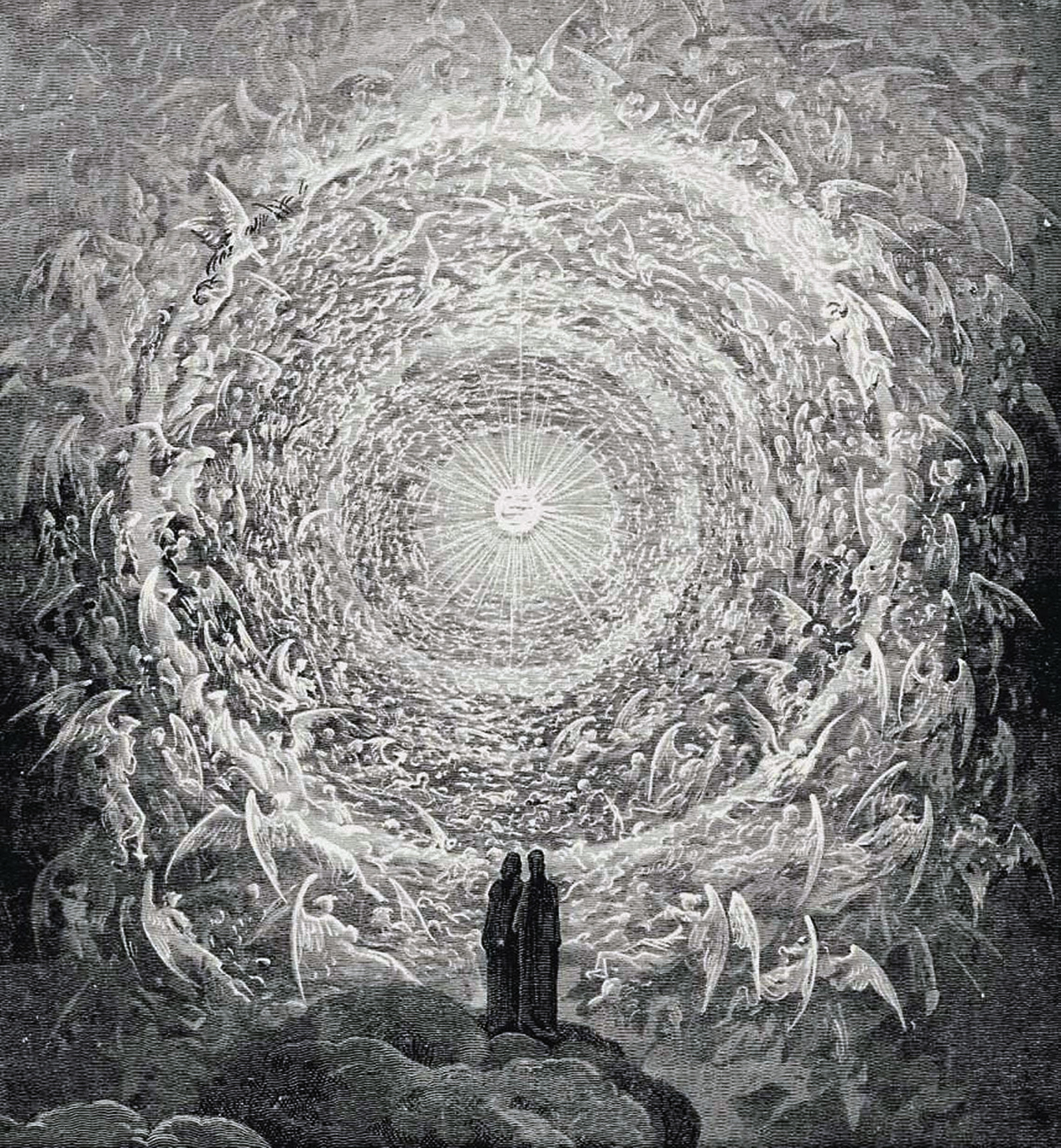
Recently, I've been learning about the history of Tibet and the Himalayan region, ostensibly for DnD purposes, but also because it's an area of the world that I simply know almost nothing about. In doing so, I've come across the work of Nicholas Roerich, who was a Russian painter who traveled Central Asia extensively in the 20's and 30's. I find his color choices to be incredibly evocative, even if he is often unconcerned with realism or detail. Here's a link to a gallery with a collection of his paintings. Some of these remind me of concept art for Tatooine or Jodorowsky's Dune.
Rocks of Ladakh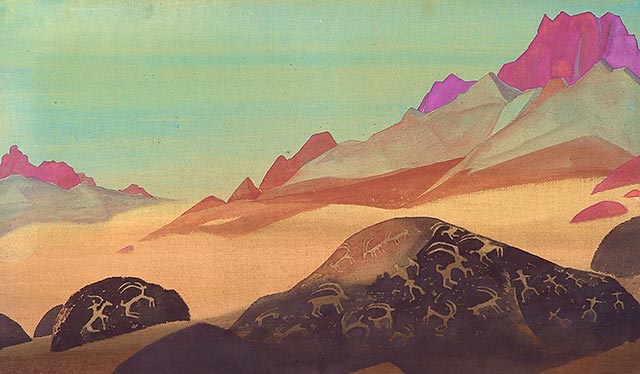
Dorje, The Daring One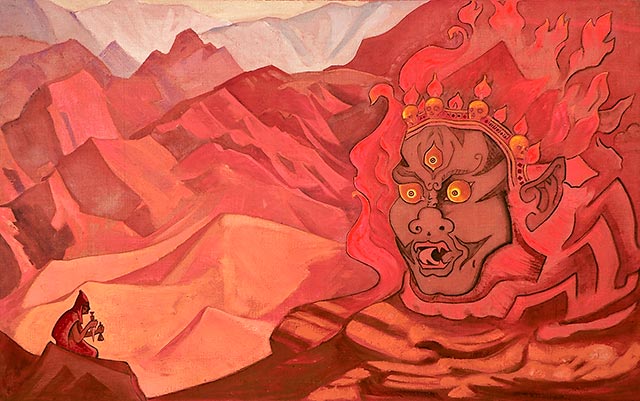
Speaking of concept art for Star Wars and Dune, I'll round this out by saying I've always loved classic science fiction and fantasy art. John Howe, Frank Frazetta, Ralph McQuarrie, and countless others all deserve a mention, but I'm running late for a volleyball game as I type this so I have to make it snappy. As a stand-in for all of the talented artists who contributed to the aesthetics of genre fiction over the decades, I'll nominate Jean Giraud (aka Moebius) as my aesthetic champion of choice.
You should share with the bugs community. Seems up their alley!
Hah! I didn't think about the Star Trek comparison, but, now that you mention it, the Galapagos sequences very much have that vibe! The conflict between their military duty versus Maturin's scientific interests, not to mention the conversations about leadership in the Captain's quarters, it is all very Trek-coded.
I've heard that Maturin is practically a card-carrying anarchist in the books, in spite of his service to the Crown. The movie touches on that in a few places, but doesn't fully explore that dynamic. Given what this article says about O'Brien's lack of aptitude for capturing characters' inner lives, do you feel like Maturin's inherent contradictions are well-explored?
Man, I knew that the naval jargon in these books would be impenetrable, but I didn't expect quite the same sesquipedalian loquaciousness from the rest of the text. I'm a fan of the movie, and have heard folks speak highly of the novels, but my drive to read them has been chilled somewhat. Also, boy howdy the author sounds like a jerk
Well, ain't this board game a temporal oddity? A week away for years now!
For anyone passing through with nostalgia for CnC Renegade' multiplayer mode (which was a first-person take on the parent series' base building) give the fan made remake Renegade X a look. I played several games with full servers when 1.0 launched and it scratched my nostalgia itch like no one's business. They have the link to the download in the description of the video.
I don't know if its validating or disappointing to be seen so thoroughly by an article like this. On the one hand, I absolutely identify with the memes that are like "men will live like this without issue" and it's just an arm chair and TV in an otherwise empty room. Aesthetics, while noticeable to me, are simply never much of a priority. However, at the same time, I also feel like taking ownership of your living space and having the confidence to imprint aspects of your personality on it is a mark of maturity in some ways.
So, I find myself stuck in an increasingly silly feedback loop of not caring about aesthetics -> feeling bad for not caring -> trying to brainstorm some ideas for how to spruce things up -> having anxiety over the infinite combinations of possibilities without a "correct" answer -> throwing my hands up and returning to not caring.
We work on it in therapy, I guess, lol.
Love the color choices!
Shared with my godfather, a mathematician at a Catholic university with a calculator collecting hobby. The only way this could be any more up his alley is if there was a Star Trek joke in there somewhere. XD
Thank you! I'm mostly very happy with how they turned out. I'm not 100% satisfied with the tumorous forearms, but I'm also not sure what exactly I would do differently, so it will just have to do for now. Maybe I'll discover a technique in the future which can inform other attempts.
Wasn't Beni buried alive under Hamunaptra at the end of the first movie? With flesh-eating scarabs closing in around him as the lights went out? I suppose anything's possible in lega-sequel land, but seems odd to bring him back.
Love me some O'Conner though, so I can't be that upset.
All good. Its even more of an odd cameo given he WASN'T an unknown at the time.
Yeah, Statham had several roles of various sizes under his belt by the time Collateral was coming out. The Transporter came out in 2002, so he had already been the face of an action franchise by that point, not to mention his prior work with Ritchie.
Is SR3, ShadowRun 3rd edition? I've never played, beyond the tutorial of the revival cRPG from years ago, but I recall being similarly aghast at the plethora of options in the character creator. It's a shame, because the premise is awfully enticing. Ah well, as someone else in here mentioned, it seems like learning new systems has some inertia to it. The more you learn, the easier it is to learn more, since there only so many ways to roll a die lol. Maybe Shadowrun can be a project for future me.
Your points about getting a baseline understanding of the flow and adding crunch in as GM and players get comfortable is well taken. My initial strategy was to focus on only one mechanic (in this case, firing a ranged weapon), but to know that mechanic absolutely front to back. However, in this system, firing a ranged weapon interacts with almost every mechanic in the game, so I was still trying to drink from the firehose. Thank you for taking the time and sharing your input.
Could be I'm just dumb and unfamiliar with crunchier RPG systems, I'll freely allow for that, but man, I feel like you and I have a different definition of "simple" lol. Considering this is a flowchart for adjudicating a single Ranged Combat roll, to say nothing of any other mechanic in the game. Granted, this is particularly egregious, but it's also the main thing most characters will be doing in combat.
I suppose the old adage holds true. How do you get to Carnegie Hall? Practice, practice, practice.
Aye, I've been following their uploads and it has been helpful from a general observation perspective. I wish they were a little clearer about the rules they are navigating, but I recognize it's not a teaching cast either. I will say it's been illuminating how free-wheeling the Ref is with the NPC rules, which has helped me conceptualize the flow a bit better.
I mean, there's a pretty critical casting of minor illusion that he's responsible for. And, it was pointed out to me, that the various instances of him cajoling the party along, especially when the flashier members are having doubts, is basically Bardic Inspiration. Which I think is a neat way of handling it.