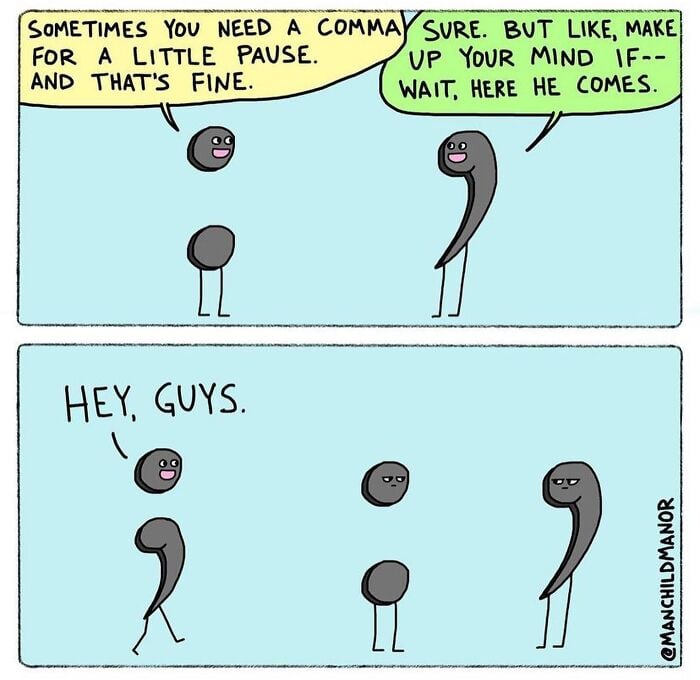
Since this is about punctuation, what's with the double dashes? Trailing off is usually written with an ellipsis, though an em dash can be used, since this is more of a break in speech. And yes, double dashes are sometimes used as a substitute on a keyboard or with a typeface that doesn't have an em dash.
But this is hand-lettered text— just draw the em dash!
An em dash is done with a triple hyphen in some programs like Microsoft Word, IIRC, and a double hyphen is an en dash.
But I am lazy and don't want to smack hyphen three times, so I tend to use double hyphen for em dash, which I use a lot more than en dash, and just use a single hyphen for en dash. People get the meaning.
I was taught it in school, have looked it up on Wikipedia, seen infographics, YouTube videos, etc., and yet I still do not know when to use those things. At this point I just refuse to purely out of fear.
You generally use them at the end of a line but it is more accurate to say you use them at the end of a statement but we usually put each statement on a single line so it is easy to make that mistake example:
::: spoiler Tap for spoiler
<?php
$x = 5; // Semicolon ends the statement
$y = 10; // Another statement ends here

if ($x < $y) { // No semicolon needed here
    echo "x is less than y"; // Semicolon ends this statement
}

$x = $x + $y; // Statement ends here
echo $x; // Outputs 15
?>
While that may be true, you also put them in places that should have a comma, but you want more pause; this is why boiling it down to a single aphorism is difficult.
For example, I've read most of the comments in this thread, as well as the Oatmeal info-comic that someone linked, and I still don't know with certainty the semicolon I used above is grammatically appropriate.
You can use a semicolon wherever you’d logically break in a sentence, without pausing overtly, but intend to follow the thought; semi-colons slip naturally into your thought process when you practice it by speaking.
I have one easy rule, and two examples. Use them when using a comma would be confusing.
Examples: often in lists, where each item might contain a comma and so trying to separate list items with commas would just be confusing; and more broadly anywhere where you have a sentance containing clauses and need a different separator.
I just used the first example above: to separate the two list items, and the other one I'm using here, where I'm already using commas; using a semicolon allows braking this up without starting a new sentance.
That second example was somewhat contrived, but does the job; it could have been two sentences.
Actually, there's another place I use them, but it's not a "rule" and if more style: I use them selectively in place of periods to prevent a series of short, choppy sentences.
28 Comments
Kolanaki@yiffit.net · 35 pts · 1y
Stop; hammer time.
SwingingTheLamp@midwest.social · 28 pts · 1y
Since this is about punctuation, what's with the double dashes? Trailing off is usually written with an ellipsis, though an em dash can be used, since this is more of a break in speech. And yes, double dashes are sometimes used as a substitute on a keyboard or with a typeface that doesn't have an em dash.
But this is hand-lettered text— just draw the em dash!
tal@lemmy.today · 9 pts · 1y
An em dash is done with a triple hyphen in some programs like Microsoft Word, IIRC, and a double hyphen is an en dash.
But I am lazy and don't want to smack hyphen three times, so I tend to use double hyphen for em dash, which I use a lot more than en dash, and just use a single hyphen for en dash. People get the meaning.
Jeffool@lemmy.world · 1 pts · 1y
Most of the time I see em dashes and en dashes though should just be commas anyway.
RacerX@lemm.ee · 25 pts · 1y
I was taught it in school, have looked it up on Wikipedia, seen infographics, YouTube videos, etc., and yet I still do not know when to use those things. At this point I just refuse to purely out of fear.
stupidcasey@lemmy.world · 22 pts · 1y
You generally use them at the end of a line but it is more accurate to say you use them at the end of a statement but we usually put each statement on a single line so it is easy to make that mistake example:
::: spoiler Tap for spoiler
:::
technomad@slrpnk.net · 2 pts · 1y
Is this programmer trolling? 🤣🤣🤣
jmcs@discuss.tchncs.de · 12 pts · 1y
Wikipedia has some examples; they are always super helpful in cases like this.
Landless2029@lemmy.world · 8 pts · 1y
I've always done this one:
Between closely related [independent clauses].
(https://en.m.wikipedia.org/wiki/Independent_clause "Independent clause") not conjoined with a coordinating conjunction, when the two clauses are balanced, opposed or contradictory:[23].
argon@lemmy.today · 6 pts · 1y
Basically you use them at points where you'd usually put a period, but you don't want to add as much of a pause.
ETA:
For example
could also be written as
but it wouldn't sound as nice.
redhorsejacket@lemmy.world · 1 pts · 1y
While that may be true, you also put them in places that should have a comma, but you want more pause; this is why boiling it down to a single aphorism is difficult.
For example, I've read most of the comments in this thread, as well as the Oatmeal info-comic that someone linked, and I still don't know with certainty the semicolon I used above is grammatically appropriate.
prettybunnys@sh.itjust.works · 7 pts · 1y
You can use a semicolon wherever you’d logically break in a sentence, without pausing overtly, but intend to follow the thought; semi-colons slip naturally into your thought process when you practice it by speaking.
Serinus@lemmy.world · 7 pts · 1y
I use them after worrying about being pretentious, but then (sometimes) deciding "fuck it. It's right." and then doing it anyway.
sxan@midwest.social · 5 pts · 1y
I have one easy rule, and two examples. Use them when using a comma would be confusing.
Examples: often in lists, where each item might contain a comma and so trying to separate list items with commas would just be confusing; and more broadly anywhere where you have a sentance containing clauses and need a different separator.
I just used the first example above: to separate the two list items, and the other one I'm using here, where I'm already using commas; using a semicolon allows braking this up without starting a new sentance.
That second example was somewhat contrived, but does the job; it could have been two sentences.
Actually, there's another place I use them, but it's not a "rule" and if more style: I use them selectively in place of periods to prevent a series of short, choppy sentences.
r0ertel@lemmy.world · 4 pts · 1y
Same. I was taught in school but never learned how to use them until I read this (The Oatmeal).
mrslt@lemmy.world · 2 pts · 1y
You would use a semi-colon in places where a comma and a colon would be equally suitable, pretty much.
homicidalrobot@lemm.ee · 3 pts · 1y
Where a period or a comma followed by "And" would go. Semicolon is a full break, distinctly more than a comma
ouRKaoS@lemmy.today · -3 pts · 1y
The rules are all made up; punctuation can be used wherever you like.
yesoutwater@lemm.ee · 1 pts · 1y
I call this; the ee cummings
turkalino@lemmy.yachts · 17 pts · 1y
Wouldn’t semicolon be their child?
sanderium@lemmy.zip · 10 pts · 1y
They are pretending its not
Amputret@lemmy.dbzer0.com · -1 pts · 1y
I thought it was an NB joke.
Lost_My_Mind@lemmy.world · 8 pts · 1y
I always read NB as New Balance. And I'm always confused.
SplashJackson@lemmy.ca · 1 pts · 1y
I read NB as New Brunswick; but I also read it as Nude Boobs, so take that as you will
feedum_sneedson@lemmy.world · 10 pts · 1y
I could not love semicolons more.
dohpaz42@lemmy.world · 7 pts · 1y
Semicolons are an important punctuation tool. It’s used to say that the author could have ended their sentence, but chose to keep going instead.
ooterness@lemmy.world · 1 pts · 1y
Lonely Island: We use semicolons every day.
partial_accumen@lemmy.world · 4 pts · 1y
Next frame should be the semicolon taking the same shit about the interrobang.