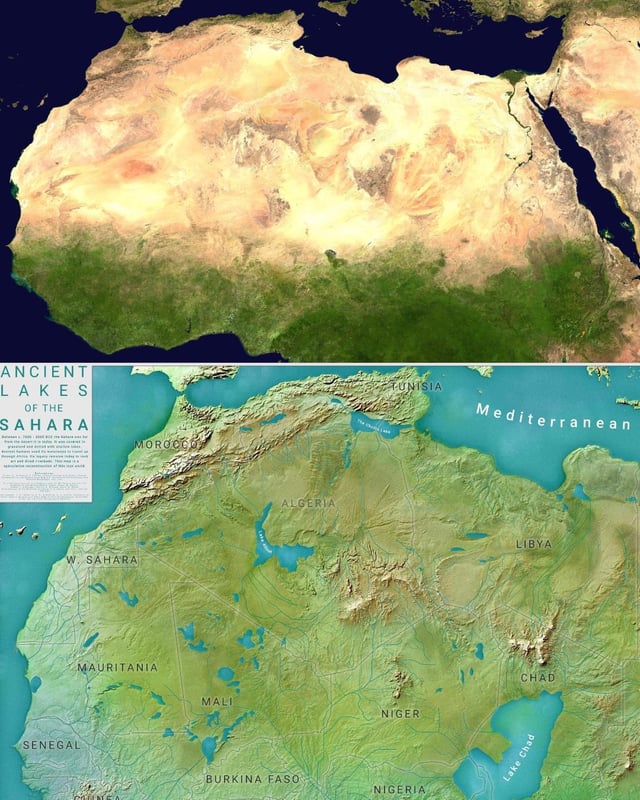
weird side note that I've seen the comparison many times and the more I look at it the more the shape of the lake in its largest form and the shape of the lake up to the 70s look very similar, but perfectly mirrored
When you just look at the modern map it's absurd to think about the number of people that live in Africa north of Sahara. It looks like a wasteland that stretches all the way to the coast.
Also, with this timeline, it seems plausible that the earliest Egyptian empires may have been around just early enough to actually experience this desertification. No doubt countless tribal peoples had (or have) oral histories describing how their homeland was eaten away by desert.
Also, with this timeline, it seems plausible that the earliest Egyptian empires may have been around just early enough to actually experience this desertification.
AfaIk, one theory is that the ancient Egyptians moved from deserting regions in the Sahara (following a now dry branch of the Nile) to Egypt, i.e. the origin of the ancient Egyptian culture is in the Sahara region.
No doubt countless tribal peoples had (or have) oral histories describing how their homeland was eaten away by desert.
it's a bit like how the bible's flood story was the result of the oceans overcoming land after the last ice age melted away.
the sahara bounced back and forth between fertile grasslands and desert wastelands over the eons and the ancient egyptians of the first kingdom became a thing at the tail end of last transition from grassland to desert.
i like how the "fall of civilizations" podcast frames it. he describes the people of the region as being disparate peoples occupying various parts of the last grassland sahara who slowly migrated over the centuries towards river deltas like the nile as the desert encroached on their homes bit-by-bit over the generations.
i suspect that climate change is going to happen the same way for us and FAR AWAY future generations will be just as ignorant about how it happened or that it even happened.
Green Sahara/Desert Sahara is a cycle that happens.
I've heard people try to claim the garden of eden is a memory of the green sahara, but that's not provable.
I also heard it has an effect on animal evolution - the desert acts as a wall, seperating north and south, then goes green and the two regions' life mingle and compete for a while until it desertification seperates them to evolve independantly of each other until the next green phase.
I’ve heard people try to claim the garden of eden is a memory of the green sahara, but that’s not provable.
Early civilizations were routinely centered around lush green river valleys, with political strife forcing dissidents out into the dry and sterile periphery. So, I wouldn't say it's a memory of a green Sahara so much as a cycle of cultivation and degradation that has informed human storytelling for millennia.
"Eden" could just as easily be the Indus Valley in modern-day Pakistan. Or the Fertile Crescent of Iraq/Iran. Or the Göbekli Tepe of southeast Turkiye. Or the Nile Delta. Or the modern-day Gaza Strip. Or the rich soils along the slopes of Mount Kenya. Or the bountiful soil of Ukraine. Or yadda yadda yadda.
Maybe all of these places, with migrating peoples constantly looking for the next Promised Land of Fruit and Honey, settling for a time, and being uprooted again.
That's pretty cool. I've heard the idea that the Garden of Eden is where the Persian Gulf is now. It supposedly had incredibly rich soil and an immense supply of fresh water until the glaciers over Europe melted and eventually flooded the area.
They are trying to combat desertification. They're fighting against a strong feedback loop of dry soil causing water to not be retained, but by using crescent burrows, they're able to soak water into the soil properly
Of course, a bunch of these efforts to forestall desertification and reverse the damage is being done with money loaned by Chinese state and private businesses. And (unlike when the IMF or western banks extend loans) we all know that this is how Evil Countries get their hooks in to do the Horrible Thing.
There's an ancient lakebed in Chad that supplies dust that blows across the Atlantic and delivers phosphorus to Amazon rainforests - phosphorus that is needed to support plant growth. Those long-dead organisms are still in the food chain. Life uuh finds a way.
That's a very, very short time for such a major change. Makes me wonder what currently green ecosystems we take for granted a bit too easily.
But it also makes me wonder whether a reversal is within human reach. To start with, cheap solar potentially enables desalinization and irrigation at unprecedented scales... What a nice thing to feel optimistic about, if nothing else.
Chinese solar farms in their deserts suddenly went green due to the constant shade protecting rain water, plus the water from the automated cleaning spray systems. It grew grass, so they put goats there to keep it mowed for free.
I'd say revesal is not just within reach, it's just a matter of people deciding to do it. We know that just digging a bunch of crescent-shaped pits/ponds is really effective at turning desert into green space, and that's hilariously low-tech.
Add on actually complex interventions and ngl i think it could be reversed within like a hundred years.
I mean imagine if massive desalination plants were built and the water pumped inland, we can do that shit, it's just expensive.
Evolution happens in bursts when species are under pressure and a lot of animals are able to make quick adaptations within a few generations. Some animals don't even need to change because of prior adaptations they never lost and they just thrive.
For example, if a species had previously adapted to arid conditions but was living in a more hospitable region they don't tend to lose their ability to handle arid conditions without some kind of pressure. Access to water doesn't mean they will lose those traits, they just don't need all the water that is available. If the area turns arid they are not impacted by the lack of water like those that don't have those traits. Or they might not currently express their genes in a way that causes that adaptation to arid conditions to show up normally, but they don't necessarily need significant genetic changes to express those traits.
Look at dogs, who can have massive variation from breeding within a few generations.
There is/was an effort to create a Great Green Wall on the southern side of the Sahara to re-green a 15km-wide band of land all across the continent. It's run into funding, civil unrest and political leadership challenges
Dust from the Sahara blows across over to the Amazon, enough of the stuff makes it across to be a factor when it comes to nutrient supply for the rainforest.
The second one. The sands of the Sahara are vital to the Amazon rainforest. They blow all the way to the Amazon and deposit phosphorus which would totally get washed away without that deposit. The surface of the earth is hyper connected. You only experience yourself as a separate being from the rest of nature just because of the limited awareness we have, not because we are actually independent.
To be fair, I've never seen myself as separate from nature, just separate from nature on another literal continent, it boggles the mind that sand can reliably and consistently travel that far.
Apart from what others have commented on, some of the sand gets deposited in the ocean when it blows across the Atlantic. That sand is eaten by sea life and goes back into that ecosystem. The world is amazing.
Overall I think making the Sahara more green would be a net positive, but I'm sure there are unforeseen negative consequences for parts of the world.
Somewhat related: Jason's myth of the Golden Fleece takes him to the east of the Black Sea. It's very likely that, around the time that the Sahara was green, it was possible to make a boat trip from the Black Sea to the Caspian Sea and from there to the northern part of Afghanistan, what was once Bactria, following the Amu Darya (Oxus) river.
Another related tidbit: there may be several prehistoric settlements that are now under the sea, due to rising sea levels in some areas. Underwater archaeology is a lot more challenging than doing it in firm, dry soil, thus findings tend to be rarer and more difficult to preserve.
Egypt was, but also the Sahara was very dry by the founding of Rome. It's looking like 1600 BCE for early settlements in the area that the city of Rome is now in, meanwhile the latest I'm seeing for desertification is 2100 BCE.
This difference in time is akin to claiming that Henry VIII had an air force. The Roman Empire is early ADs, so it's closer to claiming Julius Caesar had nukes
Carthage was in coastal north Africa and is still pretty green. There are expensive suburbs on it these days.
70 Comments
RickyRigatoni@piefed.zip · 86 pts · 36d
Lake Chad has shrunk so much in 50 years...
BillCheddar@lemmy.world · 8 pts · 36d
The lake's coming home?
Too soon?
PanGodofPanic@lemmy.blahaj.zone · 8 pts · 36d
weird side note that I've seen the comparison many times and the more I look at it the more the shape of the lake in its largest form and the shape of the lake up to the 70s look very similar, but perfectly mirrored
RickyRigatoni@piefed.zip · 5 pts · 36d
It Remembers What It Once Was
LodeMike@lemmy.today · 6 pts · 35d
Virgins seething
thebestaquaman@lemmy.world · 66 pts · 36d
When you just look at the modern map it's absurd to think about the number of people that live in Africa north of Sahara. It looks like a wasteland that stretches all the way to the coast.
Also, with this timeline, it seems plausible that the earliest Egyptian empires may have been around just early enough to actually experience this desertification. No doubt countless tribal peoples had (or have) oral histories describing how their homeland was eaten away by desert.
Successful_Try543@feddit.org · 41 pts · 36d
AfaIk, one theory is that the ancient Egyptians moved from deserting regions in the Sahara (following a now dry branch of the Nile) to Egypt, i.e. the origin of the ancient Egyptian culture is in the Sahara region.
eldavi@lemmy.ml · 4 pts · 33d
it's a bit like how the bible's flood story was the result of the oceans overcoming land after the last ice age melted away.
the sahara bounced back and forth between fertile grasslands and desert wastelands over the eons and the ancient egyptians of the first kingdom became a thing at the tail end of last transition from grassland to desert.
i like how the "fall of civilizations" podcast frames it. he describes the people of the region as being disparate peoples occupying various parts of the last grassland sahara who slowly migrated over the centuries towards river deltas like the nile as the desert encroached on their homes bit-by-bit over the generations.
i suspect that climate change is going to happen the same way for us and FAR AWAY future generations will be just as ignorant about how it happened or that it even happened.
Hegar@fedia.io · 50 pts · 36d
Green Sahara/Desert Sahara is a cycle that happens.
I've heard people try to claim the garden of eden is a memory of the green sahara, but that's not provable.
I also heard it has an effect on animal evolution - the desert acts as a wall, seperating north and south, then goes green and the two regions' life mingle and compete for a while until it desertification seperates them to evolve independantly of each other until the next green phase.
UnderpantsWeevil@lemmy.world · 8 pts · 35d
Early civilizations were routinely centered around lush green river valleys, with political strife forcing dissidents out into the dry and sterile periphery. So, I wouldn't say it's a memory of a green Sahara so much as a cycle of cultivation and degradation that has informed human storytelling for millennia.
"Eden" could just as easily be the Indus Valley in modern-day Pakistan. Or the Fertile Crescent of Iraq/Iran. Or the Göbekli Tepe of southeast Turkiye. Or the Nile Delta. Or the modern-day Gaza Strip. Or the rich soils along the slopes of Mount Kenya. Or the bountiful soil of Ukraine. Or yadda yadda yadda.
Maybe all of these places, with migrating peoples constantly looking for the next Promised Land of Fruit and Honey, settling for a time, and being uprooted again.
Hegar@fedia.io · 4 pts · 35d
Yeah for sure, that's all possible. Or eden could just be an idealized dream of an agricultural society and not a historical memory at all.
UnderpantsWeevil@lemmy.world · 4 pts · 34d
Well, it's metaphorically one way or another. I don't think there was a big tree with magic apples and talking snakes in any of these places.
Hegar@fedia.io · 2 pts · 34d
Sure yep, that also seems unlikely 😆
mirshafie@europe.pub · 6 pts · 36d
That's pretty cool. I've heard the idea that the Garden of Eden is where the Persian Gulf is now. It supposedly had incredibly rich soil and an immense supply of fresh water until the glaciers over Europe melted and eventually flooded the area.
UltraMagnus0001@lemmy.world · 2 pts · 35d
Something about the wobble of the earth's axis shifting every once in a while. Also the poles can switch too and our sun does it way more often.
Axolotl_cpp@feddit.it · 1 pts · 36d
i heard that the amazon rainforest was a desert when the sahara was green too
ODGreen@lemmy.ca · 39 pts · 36d
There was once an inland sea called Mega-Chad? Is this one step to discovering the legendary Giga-Chad?
e0qdk@reddthat.com · 37 pts · 36d
nore@sh.itjust.works · 12 pts · 36d
Is that Radiant Historia?
e0qdk@reddthat.com · 9 pts · 36d
Yep! It's from the opening.
StillAlive@piefed.world · 18 pts · 36d
sepi@piefed.social · 5 pts · 36d
Brilliant. You had this one locked in for a while waiting for the perfect moment. Great shot.
UpperBroccoli@feddit.org · 1 pts · 34d
Baguette@lemmy.blahaj.zone · 15 pts · 36d
https://youtu.be/vG1H9Sg4lBM
They are trying to combat desertification. They're fighting against a strong feedback loop of dry soil causing water to not be retained, but by using crescent burrows, they're able to soak water into the soil properly
UnderpantsWeevil@lemmy.world · 4 pts · 35d
How China Turned a Desert Green
Reversing Desertification A Green Blueprint for Kenya
Of course, a bunch of these efforts to forestall desertification and reverse the damage is being done with money loaned by Chinese state and private businesses. And (unlike when the IMF or western banks extend loans) we all know that this is how Evil Countries get their hooks in to do the Horrible Thing.
So I'm obligated to ask the question:
AT. WHAT. COST?!
nullspace@lemmy.world · 14 pts · 36d
Lake Chad used to be Lake Giga Chad. It's currently a fraction of its former size.
Deebster@infosec.pub · 8 pts · 35d
There's an ancient lakebed in Chad that supplies dust that blows across the Atlantic and delivers phosphorus to Amazon rainforests - phosphorus that is needed to support plant growth. Those long-dead organisms are still in the food chain. Life uuh finds a way.
Soggy@lemmy.world · 4 pts · 35d
This is the kind of stuff the "don't tell me what to do with my land" crowd doesn't know or care about. Everything affects everything on this planet.
Balinares@pawb.social · 12 pts · 35d
That's a very, very short time for such a major change. Makes me wonder what currently green ecosystems we take for granted a bit too easily.
But it also makes me wonder whether a reversal is within human reach. To start with, cheap solar potentially enables desalinization and irrigation at unprecedented scales... What a nice thing to feel optimistic about, if nothing else.
iocase@lemmy.zip · 16 pts · 35d
Chinese solar farms in their deserts suddenly went green due to the constant shade protecting rain water, plus the water from the automated cleaning spray systems. It grew grass, so they put goats there to keep it mowed for free.
Taleya@aussie.zone · 1 pts · 35d
Careful, goats is how chunks of africa got like that.
thisorthatorwhatever@lemmy.world · 6 pts · 34d
Ireland looked like the rain forest in Vancouver 8,000 years ago, but all the trees were cut down. Now it is flat and windy.
thisorthatorwhatever@lemmy.world · 3 pts · 34d
The Aral sea, drainage, happened in just a few years.
The South West in the U.S.A., might be going dry.
Swedneck@discuss.tchncs.de · 3 pts · 30d
I'd say revesal is not just within reach, it's just a matter of people deciding to do it. We know that just digging a bunch of crescent-shaped pits/ponds is really effective at turning desert into green space, and that's hilariously low-tech.
Add on actually complex interventions and ngl i think it could be reversed within like a hundred years.
I mean imagine if massive desalination plants were built and the water pumped inland, we can do that shit, it's just expensive.
brave_lemmywinks@lemmy.world · 12 pts · 36d
How did entire species evolve to live in the desert in just 8000 years?
snooggums@piefed.world · 20 pts · 36d
Evolution happens in bursts when species are under pressure and a lot of animals are able to make quick adaptations within a few generations. Some animals don't even need to change because of prior adaptations they never lost and they just thrive.
For example, if a species had previously adapted to arid conditions but was living in a more hospitable region they don't tend to lose their ability to handle arid conditions without some kind of pressure. Access to water doesn't mean they will lose those traits, they just don't need all the water that is available. If the area turns arid they are not impacted by the lack of water like those that don't have those traits. Or they might not currently express their genes in a way that causes that adaptation to arid conditions to show up normally, but they don't necessarily need significant genetic changes to express those traits.
Look at dogs, who can have massive variation from breeding within a few generations.
toynbee@piefed.social · 3 pts · 36d
That's how we get mutants.
edit: Link.
cattywampas@lemmy.world · 10 pts · 36d
Desert already existed but wasn't as widespread.
RecursiveParadox@piefed.social · 11 pts · 36d
I adore maps like these.
Nutteman@lemmy.world · 10 pts · 36d
Arakkis moment
captainlezbian@lemmy.world · 2 pts · 35d
Including the fact that it will be green again
Nutteman@lemmy.world · 1 pts · 34d
Rakis moment
plyth@feddit.org · 5 pts · 36d
With global warming can't we compensate for the diminished radiation? What's the probability for Sahara to go green again during the next century?
cymbal_king@lemmy.world · 23 pts · 36d
There is/was an effort to create a Great Green Wall on the southern side of the Sahara to re-green a 15km-wide band of land all across the continent. It's run into funding, civil unrest and political leadership challenges
freebee@sh.itjust.works · 15 pts · 36d
Lesson learned: it technically somewhat works.
The best time to plant trees is now. The best time is always now.
Zephyr@sh.itjust.works · 4 pts · 35d
How was the Amazon? From my understanding it gets a substantial amount of benefit from the sands of the Sahara currently.
boonhet@sopuli.xyz · -1 pts · 35d
Wait what?
Did you confuse rivers (Amazon vs Nile) or do the sands of Sahara literally affect ecosystems on another continent?
gnu@lemmy.zip · 17 pts · 35d
Dust from the Sahara blows across over to the Amazon, enough of the stuff makes it across to be a factor when it comes to nutrient supply for the rainforest.
boonhet@sopuli.xyz · 2 pts · 35d
Damn, that's a long way to move some dust, I need that vacuum cleaner in my life.
Whats_your_reasoning@lemmy.world · 6 pts · 35d
Fun fact: Saharan dust is also responsible for the fantastic, vivid sunsets that Florida and the Caribbean get.
Zephyr@sh.itjust.works · 12 pts · 35d
The second one. The sands of the Sahara are vital to the Amazon rainforest. They blow all the way to the Amazon and deposit phosphorus which would totally get washed away without that deposit. The surface of the earth is hyper connected. You only experience yourself as a separate being from the rest of nature just because of the limited awareness we have, not because we are actually independent.
boonhet@sopuli.xyz · 3 pts · 35d
Pretty cool.
To be fair, I've never seen myself as separate from nature, just separate from nature on another literal continent, it boggles the mind that sand can reliably and consistently travel that far.
Zephyr@sh.itjust.works · 2 pts · 35d
The atmosphere is crazy, don't even get started on the water.
Notyou@sopuli.xyz · 1 pts · 34d
Apart from what others have commented on, some of the sand gets deposited in the ocean when it blows across the Atlantic. That sand is eaten by sea life and goes back into that ecosystem. The world is amazing.
Overall I think making the Sahara more green would be a net positive, but I'm sure there are unforeseen negative consequences for parts of the world.
ICastFist@programming.dev · 3 pts · 34d
Somewhat related: Jason's myth of the Golden Fleece takes him to the east of the Black Sea. It's very likely that, around the time that the Sahara was green, it was possible to make a boat trip from the Black Sea to the Caspian Sea and from there to the northern part of Afghanistan, what was once Bactria, following the Amu Darya (Oxus) river.
Another related tidbit: there may be several prehistoric settlements that are now under the sea, due to rising sea levels in some areas. Underwater archaeology is a lot more challenging than doing it in firm, dry soil, thus findings tend to be rarer and more difficult to preserve.
Luisp@lemmy.dbzer0.com · 3 pts · 36d
Isn't this the place where mass agriculture was first implemented? What are the odds
CookieOfFortune@lemmy.world · 10 pts · 36d
Isn’t that supposed to be Iran/Iraq?
cabillaud@lemmy.world · 2 pts · 36d
I've heard it was goat domestication and that it caused an environmental crisis.
birdwing@lemmy.blahaj.zone · 2 pts · 36d
Imagine if human civilisation got to modern day's level back then. I wonder what the climate change deniers would say about the desertification...
WingedObsidian@sh.itjust.works · 2 pts · 36d
Honest question is the Mediterranean supposed to empty 8000 years ago and just be land?!
MasterNerd@lemmy.zip · 9 pts · 36d
Uh... it looks pretty sea-like on both maps.
BartyDeCanter@piefed.social · 8 pts · 36d
Not 8000 years ago, but both in the past and in the future it is.
MonkderVierte@lemmy.zip · 8 pts · 36d
That was the messinian salinity crysis 5 million years ago.
Goldholz@lemmy.blahaj.zone · 2 pts · 35d
I dont like sand
No1@aussie.zone · 1 pts · 36d
Gammelfisch@lemmy.world · -1 pts · 36d
Well, Carthage was the bread basket for the Roman Empire.
captainlezbian@lemmy.world · 3 pts · 35d
Egypt was, but also the Sahara was very dry by the founding of Rome. It's looking like 1600 BCE for early settlements in the area that the city of Rome is now in, meanwhile the latest I'm seeing for desertification is 2100 BCE.
This difference in time is akin to claiming that Henry VIII had an air force. The Roman Empire is early ADs, so it's closer to claiming Julius Caesar had nukes
Carthage was in coastal north Africa and is still pretty green. There are expensive suburbs on it these days.
FilthyShrooms@lemmy.world · -6 pts · 36d
Its a desert now because of global warming /s
starlinguk@lemmy.world · -45 pts · 36d
Yay, overgrazing.
Cobrachicken@lemmy.world · 44 pts · 36d
From the article: "Around 5,000 years ago, orbital changes began to weaken the monsoons, reducing rainfall and initiating desertification."
6_Electrons@lemmy.world · 22 pts · 36d
You're a bot right? Lol I knew there would be a comment like this, or someone saying global warming that clearly didn't read the article
All you had to do was make it to the third paragraph and you would have known this comment was clearly unrelated