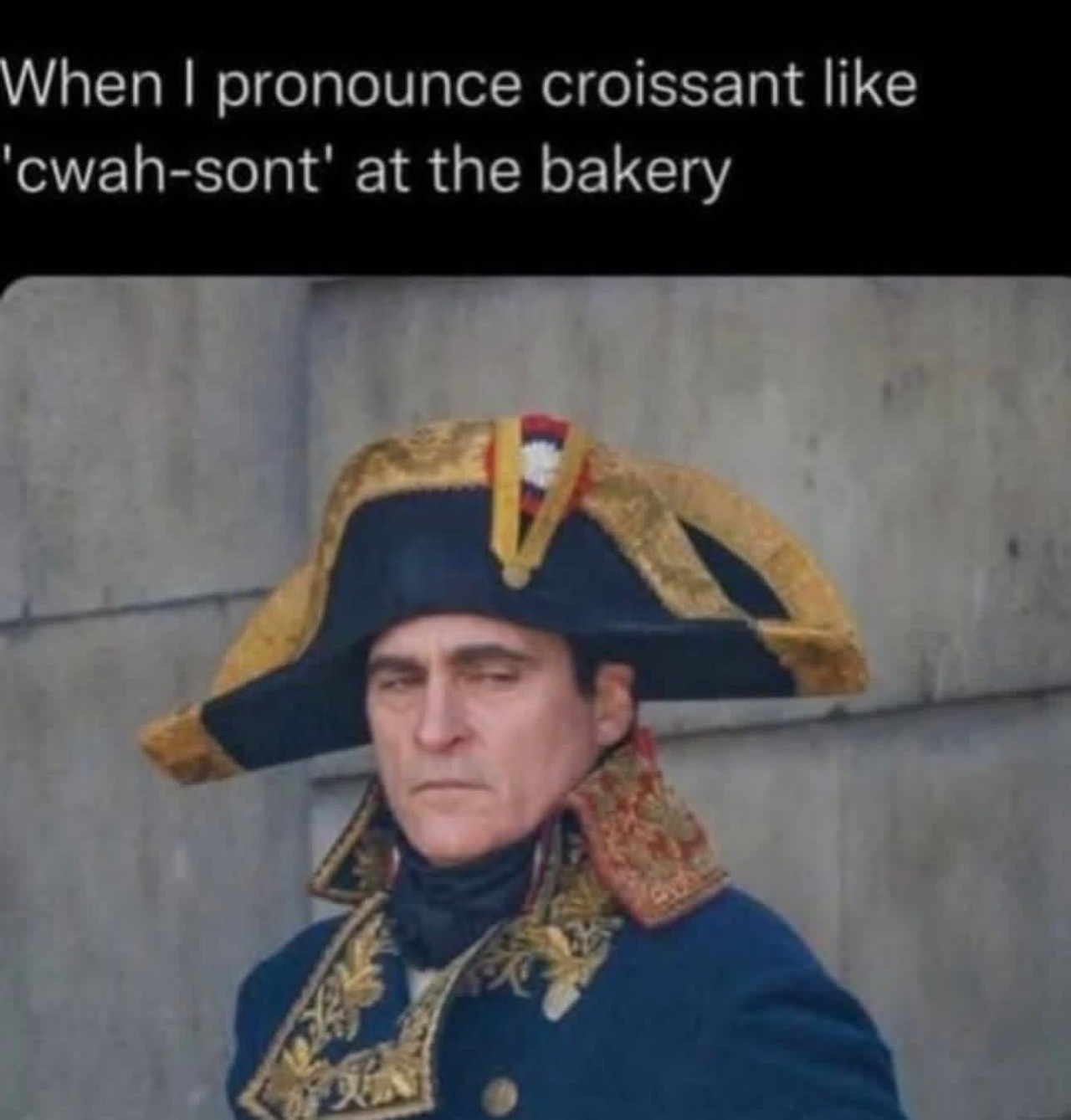
Fun Fact! Napoleon Bonaparte, the famous French general and Emperor, was actually infamously hard to understand by his native French colleagues, in part because French was not his native tongue! He spoke French with a thick Corsican accent!
Can someone please tell me how Americans, or whoever this meme is about, pronounce croissant? Because I only know the french pronunciation and can not imagine another one.
Generally, in the US, it's pronounced as cres-AHNT. It has a clear R sound, the T at the end involves moving your tongue toward the T position, but the word ends without a clear T sound (as opposed to the French pronunciation, where the R becomes a W and the word ends on the N sound, with the T completely omitted.)
Not that I would ever claim to know every French pastry, but I'm reasonably certain that there's nothing in all of France or in the French language named ‘cwah-sont’.
It's as close as some English speakers can get. Some people can't make foreign sounds. The 'sant' 'sont' ending is not right either, its more like a sohn ending with imperceptible nasal n. But again have you heard people to to speak a foreign language, it usually sounds terrible.
The British English I can't say I have hears a Brit say it. The first American one sounds right to me as does the Australian one for how we'd probably here it in Canada dltoo
I fail to see the connection to ‘cwah-sont’, apart from the first and last letter being the same, but if that was a sufficent criteria then one might as well write just anything, like 'convalescent'.
Well I guess I was just trying to show that the French barely pronounce the R. It's very soft at best and English speakers often hear it as more of a "kwa" or like "quoi" is pronounced (or like, maybe "cwah" if you like a hard C in your drink.)
The phonetic pronunciation in French is: [kʁwasɑ̃] (if that doesn't come through, look at Wikipedia
The ʁ (upside down R) is guttural or uvular, and in some pronunciation guides it can even be dropped.
Anyways, you seem upset at their butchering of the pronunciation guide they're giving to show how badly they butcher their imitation of how the French pronounce croissant (there's no hard T at the end, for example) and I think that makes this particularly funny.
It is actually fairly irritating to me when people do this. It's not a proper noun. It's honestly wild to completely change your accent for the pronunciation of a single word in your sentence.
If you had a trans-atlantic accent, you wouldn't suddenly roll your rs when pronouncing "burrito", or do an impression of the Japanese when saying "sashimi". If you did, it would probably sound disrespectful af.
So why does everyone do it with "croissant" and act like it's totally normal?
IDK what "trans-atlantic" means for you, nor what you mean by putting on an accent or impression, but I'm German and I made it a habit to try to pronounce foreign words closer to their native language. I do roll rs in burrito, for instance. It's not a big change. Croissant is a given since everyone here pronounces it fairly French anyway. I don't know how Sashimi is pronounced, but if I had regular encounters with the word, I'd probably learn.
"Trans-atlantic" is a forced/learned accent that used to be more popular ~100 years ago. It was basically meant to represent people that were born in the US, but educated in the UK (or vice versa). Essentially, it was supposed to signify that you were wealthy enough to have connections on both sides of the Atlantic.
People intentionally learned to speak that way, though, and it became common on radio broadcasts (so you could also hear it referred to as an "old-timey announcer voice" or something similar).
I think people have made the point with specific references like "coup d'etat" and "faux pas". I think the general answer is that language standards are fluid and common usage tends to become standard over time. The word "croissant" might be in a transition period depending on personal experience. I've always heard it in pronounced in the French or at least French-ish way, so to me "croy-sant" sounds kind of hillbilly. I grew up with Pillsbury Crescent Rolls.
Exactly! Rapidly changing accent for single words leads to poor understanding, which is the whole point of speech.
A loanword is not a word randomly spoken in another language, it's a word taken from one language into another, which often involves a change in pronunciation.
If you dont acknowledge that, you'd have to acknowledge that the entire French language is just poorly pronounced Latin, which is insane.
"Burrito" is a Spanish word for a little donkey, but it's also an English word for a food item, and they are not typically pronounced the same. Someone fluent in both languages will pronounce them differently depending on which language they are speaking.
Yeah, but I would argue that when I say "pass me a tortilla" I'm saying "tortilla" in English, which has mostly the same pronunciation as the Spanish (though I think the "t" is pronounced differently).
The fact that "coup d'etat" is pronounced mostly the same might just be happenstance.
50 Comments
PugJesus@piefed.social · 37 pts · 63d
Fun Fact! Napoleon Bonaparte, the famous French general and Emperor, was actually infamously hard to understand by his native French colleagues, in part because French was not his native tongue! He spoke French with a thick Corsican accent!
teft@piefed.social · 26 pts · 63d
The t is silent. The end sound is a nasal n so more like kwah--sahn with the final n being very nasal and soft.
I actually find the french r to be super difficult though. Way the hell back in the throat where letters aren't supposed to be formed.
NoneOfUrBusiness@fedia.io · 8 pts · 63d
I think you'd have a "fun" time with Arabic (CTRL+F "Pharyngeal" for the fun).
Zwiebel@feddit.org · 6 pts · 63d
It is pronounced croissant actually
UpperBroccoli@feddit.org · 4 pts · 62d
No no no no no.
It's croissant.
Zwiebel@feddit.org · 4 pts · 63d
Same in parts of germany. Though we also have tongue-r regions so you can choose
CultLeader4Hire@lemmy.world · 4 pts · 63d
It’s because your mouth isn’t soft enough. French requires you to release the tension in your mouth and tongue, it’s weird but it really works
evasive_chimpanzee@lemmy.world · 2 pts · 62d
It's especially hard because the harder you try, the more tense your mouth is, so you are less likely to do it.
wonderingwanderer@sopuli.xyz · 2 pts · 62d
There is absolutely no way to spell French phonetically, so we should all just give it up now
teft@piefed.social · 1 pts · 62d
And just when you think you understand how to spell in french they throw some other weird rule at you.
wonderingwanderer@sopuli.xyz · 2 pts · 62d
It's almost as bad as English in that regard...
Lumidaub@feddit.org · 12 pts · 63d
... tch. Imbecile.
CapuccinoCoretto@lemmy.world · 10 pts · 63d
Obligatory Foux du Fafa - Flight of the Conchords
Azzu@leminal.space · 9 pts · 63d
Can someone please tell me how Americans, or whoever this meme is about, pronounce croissant? Because I only know the french pronunciation and can not imagine another one.
Whats_your_reasoning@lemmy.world · 8 pts · 62d
Generally, in the US, it's pronounced as cres-AHNT. It has a clear R sound, the T at the end involves moving your tongue toward the T position, but the word ends without a clear T sound (as opposed to the French pronunciation, where the R becomes a W and the word ends on the N sound, with the T completely omitted.)
darklamer@feddit.org · 8 pts · 63d
WTF is 'cwah-sont'!?
BCsven@lemmy.ca · 6 pts · 63d
A French pastry
darklamer@feddit.org · 6 pts · 63d
Not that I would ever claim to know every French pastry, but I'm reasonably certain that there's nothing in all of France or in the French language named ‘cwah-sont’.
Skunk@jlai.lu · 5 pts · 63d
We just say croissant.
fakeman_pretendname@feddit.uk · 2 pts · 63d
"Can I have one of those Croy Sunts please?"
"What? I don't know what a Quasson is"
BCsven@lemmy.ca · 1 pts · 63d
Assuming no sarcasm, Its a spelling attempt at the French pronuncitation of croissant. https://www.youtube.com/watch?v=pnAoRcnY4xs
pmk@piefed.ca · 4 pts · 63d
But the french "r" is not like an english "w"?
BCsven@lemmy.ca · 2 pts · 62d
It's as close as some English speakers can get. Some people can't make foreign sounds. The 'sant' 'sont' ending is not right either, its more like a sohn ending with imperceptible nasal n. But again have you heard people to to speak a foreign language, it usually sounds terrible.
darklamer@feddit.org · 2 pts · 62d
That makes zero sense.
The examples of English pronounciations she gives there are truly bizarre.
BCsven@lemmy.ca · 0 pts · 62d
What country are you from and what language do you speak?
darklamer@feddit.org · 2 pts · 62d
Switzerland … English is not my first or second language. Do you not find those English pronunciations there in the video bizarre?
BCsven@lemmy.ca · 1 pts · 62d
The British English I can't say I have hears a Brit say it. The first American one sounds right to me as does the Australian one for how we'd probably here it in Canada dltoo
teft@piefed.social · 1 pts · 62d
American english is my first language and those all sounded spot on for all the regions she did. Even her french sounded great.
JohnnyCanuck@lemmy.ca · 2 pts · 63d
https://www.frenchlearner.com/pronunciation/croissant/
darklamer@feddit.org · 2 pts · 62d
I fail to see the connection to ‘cwah-sont’, apart from the first and last letter being the same, but if that was a sufficent criteria then one might as well write just anything, like 'convalescent'.
JohnnyCanuck@lemmy.ca · 4 pts · 62d
Well I guess I was just trying to show that the French barely pronounce the R. It's very soft at best and English speakers often hear it as more of a "kwa" or like "quoi" is pronounced (or like, maybe "cwah" if you like a hard C in your drink.)
The phonetic pronunciation in French is: [kʁwasɑ̃] (if that doesn't come through, look at Wikipedia
The ʁ (upside down R) is guttural or uvular, and in some pronunciation guides it can even be dropped.
Anyways, you seem upset at their butchering of the pronunciation guide they're giving to show how badly they butcher their imitation of how the French pronounce croissant (there's no hard T at the end, for example) and I think that makes this particularly funny.
darklamer@feddit.org · 2 pts · 62d
I'm just struggling to decipher what the joke in OP's picture actually means.
evasive_chimpanzee@lemmy.world · -1 pts · 62d
The link you posted literally says "kwa-son"
wieson@lemmy.world · 1 pts · 62d
There's a very clear and distinct R
darklamer@feddit.org · 1 pts · 62d
I haven't posted any links.
FryHyde@lemmy.zip · 6 pts · 62d
It is actually fairly irritating to me when people do this. It's not a proper noun. It's honestly wild to completely change your accent for the pronunciation of a single word in your sentence.
If you had a trans-atlantic accent, you wouldn't suddenly roll your rs when pronouncing "burrito", or do an impression of the Japanese when saying "sashimi". If you did, it would probably sound disrespectful af.
So why does everyone do it with "croissant" and act like it's totally normal?
marzhall@lemmy.world · 8 pts · 62d
How do you pronounce jalapeño?
LovableSidekick@lemmy.world · 3 pts · 62d
Duh... jappaleeno!
Swedneck@discuss.tchncs.de · 1 pts · 60d
i am hard man
luciferofastora@feddit.org · 7 pts · 62d
IDK what "trans-atlantic" means for you, nor what you mean by putting on an accent or impression, but I'm German and I made it a habit to try to pronounce foreign words closer to their native language. I do roll rs in burrito, for instance. It's not a big change. Croissant is a given since everyone here pronounces it fairly French anyway. I don't know how Sashimi is pronounced, but if I had regular encounters with the word, I'd probably learn.
evasive_chimpanzee@lemmy.world · 3 pts · 62d
"Trans-atlantic" is a forced/learned accent that used to be more popular ~100 years ago. It was basically meant to represent people that were born in the US, but educated in the UK (or vice versa). Essentially, it was supposed to signify that you were wealthy enough to have connections on both sides of the Atlantic.
People intentionally learned to speak that way, though, and it became common on radio broadcasts (so you could also hear it referred to as an "old-timey announcer voice" or something similar).
luciferofastora@feddit.org · 2 pts · 62d
Ooooh it's a specific accent, gotcha. Thanks!
teft@piefed.social · 4 pts · 62d
Probably because english has a bunch of french words we do this for because of our legacy with courtly french. Entree is another example.
LovableSidekick@lemmy.world · 4 pts · 62d
I think people have made the point with specific references like "coup d'etat" and "faux pas". I think the general answer is that language standards are fluid and common usage tends to become standard over time. The word "croissant" might be in a transition period depending on personal experience. I've always heard it in pronounced in the French or at least French-ish way, so to me "croy-sant" sounds kind of hillbilly. I grew up with Pillsbury Crescent Rolls.
evasive_chimpanzee@lemmy.world · -2 pts · 62d
Exactly! Rapidly changing accent for single words leads to poor understanding, which is the whole point of speech.
A loanword is not a word randomly spoken in another language, it's a word taken from one language into another, which often involves a change in pronunciation.
If you dont acknowledge that, you'd have to acknowledge that the entire French language is just poorly pronounced Latin, which is insane.
"Burrito" is a Spanish word for a little donkey, but it's also an English word for a food item, and they are not typically pronounced the same. Someone fluent in both languages will pronounce them differently depending on which language they are speaking.
zaph@sh.itjust.works · 6 pts · 62d
I doubt you pronounce tortilla "tour-till-uh" or Coup d'état "coop-dee-tat." Sometimes we change the pronunciation and sometimes we don't.
evasive_chimpanzee@lemmy.world · -1 pts · 62d
Yeah, but I would argue that when I say "pass me a tortilla" I'm saying "tortilla" in English, which has mostly the same pronunciation as the Spanish (though I think the "t" is pronounced differently).
The fact that "coup d'etat" is pronounced mostly the same might just be happenstance.
nightlily@leminal.space · 5 pts · 62d
Quaso
Aneorthisio@lemmy.ml · 4 pts · 63d
Kolanaki@pawb.social · 4 pts · 63d
Me: "I'll have a crescent, please."