this could be one of those bell curve memes where the low end and high end are the moron/jedi guys saying “just print more money” and the middle of curve has a freshman Econ student trying to explain macroeconomics.
Yeah, exactly what I was thinking. Like, it isn't quite as simple as "print $1m for everyone and they can all go out and buy Ferraris." But, there are plenty of situations where the government can just print the money and it won't cause inflation or any other harmful effects.
Printing more money and using it for public works or giving it directly to the poor could be a valid form of wealth redistribution that doesn't require collecting taxes. The problem of course is capital, it's immune to this kind of inflation, though rich people who have their wealth in debt would be hurt.
Was not expecting to see Street-Fighter's-Guile-as-a-magician quoted in this comment section... or at all really. He's come a long way since Scam School, I guess.
That is true, but Bitcoin, like all other crypto"currencies", is a Ponzi scheme. Its value is driven purely by speculation, and the hope that it can be passed on to a "greater fool" for profit. This is true for a lot of financial assets, by the way.
True, but somene has to, and they will create a demand for the currency. If I hear that Joe the baker needs money to pay taxes, and I want to buy bread from him, I know he will accept the government currency as payment for his bread. This in turn makes me demand money to be able to buy the bread.
Money is made up, but it's definitely real. Magic is made up and fake. If it actually exists and does something, it's real. You can bring something from non-existence and make it real. It has no intrinsic value.
A bit subjective depending on the circumstances though right? Say a man has a horse that you want. Well, today, there probably exists a monetary figure that the man would accept to sell you his horse, even if it's absurdly high. But let's say something cataclysmic happens and humanity is blown back to the dark ages. If there is no society available for the man to use the money, then it really doesn't matter how much you offer him because at that point money isn't real. You could offer to trade good or services, but not money. You might as well be offering leaves from the ground.
That's what the guy said. Money isn't "intrinsically" real - it doesn't have something in-and-of itself. It's extrinsically real - it represents something in the society we live in, a system of arbitrage and barterage that we use to represent an amount of work (Poorly, and with little benefit to a large number of people).
So no - if the extrinsic reality changes, then the barter or arbitrage currency will change - bottle caps, for instance, take over. But for a large society to function, a commonly accepted means of representing "value" has to be agreed upon. I can't just say, "Well, I've got the worth of x hours worth of time spent on projects to provide", instead I'll say "I've got x pounds to provide".
Originally, this was made more explicit, and it still exists on UK currency: "I promise to pay the bearer..." At that point, the notes had a (Bank-enfornced) intrinsic value. The words meant a promise to provide the currencies face-value in Gold. Now, we've done away with gold-backed currency, and the raw value is arbitrary, it has no intrinsic value but that set by extrinsic realities.
Ehhh, not sure I'd go that far. Money, no matter what backs it, is just what people value it as. Just that when backed by real goods, e.g. gold, that it gives people a better reason to value it because the goods are worth something.
Mostly saying, money backed by a good have at least the value of the good itself. Which I would say makes money not fake.
The value of those “real goods” is typically just as fake as the value of fiat currencies anyways. Trying to use things with actual usefulness as money has its own issues too.
To be fair i was being hyperbolic. Money has the power we give it. And we gave it too much.
We print money through increasing interest rates, increasing divide between rich and poor requiring the working class to take out loan after loan after loan.
Some may say interest is the cost of borrowing money, but it is money value that comes out of nothing, it's made out of thin air and reduces the value of our dollar.
But then said good only has as much value as we put on it. There's a tacit acceptance of what a group of people decided that good is worth. Its value is as real as we collectively decide it is; it's a construct
Fiat currencies are actually backed by the tax liabilities denominated in them. If you are liable for one of my business cards, else a guy with a gun shows up at your door, you suddenly have demand for my business cards.
Modern money is backed by the economic power of the state issuing it, so its workers, infrastructure, education, soft and hard power. Those are definitely real things with real value.
And I suspect you might even suggest the only real aspect of economics boils down to supply vs demand regardless of what the thing in supply or demand is?
Definitely not. The rules behind supply and demand hinge on some extremely flimsy assumptions, namely:
that people always act in their own best interest (they fucking don't)
that people can actually choose not to buy the product
For things like food, housing, medicine, etc. People don't get the luxury of voting with their wallets, and this is why the free market cannot allocate resources effectively.
Just because I went to school for economics does not mean I am a free market capitalist. I'm definitely not.
that people always act in their own best interest (they fucking don't)
Totally agree
that people can actually choose not to buy the product
This is actually pretty well deacrived by what's called the price elasticity of demand in standard neoclassical models. For things like housing one might say that the demand is very inellastic: A change in price does not affect the quatity demanded.
Yes exactly. This is why I find it funny when they use two different, yet contradictory reasons to justify the sin tax:
it prevents people from using it because they'll choose not to use it (the thing they're addicted to) if it gets too expensive; and,
the demand is very inelastic which means the government will make more revenue
When really they're primarily taxing the things poor people are addicted to.
Idk, I'm generalizing, I'm just kind of pointing out how a lot of the supports capitalism rests on are weird little opaque excuses to convince the masses that exploitation is what's best for us
So many economists are stuck in a box of what our society has been, they can't think past our current rules and regulations to what could be, because they think that the rules and trends they learn in school are the only possibility, or that profit must be king.
Things that are always in demand don't drive a price solely based on supply, and since people don't act in their own best interest the actual demand of something can't be a useful way to determine the value of a thing.
So that sort of says to me that with a truly free market economy, it would be just as impossible to model future prices because of the inherent unpredictability of humans.
All government spending is done by "printing money", at least in monetary sovereign countries like the US, UK, and other countries issuing their own cureencies. The government is the monopoly issuer of the currency and cannot run out of it, just like the scorekeeper of a baseball match cannot run out of points. Taxes are also not for funding the government, but for removing momey from circulation, precisely to curb inflation. (Also to drive the value of the currency by making people demand it to be able to pay their taxes).
Thus "printing money" isn't in itself inflationary, as long as the newly created money is spent on something where there is excess production capacity.
The question for the government is never "can we afford it", but rather "are the real resources there to achieve it".
Thus “printing money” isn’t in itself inflationary
Your conclusion doesn't follow from what you said.
Inflation is merely the change in subjective value of a currency over time. Inflation goes up when people want more money for the same stuff.
If the government creates money to fund something, that pulls resources (employees, production, etc) from other parts of the economy, increasing the costs of the remaining resources since there's less available. That's inflation.
The Covid stimulus packages are a fantastic example of this, because it directly resulted in more money chasing fewer goods (less production). There would've been inflation anyway since net production decreased, but the stimulus package exacerbated it. A significant amount of the inflation we saw recently was a mix of COVID supply chain disruption and Trump and Biden's stimulus bills.
Excess production is deflationary, but that doesn't mean printing money to cover isn't inflationary, it just means you can counter deflation from one source with inflation from another.
The question for the government is never “can we afford it”, but rather “are the real resources there to achieve it”.
Sure. But at that point we're not talking about inflation anymore. If the government really wants something, it can get it, but that will have consequences. The question is whether it's a net benefit, and how to fund it:
a hidden tax through printing money (inflation)
direct tax - income tax, capitation tax, etc
indirect tax - sales tax, tariffs, etc
Each option has consequences, and generally speaking, you get less of whatever you tax, if the tax is high enough.
Please, multiple studies were done about the causes of the recent wave of inflation and they determined that the vast majority of it was a result of greedy corporations taking the opportunity to boost their profits.
Modern Monetary Theory is complete BS, look at Argentine, Venezuela, and Turkey to see why monetary policy shouldn't be political
There's little more consistent in this world than corporate greed, and corporations didn't suddenly decide to be more greedy in 2020 and 2021.
For 1, talk to any respected economist and they'll tell you MMT is a popular minority view but far from mainstream and very much riddled with criticism.
Ball and colleagues conclude that the rise in the ratio of job vacancies to unemployment contributed almost a third of the rise in core inflation of 2.0 percentage points over a 12-month period. The 2.0-percentage-point increase in inflation explains about half the rise in core inflation, climbing from 2.3 to 6.9 percent (total increase of 4.6 percentage points). And finally, they found that the main contributors to the headline inflation shocks were energy prices (2.7 percentage points) and a backlog of work (1.7 percentage points).
Backlog of work is a nice way to say people weren't producing, but were still spending. And energy prices spiked because of the recovery (energy consumption dropped during COVID and recovered when restrictions were lifted}.
In my analysis, inflation mostly came from the government’s $5 trillion in COVID and post-COVID deficits. The government essentially sent people $5 trillion with no plans to pay the money back. People tried to spend it, driving up prices. The Fed eventually raising interest rates made inflation come down a bit faster than it would have otherwise, but it was going to go away on its own anyway. There is no magic momentum to inflation. Stop pushing, and it stops.
For example, the Federal Reserve was far too late identifying inflation in its early days, choosing to frame it as transitory. As a result, the Fed kept interest rates too low for too long. Congress was guilty of massive spending increases, which caused demand to surge. In short, an artificially induced demand and a drastic shortfall in supply were the culprits in creating inflation.
Those aren't cherry picked either, they're the top sources when I search for causes of inflation, and is a mix of government, academic, and "mainstream" financial analysis.
From what I've read, here's what seems like the most credible explanation:
COVID happens and governments issue stay at home orders, cutting production and energy use, resulting in supply chain disruption (esp in the car industry, demand for cars dropped off a cliff during COVID)
Reduced energy demand reduces fossil fuel prices, so production reduces
Stay at home orders spark consumer demand for things to do at home (electronics, home renovation, etc), and stimulus money fuels this demand
Supply can't keep up with 3 because of 1, so prices surge (direct consumer impact, but mostly localized)
Return to work spikes demand for energy, causing energy prices to spike (major component of inflation) as production ramps back up
Corporations didn't increase prices because they all of a sudden decided to screw the consumer, they increased prices because demand went up (people had more to spend) and supply was limited. If corporations are jacking up prices, it's not because they decided to be greedy (they're always greedy), it's because something changed that allowed them to change prices.
Look, I don't doubt that some of what you outlined had a role in inflation. But unlike you, I think that absolving corporations of blame here is the real copout.
Your last paragraph makes it sound like the poor, innocent corporations didn't have a choice and were forced to crank their profits up when they saw a $$$ opportunity, because what else were they to do in the middle of a pandemic ravaging the country? Poor angels!
I'm not making a value judgment here, I'm merely talking about how economics works.
The whole purpose of a corporation is to generate profit, and to do that it needs to convince customers to buy from them. If there's sufficient competition, corporations may appear to be acting "good," but that's only because the profitable option benefits customers.
Yes, profit and inflation are linked, but it's important to understand both what allowed increased profits (in this case supply disruption) and the consequences. From your article:
A spike in profit margins contributed significantly to inflation in the early part of the pandemic recovery, and likely contributed to even more persistent inflationary pressure by helping spur a countervailing rise in nominal wage growth.
It's not just profits, but real wage growth. If you'll remember, there was a labor shortage during and just after the pandemic, which led to workers demanding increased pay. Fast food jobs, for example, typically paid $8-9/hr in my area, with "better" chains (the ones for whom better customer service was their competitive advantage) offering $12/hr. During and just after the pandemic, $12 was the normal fast food wage, and the "better" chains jumped to $15+. My state still uses the federal minimum wage ($7.25/hr), so it's not legislative action, but shifts in wage expectations that resulted in wages going up, which justifies the higher prices for fast food (fast food is incredibly price competitive).
Continuing on with your source:
instead of suppressing wages, they raised prices. If this episode increases public support for measures that constrain excess corporate power, that would be good even if it has little relevance for inflation in the future.
Both prices and wages are sticky, especially in less competitive industries. But prices do come down relative to inflation over time, provided the market is competitive enough. Look at car prices, they were sticky until well after supply returned to normal because demand for cars remained high, but now car prices are largely back to normal, relative to inflation, because it turns out higher volume is usually better than higher margins.
The same pattern will happen to eggs, but even faster because the cycle time to bring getting a new batch of egg laying hens is comparatively short (5-6 months from hatching to producing eggs), and the customer purchase cycle is rapid.
To understand what's going on, we need to understand why corporations could get away with increasing prices:
Supply was constrained due to global supply chain factors; if your competitors all sell out, people will come to you and your higher prices (also why scalping works)
People had extra cash (stimulus, less activities outside)
Production costs increased due to shortages (lots of great excuses)
Yes, they cranked up profits when they saw an opportunity. I don't see that as "bad," I see it as expected. Corporations exist to generate profits, so if life gives you lemons (supply chain disruption), you make lemonade (increase margins on the supply you have).
What I do see as "bad" is corporations getting away with violating the law with essentially a slap on the wrist. There are two main ways to fix bad corporate behavior:
stiff competition
lawsuits
And when the first fails, the second just isn't sufficient to actually change behavior, since fines are merely a cost of doing business. Raising prices itself isn't illegal, colluding with competitors absolutely is, and the penalties need to more than account for the profit from colluding.
Corporations can get away with unreasonably and unjustifiably raising prices because government power to control them decreases year by year, and is just about to be completely extinguished in the US by the current administration. Same thing with corporations violating the law - it's just a little further behind. This has been a continuous process of the people with money and power dismantling all the systems that can keep them in check over the last several decades.
Corporations can raise prices however they want because there's no law against it. There may be for declared emergencies (e.g. hurricane or something), but other than that, prices are kept in check by market forces. If supply dips, prices go up to keep some inventory on the shelves, and if supply exceeds demand, prices will drop to move inventory. That's how it works, regardless of who controls the White House.
and is just about to be completely extinguished in the US by the current administration
That's alarmist BS. The President cannot change the law without a bill passed by Congress, so the next President can reverse whatever EOs make it past judicial review. The GOP has a narrow majority in Congress, so that's going to put a damper on what Trump can do long term.
Yes, Trump can cause a lot of damage, and that's likely to happen, but that damage can be reversed. The critical bit here is Congress, and we'll have midterms to determine whether people like the direction the GOP is taking or they want something different. I think a likely outcome is that inflation goes up (if Trump makes good on tariff threats), the Fed tightens monetary policy, and Trump is forced to either lighten up or lose the midterms. It's also likely that Trump is bluffing and just looking for some meaningless concessions so he can claim a win. We'll see. But I highly doubt we'll see systemic change in any meaningful way.
[...] pulls resources (employees, production, etc) from other parts of the economy, increasing the costs of the remaining resources since there's less available.
That is why I specified that there needed to be excess productive capacity for whatever they are buying. As long as the economy is not at full employment, the government isn't bidding up the prices with its spending.
At full employment though, you are absolutely right.
That doesn't really exist in most developed countries. The US, for example, has about a 4% unemployment rate, which is pretty healthy. There will always be some people out of work for various reasons, so a relatively small amount of unemployment is pretty healthy.
If you have excess productive capacity, you probably have some systemic issues in your economy, and more government spending probably isn't the right solution (e.g. FDR's jobs programs didn't fix the Great Depression).
It's going to be a tradeoff, and spending more is rarely "free." That money comes from somewhere, either directly from your pocket from a tax, or indirectly from your pocket from inflation.
There actually isn't such a thing as a "natural rate of unemployment", so all of those 4% are part of the excess productive capacity.
There will always be some people out of work for various reasons
If those people are unemployed simply because their previous contract expired a bit before their new one started (frictional unemployment), then I agree it is totally unproblematic. If it is because there aren't enough jobs going around (structural unemployment), it isn't.
That money comes from somewhere
All money in monetarily sovereign countries come from government spending: It is spent into existence by the central bank marking up the reserve accounts of the banks of the people and businesses it pays to. The money in circulation and saving is simply the difference between total government spending and revenue. It is important to realize the order of operations here: The governments has to spend before it can tax, or else there wouldn't be any money to tax.
There actually isn’t such a thing as a “natural rate of unemployment”
I never claimed there was, I only claimed that 4% is right around ideal.
It seems somewhere between 3-6% is a good range. If you drop too low, you get inflation due to wage inflation (workers demand more pay) outpacing regular inflation (more money chasing the same number of goods -> inflation). If you go too high, you get do deflation due to reduced demand.
That's why monetary policy tends to town tighten with lower unemployment (cool off the labor market), and it tends to loosen with higher unemployment (encourage investment and therefore job creation).
That said, this is a simplistic view of monetary policy, and employment is merely one of many factors central banks look at.
The governments has to spend before it can tax, or else there wouldn’t be any money to tax.
That's only true if you lump monetary policy with "government spending." In the US, the Federal Reserve is largely separate from the rest of government, so it makes little sense to combine them in your simplistic explanation.
The ideal scenario is that government spending matches receipts, meaning there's a plan to pay for all spending. If there's a deficit, monetary policy needs to step in to issue debt to fund the gap, and that's inflationary. If there's a surplus, monetary policy needs to step in to buy back debt, which is deflationary.
They're absolutely related, but the perspective you seem to be talking from tends to justify deficit spending: "we can always just expand the money supply." That works until it doesn't, such as with Venezuela, Argentina, and Turkey. That's a large part of why the Federal Reserve is independent, and why giving the legislative wing (or worse, executive wing) of government direct control over monetary policy is so dangerous.
Totally agree. The intial tax liability declared in a currency has the purpose of creating demand for the currency so that people, either directly or indirectly, want to work for the government to get the money they are issuing.
This effect is probably most import when the currency is first created, but at the same time also the most important function of tax: It is what goves the money its value.
Yeah, this is the common MMT definition of money, I think.
Another way to think of it is that all money is IOUs. This one's a bit hard to wrap your head around, but it works.
Start with government spending. A mail carrier walks through sleet and hail to deliver mail, a service they're doing on behalf of the government. The government says "thanks for all that work, I owe you" and gives them a pile of IOUs in the form of dollars. Whenever the government receives a good or a service from a person or a company, it gives them an IOU in exchange.
Going back to the mail carrier, their work day is done, so they stop off at a supermarket. They grab some milk and some sausages and go to the cash. Now, maybe it would be possible for the mail carrier to do some kind of work in exchange for the groceries. Maybe advise them on how to ship things efficiently, or maybe just help stock shelves. But, it's much easier just to hand over some IOUs. So, they hand over some of the IOUs (dollars) they got from the government. Now, the government owes the supermarket, rather than the mail carrier.
So, the store keeps doing business. It collects a bunch of IOUs from various customers, and issues a bunch of IOUs to its suppliers. When tax time rolls around, the store has a whole bunch of IOUs (originally from the government, but given in by various customers). Since the store owes the government for things like providing police to keep things secure, the FDA for keeping the food safe, and so-on, it effectively "cancels" that debt by almost ripping up the IOUs. Well, really, it hands the IOUs back to the government and allows the government to rip them up.
So, you can see the whole economy as the government issuing IOUs as spending. Those IOUs enter the economy and flow around, and people want to hang onto them because they know that in April the governments going to come around to settle things. Tax time is basically a point where people who didn't do any work directly for the government can say "Yeah, I didn't do any work for you, but I did give that mail carrier some milk and sausages, and he handed over your IOUs, so I'm giving those to you now". And the government says "Yep, fair enough". It collects the IOUs and rips them up, and the whole thing starts over.
In the past, this actually used to be a lot more explicit. When you could exchange your US dollars for gold, the idea that it was an IOU for the gold was a bit more explicit. These days we don't need the gold. It's an IOU not for gold, but for work done.
It took me a while to get the idea that money could be debt / IOUs. But, when I thought of government employees doing things for the government and getting given IOUs it clicked.
That all makes it much easier to understand the flow of IOUs through the economy, and much easier to understand how taxing destroys money. It's the government ripping up IOUs that it itself issued to its own workers (or suppliers or contractors or whatever).
But then we’ll go on and say stuff like “taxpayer money”, “how are we gonna pay for that”, or “our grandkids are gonna have to pay back the national debt”.
The pursuit of a “balanced budget” is one of the most successful bits of propaganda ever.
I think the problem isn’t that there is a lack of money which could be solved by printing more, but that there is a lack of money because like 6 guys have stolen most of it and piled it up under their mattresses with no intention of actually using it at any point.
Prices should be set by the king tho, the only acceptable rate of inflation is zero.
It's not particularly difficult to fix the economy.
Make a law. This law will require the head of the IRS go to the richest person in the country, and give them the option of writing a check large enough that they are knocked out of the top 1%, or playing a round of Russian Roulette.
Repeat every month, and the problems of wealth disparity will be solved in about a year.
It is much harder to "hide" wealth in the form of the highly regulated financial assets that are creating the wealth disparity problems. It is much easier to "hide" wealth in largely unregulated tangible assets, like yachts, private jets, and other things that workers produce. When they buy that jet, they pay the salary of an airplane builder. When they buy that yacht, they pay the salary of a shipbuilder.
The problem isn't solved by taking away their riches. The problem is solved when those riches are spent. If they don't want to do the spending, the government is perfectly capable of spending it for them.
Usually those rich guys don't have that money sitting around - it is invested somewhere. It also often only exists as shares - that are some kind of imaginary money that doesn't really exists.
They can't spent that money without destroying what gives its value.
You are describing "securities". Financial assets. Those financial assets (when held by the ultra-rich) are the problem. Those financial assets are transferring real wealth from the general economy to the people holding them.
I addressed financial assets.
Now, the nice thing about shares is that they don't have to be held by any particular person. The value of those shares doesn't change when they are transferred to someone else.
We could, if we wanted to, establish a tax on registered securities. We could have the SEC automatically transfer 2% of the shares in Elon's portfolio from his ownership directly to the IRS. We could do that every year if we wanted to.
IRS liquidators could then sell off those shares, slowly over time, so that their sold shares are never more than 1% of the total traded volume.
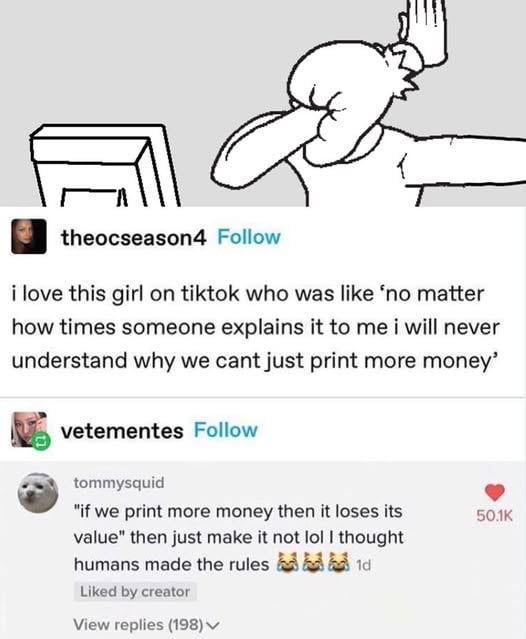
The funny irony is that because money is mostly made up bullshit anyway, we kinda could just decide to print more money and keep its value. Granted, it would take the unanimous agreement of basically everyone on this silly little planet, so the chances of this ever occurring are effectively absolute zero, but still, there is no actual rule that says we cant except for the ones we ourselves created
It would do nothing to wealth inequality. The assets the current billionaires own would just become valued at a trillion dollars, or even a quadrillion depending on how badly devalued the dollar became.
The problem here is that a government does not in fact have the ability to decide how much their currency is valued, they can only indirectly influence it. When they try to pretend like it's just a "rule" they can set like "here is the mandated exchange rate, we'll put you in jail if you make trades at any other price" is when things get real stupid.
India made a run at wealth hoarding by issuing a new currency. They declared it was worth something like 5 old currency and you had to personally turn in old money to get new money. You couldn't just digital it.
I have no clue how well that did or didn't work but they haven't imploded yet. So there's a lot more play in this money thing than the finance industry would like us to believe.
Do you mean the 2016 demonetisation? It was allegedly aimed at reducing counterfeit notes, and involved removing the largest value notes in circulation and replacing them with new notes at a 1:1 exchange. It failed to stop counterfeiting, and resulted in at least 80 deaths, 15 lakh job losses and a measurable fall in GDP growth.
Prices of goods on a market are set by Supply:Demand Equilibrium
If a business knows they can charge more for a good or service and still sell enough to get more profit than selling them all quickly and cheaply, then they have to calculate what to sell at to optimize profits.
You can chart out the supply and the demand as a function of price with inverse correlation at varying strengths, *implying that supply will change to meet market demand so long as enough capable workforce exists to accomplish it.
Now apply this concept to Money.
If Money is plentiful and people are more willing to spend money on goods and services, then the providers of those goods and services will raise the prices to maximize the gains. In this example the regulatory bodies might use Bonds to reclaim and retire money and/or use a variety of techniques targeting loan interest rates in various ways to limit the *creation of money.
If Money is Scarce, then the prices will lower until they reach a threshold at which A) it cannot be produced for cheaper or B) somebody somewhere needs it and therefor will pay the price no matter how comparatively steep. Since these two scenarios are generally quite bad in the context of unnecessary human suffering, unprofitable goods and service industries generally receive subsidies so that regulatory bodies can keep a steady calculated amount of necessary supplies available to citizens far into the future, examples give: food, medicine, hygiene, or housing.
This also has an effect on exchange rates for trade partners. You can set a price on money. If your money is more valuable than another country's money as a result of their willingness to purchase that money as an investment, then it makes sense to trade and buy up their cheap goods. The USA's financial system is built around this concept of lending to struggling economies and providing data-heavy telecommunications services, built on the back of their decades of leading the pack for telecommunications technology and their leadership roles in many trade organizations including World Bank headquartered in Washington DC. Basically, the value of USD is dependent on investors in the EU and China owning US Treasury Bonds.
So it becomes obvious to most of us that creation of money can oftentimes be beneficial, but it also devalues savings and bonds, so it's often thought a delicate balance is needed to maintain value.
*implying - it's not always true that supply reflects demand in the same way that demand relies on supply, many modern economic theories revolve around the idea that Supply has much more power and therefor regulatory actions which focus on supply are more effective fiscal policies.
*creation of money - Loans create money. If you lend 100 dollars at 5% interest then you get back 105 dollars. While the debt is yet to be repaid, that 5 dollars exists. Debts can be traded as well. At first it doesn't seem like it would add up to much, but in fact Bonds act as Debts and also large Loans are very very very common for the USA, and this all sort of stacks year after year until it's reached the current point where the majority of USD is non-M1 M2 which is to say money that doesn't physically exist: digital money and promissory notes.
Theres a lot more but I can't be asked to teach economics.
Might be easier to just show the really slow ones a clip of the black and white footage of Germans setting wheelbarrows of their own worthless money on fire after the war.
The US has such a huge pool of people using the dollar that when they do seigniorage they're essentially taxing the world instead of only their citizens. It's kind of obscene and why the imperialists are very hostile to BRICs.
Interesting story but it's also talking about how inflation was at 80% in Brazil in the 1980s, because they were printing money. What they did in 1993 with the URVs is a fascinating psychological experiment, but I'm not sure if it was the critical factor in stopping inflation. As per the article
It wasn't the only trick, obviously. While they put URVs in place, the group of economists made the government balance its budget and slow down on money creation.
So I feel like it was basic economic policy that mostly worked, rather than printing money and trying to dictate its value.
Have you peeps never heard of modern monetary theory (mmt)? Macroeconomics is not so simple! Most people talking about have the knowledge of a minor in business econ though
So let me ask you this. If the U.S. "printed" 20T dollars (really just say it exists in an account). Then they start investing that in the market... The value of the money in theory would decay by 14% (rough math) but the market would thrive from the increase in buying.
That said. It would "hurt" the lower classes purchasing power at first. But the interest made off that 20T is enough to build every person in the U.S. a new house every 30 years assuming the average household is 2.5 people. At first you would be building new ones and repurposing old ones. But after 15 years or so, you would have the country all sans rent/mortgage payments, which frees up their money to be spent on things like resteraunts, movies, plays, sports, whatever it is people do. So the economy would be growing, while homelessness would be gone foreve and everyone would have a $250,000 equivalent house built/renovated every 30 years. Which because of the mass building projects and it all being purchased from one group.. would likely be like getting a $400,000 in todays market. This doesn't mean people can't save and invest money to have a larger dwelling and size up, just that everyone would have the base $400,000 equivalent house in a restabilized economy where everyone is less stressed and free-er to spend money at ease not worrying about becoming homeless if something goes wrong.
Does this mean some people will choose to work less, maybe. But with automation growing the way it is, we really have less work and more people already. It would also give us the opportunity to build some new cities/towns built around more walking and less car dependency, which would promote public health and people not being as reclusive if they don't want.
Idk, it would never happen, but I'm just saying it could probably happen and we choose not to because people think helping everyone is bad.
Edit: the number of stress based mental issues alleviated by this would be huge. Less reasons to murder and rob people as well, so crime would likely drop
I think there are flaws and oversimplifications in that statement even before taking into account the planetary boundaries and international development dynamics...
Basically the state can invest without causing inflation by printing money as long as it leads to activating productivity and not to competing with other consumers for goods and services which are at their limits already.
Btw I am not a macro economist by trade the mmt just makes the most sense in comparison to other (neoliberal or classic) models
I do sometimes wonder if you could technically still run a working government off printing money, just recognizing that doing so didnt create more value, but instead acted as a form of taxation. Imagine a government that currently holds no significant fraction of its currency. It then prints an amount equal to what is currently in circulation, doubling the money supply and in doing so presumably halving the value of a given unit of that currency. Once it has done so, no new value is created, but that government has gone from having no significant fraction of the money in circulation, to having half of it, which it can now spend.
Suppose you did this predictably, you let everyone know that you will be increasing the money supply by x percent every year, and will be re-denominating it to avoid difficult to work with numbers at set intervals. Wouldnt you technically have a functioning system for extracting value from the economy to pay for government functions?
It might not be a very good system, since all it would effectively tax is people's savings of currency and not stuff like property, and you would have to set up things like employment contracts or debts to compensate for constant high inflation rates, but Im not sure I see a reason why it technically couldn't be done.
On a technical level, it would (probably) work. But I think it would feel terrible for the most people : the middle class would see it's savings melt away unless they lock a lot of it in investments, and people would have to reevaluate their value scale much more regularly than now. And the capital would likely not be "taxed" that in much in this setup.
You kinda just explained modern monetary theory. The US, UK, Canada, and a few other countries don't get money from taxes, they owe debt to themselves and earn it back through the next printing. There is a budgetary limit though, which is the amount of labor and resources available to the government
just declare the leaf to be the official currency ... from one of the books in "The hitchhikers guide to the Galaxy" ... which is, you should know, the only trilogy in five books.
That’s precisely why the DOGE takeover of the payment system is so scary. Government money isn’t being transferred from some limited pool of taxpayer funds, it’s spent into existence out of thin air.
We also borrow, in the form of bonds, but that’s mostly to tame inflation by taking currency temporarily out of circulation with the promise of a later profit for the bond holder. (And also to encourage long-term investment in domestic currency.)
Given we have multiple examples of printing money leading to inflation and eventually hyperinflation, and we have 0 examples of printing money not leading to that, it's reasonable to conclude there is a causative link.
We see inflation all the time. Every country that ramped up the printing during covid also saw increased inflation. Most countries stop printing before hyperinflation, we can even see in real time with Argentina that stopping the printing slows the inflation.
My original post literally mentioned both, it's not moving the goal posts at all. Printing money leads to inflation, printing even more leads to the end state of hyperinflation.
MMT is the counter example to that, and it's how all sovereign currency issues work right now.
In the US, taxes do not fund the government. They haven't since at least the death of the gold standard. They act as a way to remove currency from circulation. The US just prints money and allows individual banks to print nearly unlimited money. It taxes in order to remove money from circulation and keep inflation at the target, but even then inflation isn't necessarily connected to the amount of money available, just the perception of money available.
There's plenty of ways to use MMT in other ways though, to print more money. If we create a function to invalidate 'dead' or noncirculated money, then we can print triple thr amount of money we do without raising the rate of inflation... But that would hurt rich people.
MMT is popular among politicians because it makes money seem free, but reality gets in the way when countries increase their printing and inflation goes up.
It certainly did, inflation started right before the lockdowns started in response to the market shock from the rumors, and hasn't stopped or massively slowed. It was not higher during the various stimulus packages or giveaways.
Both Weimar and Zimbabwe, and all other examples of hyperinflationary economies (many Latin American countries come to mind), had large debts denominated in foreign currencies, or had fixed exchange rates with such. This makes the government depenent on aquireing these forein currencies which they themselves cannot issue. Printing your own currency to pay these debts is definately inflationary, but doing so to pay for goods priced in your own domestic currency, when there is excess productive capacity, is not.
I started turning my American Dollars into Euros. Here's hoping that mitigates the economic damage that will come from Elon's stupidity.
Honestly, I don't like messing around with money since I don't really understand it...but if I don't, I fear that I won't be able to get onto a lifeboat. It also makes me feel silly being proactive. Here's hoping my Blue State would either vindicate or placate my fears.
Imagine there's a new issue of a famous comic book being printed (the series doesn't matter; take your pick). But the caveat is that there's only going to be ONE copy printed. Only one in existence. That single issue could potentially be worth millions, because it's so desirable for comic book nerds and they all want to get their hands on it. Only the wealthiest of collectors will be able to throw enough money at it to win an auction, which raises its value significantly.
Now imagine the publisher decides to make 100 copies instead. The value of that issue is now much cheaper; maybe worth several thousand dollars per comic, because there are a handful of them floating around now. Still, only wealthy collectors will be able to afford bidding on a copy, but at least the top 100 bids will win a copy. Raising the value, but not as much as if they are all bidding on a single product.
Now imagine 100,000 copies are made. Now it's mostly a standard printing, and it's only worth the cover price for a comic nowadays (what, like $3.99 or so?)
The more copies that are out there, the easier it is to find and acquire, and thus the cheaper its value is. Same goes for money; the more printed bills that are out there, the less value each bill has, and you'll need more of them to afford basic products. Which is why inflation is a thing, because we're constantly printing more money each year.
In reference to my point about comic book values, there are only about 100 copies left in existence of the first Superman comic (Action Comic #1). A single copy sold last year for $6 million, and its condition was only rated 8.5/10, which means it's a little rough around the edges from wear and tear. Not even a pristine comic book, and it still cost millions to buy!
That same issue sold for 10 cents when it was first made in 1938, but the fact that comics were made to be read and then discarded back then means most people never held on to their comic books and their numbers have dwindled over the years. Now Superman is a huge deal - one of the best-selling comics of all time - and his first appearance in a comic book is so rare, people will spend millions just to have an original copy.
Then, imagine if the comic printing company had a guy with a gun going around demanding everyone give him an amount of comic books each year. Now suddenly everyone is looking to get the comic books, driving their values up.
This is how taxes are driving the value of modern money.
are we still in the "the state should just go further into debt to pay for infrastructure" or already in the "fuck, that was a big mistake, what do we do with all that debt now?" stage? i can't tell anymore.
The government "debt" is not a problem whatsoever. It cannot be a problem. The so called debt is simply the difference between the amount of money created and the amount taxed. If there was no "debt" there couldn't be any saving in an economy. If the government wanted to, it could simply "print" the money to pay off all its debt tomorrow. It souldn't necessarily be a smart thing to do, but there wouldn't be any financial constraints stopping them from doing it.
However, i'm worried that it does not actually work that way. It is short-sighted and ignores second-round consequences.
For example, first of all, where do all these savings go to? They go to the rich, making the poor poorer. As such, if the government goes into debt instead of taxing the rich, it actually contributed through its inaction to make the poor poorer. The government should tax the rich instead of printing more money.
Secondly, if the government does print more money to rid itself of its debt (as you have rightfully suggested), that leads to hyperinflation, which mostly tolls the poor, because they have more difficulty stabilizing in a shaking environment that the big companies.
Thirdly, probably the government can print lots of money once to rid itself of the debt, but it can only do so once. Because once it has done so, people will assume "money has no value anyway, if it can just lose all its meaning overnight", and stop considering that money as valuable in the first place. Therefore, that is the end of paper money. What do you do then?
152 Comments
will_a113@lemmy.ml · 89 pts · 1y
this could be one of those bell curve memes where the low end and high end are the moron/jedi guys saying “just print more money” and the middle of curve has a freshman Econ student trying to explain macroeconomics.
xorollo@leminal.space · 18 pts · 1y
will_a113@lemmy.ml · 9 pts · 1y
The world is run by middle-of-the-curve people.
Semi_Hemi_Demigod@lemmy.world · 5 pts · 1y
As someone two standard deviations above the mean height, the tyranny of the average is real
Gradually_Adjusting@lemmy.world · 6 pts · 1y
Yeah but I hella refuse to see Yellen as a Jedi.
will_a113@lemmy.ml · 4 pts · 1y
😂
explodicle@sh.itjust.works · 3 pts · 1y
She's like a prequel Jedi councilor
grrgyle@slrpnk.net · 4 pts · 1y
Yeah it's not as simple as just printing more money and not changing anything else, but she's right
xapr@lemmy.sdf.org · 8 pts · 1y
Very good observation. On the high end of that bell curve, there's Modern Monetary Theory (MMT): https://en.wikipedia.org/wiki/Modern_monetary_theory
merc@sh.itjust.works · 6 pts · 1y
Yeah, exactly what I was thinking. Like, it isn't quite as simple as "print $1m for everyone and they can all go out and buy Ferraris." But, there are plenty of situations where the government can just print the money and it won't cause inflation or any other harmful effects.
Semi_Hemi_Demigod@lemmy.world · 4 pts · 1y
There's a line from (I think) a Tyler Perry movie that goes "The only thing reparations will do is make Cadillac the best selling car in the country."
Floey@lemm.ee · 78 pts · 1y
Printing more money and using it for public works or giving it directly to the poor could be a valid form of wealth redistribution that doesn't require collecting taxes. The problem of course is capital, it's immune to this kind of inflation, though rich people who have their wealth in debt would be hurt.
hemko@lemmy.dbzer0.com · 13 pts · 1y
Aren't the big loans interest rates tied to inflation though?
Banana@sh.itjust.works · 18 pts · 1y
Directly. Yes.
explodicle@sh.itjust.works · 3 pts · 1y
They are, but the rate you're offered in the first place includes the loss to inflation. Capitalists aren't going to offer a losing deal.
stebo02@lemmy.dbzer0.com · 2 pts · 1y
Floey@lemm.ee · 6 pts · 1y
My point was that the wealthiest people have most of their wealth in assets that are protected from inflation.
stebo02@lemmy.dbzer0.com · 2 pts · 1y
zephorah@lemm.ee · 72 pts · 1y
To be fair, Economics is half imagination and magic. It’s why something like bitcoin could even become a thing.
Banana@sh.itjust.works · 51 pts · 1y
One of the main things I learned during my economics degree is that money is fake.
captain_aggravated@sh.itjust.works · 25 pts · 1y
To quote Brian Brushwood, "It's just pieces of paper that we believe in."
GraniteM@lemmy.world · 15 pts · 1y
U.S. Economy Grinds To Halt As Nation Realizes Money Just A Symbolic, Mutually Shared Illusion
Sunsofold@lemmings.world · 1 pts · 1y
Was not expecting to see Street-Fighter's-Guile-as-a-magician quoted in this comment section... or at all really. He's come a long way since Scam School, I guess.
captain_aggravated@sh.itjust.works · 1 pts · 1y
The Modern Rogue was fun while it lasted.
konki@lemmy.one · -2 pts · 1y
The reason that you and everyone else believe in it is primarily because you need it to pay taxes, so the belief is not arbitrary.
brbposting@sh.itjust.works · 6 pts · 1y
Thinking of how I got here, reductively speaking:
konki@lemmy.one · 0 pts · 1y
I agree, but that leads to an infinite regress of your parents observering their parents, etc. My argument is really about the start of this chain.
brbposting@sh.itjust.works · 2 pts · 1y
Ah I see!
Convenience ought to have helped too! Though yes when the person with that monopoly on violence thing asks, you do.
explodicle@sh.itjust.works · 2 pts · 1y
You don't need Bitcoin to pay taxes, yet belief in it continues to grow.
konki@lemmy.one · 0 pts · 1y
That is true, but Bitcoin, like all other crypto"currencies", is a Ponzi scheme. Its value is driven purely by speculation, and the hope that it can be passed on to a "greater fool" for profit. This is true for a lot of financial assets, by the way.
explodicle@sh.itjust.works · 2 pts · 1y
You don't think secure time stamps are useful?
Arcka@midwest.social · 1 pts · 1y
Lots of people don't have to pay taxes.
konki@lemmy.one · 1 pts · 1y
True, but somene has to, and they will create a demand for the currency. If I hear that Joe the baker needs money to pay taxes, and I want to buy bread from him, I know he will accept the government currency as payment for his bread. This in turn makes me demand money to be able to buy the bread.
Cethin@lemmy.zip · 9 pts · 1y
Money is made up, but it's definitely real. Magic is made up and fake. If it actually exists and does something, it's real. You can bring something from non-existence and make it real. It has no intrinsic value.
Semi_Hemi_Demigod@lemmy.world · 8 pts · 1y
Money is an intersubjective reality, like nations, religions, and ghosts.
Banana@sh.itjust.works · 3 pts · 1y
Definitely a fun philosophical and semantic thought experiment!
I_Has_A_Hat@lemmy.world · 1 pts · 1y
A bit subjective depending on the circumstances though right? Say a man has a horse that you want. Well, today, there probably exists a monetary figure that the man would accept to sell you his horse, even if it's absurdly high. But let's say something cataclysmic happens and humanity is blown back to the dark ages. If there is no society available for the man to use the money, then it really doesn't matter how much you offer him because at that point money isn't real. You could offer to trade good or services, but not money. You might as well be offering leaves from the ground.
LazerFX@sh.itjust.works · 2 pts · 1y
That's what the guy said. Money isn't "intrinsically" real - it doesn't have something in-and-of itself. It's extrinsically real - it represents something in the society we live in, a system of arbitrage and barterage that we use to represent an amount of work (Poorly, and with little benefit to a large number of people).
So no - if the extrinsic reality changes, then the barter or arbitrage currency will change - bottle caps, for instance, take over. But for a large society to function, a commonly accepted means of representing "value" has to be agreed upon. I can't just say, "Well, I've got the worth of x hours worth of time spent on projects to provide", instead I'll say "I've got x pounds to provide".
Originally, this was made more explicit, and it still exists on UK currency: "I promise to pay the bearer..." At that point, the notes had a (Bank-enfornced) intrinsic value. The words meant a promise to provide the currencies face-value in Gold. Now, we've done away with gold-backed currency, and the raw value is arbitrary, it has no intrinsic value but that set by extrinsic realities.
merc@sh.itjust.works · 4 pts · 1y
Money is fancy IOUs, that people mostly believe will be repaid.
zephorah@lemm.ee · 1 pts · 1y
I’m proud to have properly digested how inflation works. But I still don’t understand it.
guaraguaito@lemmy.blahaj.zone · 1 pts · 1y
Inflation can be seen through the lens of lessening scarcity but for money.
Alexstarfire@lemmy.world · 0 pts · 1y
Ehhh, not sure I'd go that far. Money, no matter what backs it, is just what people value it as. Just that when backed by real goods, e.g. gold, that it gives people a better reason to value it because the goods are worth something.
Mostly saying, money backed by a good have at least the value of the good itself. Which I would say makes money not fake.
When it's backed by belief, then it's fake.
zephorah@lemm.ee · 8 pts · 1y
But if it’s not backed by belief, it doesn’t work.
Shiggles@sh.itjust.works · 6 pts · 1y
The value of those “real goods” is typically just as fake as the value of fiat currencies anyways. Trying to use things with actual usefulness as money has its own issues too.
Banana@sh.itjust.works · 2 pts · 1y
To be fair i was being hyperbolic. Money has the power we give it. And we gave it too much.
We print money through increasing interest rates, increasing divide between rich and poor requiring the working class to take out loan after loan after loan.
Some may say interest is the cost of borrowing money, but it is money value that comes out of nothing, it's made out of thin air and reduces the value of our dollar.
IntriguedIceberg@lemmy.world · 2 pts · 1y
But then said good only has as much value as we put on it. There's a tacit acceptance of what a group of people decided that good is worth. Its value is as real as we collectively decide it is; it's a construct
Alexstarfire@lemmy.world · 1 pts · 1y
Yes, but things like gold have actual uses which give them at least some actual value. Fiat currency is backed 100% by belief.
earphone843@sh.itjust.works · 5 pts · 1y
Gold as a currency only has as much value as people assign to it. It's really no different than a fiat currency.
konki@lemmy.one · 0 pts · 1y
Fiat currencies are actually backed by the tax liabilities denominated in them. If you are liable for one of my business cards, else a guy with a gun shows up at your door, you suddenly have demand for my business cards.
superkret@feddit.org · 2 pts · 1y
Modern money is backed by the economic power of the state issuing it, so its workers, infrastructure, education, soft and hard power. Those are definitely real things with real value.
peoplebeproblems@midwest.social · -1 pts · 1y
And I suspect you might even suggest the only real aspect of economics boils down to supply vs demand regardless of what the thing in supply or demand is?
Banana@sh.itjust.works · 8 pts · 1y
Definitely not. The rules behind supply and demand hinge on some extremely flimsy assumptions, namely:
For things like food, housing, medicine, etc. People don't get the luxury of voting with their wallets, and this is why the free market cannot allocate resources effectively.
Just because I went to school for economics does not mean I am a free market capitalist. I'm definitely not.
konki@lemmy.one · 3 pts · 1y
Totally agree
This is actually pretty well deacrived by what's called the price elasticity of demand in standard neoclassical models. For things like housing one might say that the demand is very inellastic: A change in price does not affect the quatity demanded.
Banana@sh.itjust.works · 1 pts · 1y
Yes exactly. This is why I find it funny when they use two different, yet contradictory reasons to justify the sin tax:
When really they're primarily taxing the things poor people are addicted to.
Idk, I'm generalizing, I'm just kind of pointing out how a lot of the supports capitalism rests on are weird little opaque excuses to convince the masses that exploitation is what's best for us
So many economists are stuck in a box of what our society has been, they can't think past our current rules and regulations to what could be, because they think that the rules and trends they learn in school are the only possibility, or that profit must be king.
peoplebeproblems@midwest.social · 2 pts · 1y
Ah ok, I see the flaw in my thinking.
Things that are always in demand don't drive a price solely based on supply, and since people don't act in their own best interest the actual demand of something can't be a useful way to determine the value of a thing.
So that sort of says to me that with a truly free market economy, it would be just as impossible to model future prices because of the inherent unpredictability of humans.
Supervisor194@lemmy.world · 2 pts · 1y
explodicle@sh.itjust.works · 1 pts · 1y
Or there's principles to economics that we just don't understand yet. It's gotten a lot more scientific since the 1970's.
konki@lemmy.one · 27 pts · 1y
All government spending is done by "printing money", at least in monetary sovereign countries like the US, UK, and other countries issuing their own cureencies. The government is the monopoly issuer of the currency and cannot run out of it, just like the scorekeeper of a baseball match cannot run out of points. Taxes are also not for funding the government, but for removing momey from circulation, precisely to curb inflation. (Also to drive the value of the currency by making people demand it to be able to pay their taxes). Thus "printing money" isn't in itself inflationary, as long as the newly created money is spent on something where there is excess production capacity. The question for the government is never "can we afford it", but rather "are the real resources there to achieve it".
sugar_in_your_tea@sh.itjust.works · 4 pts · 1y
Your conclusion doesn't follow from what you said.
Inflation is merely the change in subjective value of a currency over time. Inflation goes up when people want more money for the same stuff.
If the government creates money to fund something, that pulls resources (employees, production, etc) from other parts of the economy, increasing the costs of the remaining resources since there's less available. That's inflation.
The Covid stimulus packages are a fantastic example of this, because it directly resulted in more money chasing fewer goods (less production). There would've been inflation anyway since net production decreased, but the stimulus package exacerbated it. A significant amount of the inflation we saw recently was a mix of COVID supply chain disruption and Trump and Biden's stimulus bills.
Excess production is deflationary, but that doesn't mean printing money to cover isn't inflationary, it just means you can counter deflation from one source with inflation from another.
Sure. But at that point we're not talking about inflation anymore. If the government really wants something, it can get it, but that will have consequences. The question is whether it's a net benefit, and how to fund it:
Each option has consequences, and generally speaking, you get less of whatever you tax, if the tax is high enough.
xapr@lemmy.sdf.org · 1 pts · 1y
Please, multiple studies were done about the causes of the recent wave of inflation and they determined that the vast majority of it was a result of greedy corporations taking the opportunity to boost their profits.
Also: https://en.wikipedia.org/wiki/Modern_monetary_theory
sugar_in_your_tea@sh.itjust.works · 2 pts · 1y
For 1, talk to any respected economist and they'll tell you MMT is a popular minority view but far from mainstream and very much riddled with criticism.
For 2, blaming corporations is an absolute copout. Here's the US BLS's official statement on the causes of inflation:
Backlog of work is a nice way to say people weren't producing, but were still spending. And energy prices spiked because of the recovery (energy consumption dropped during COVID and recovered when restrictions were lifted}.
Here's a discussion with John Cochrane about inflation causes, and he argues the main cause is stimulus spending because the government had no plan to fund it:
Here's a Forbes article about it:
Those aren't cherry picked either, they're the top sources when I search for causes of inflation, and is a mix of government, academic, and "mainstream" financial analysis.
From what I've read, here's what seems like the most credible explanation:
Corporations didn't increase prices because they all of a sudden decided to screw the consumer, they increased prices because demand went up (people had more to spend) and supply was limited. If corporations are jacking up prices, it's not because they decided to be greedy (they're always greedy), it's because something changed that allowed them to change prices.
xapr@lemmy.sdf.org · 1 pts · 1y
Look, I don't doubt that some of what you outlined had a role in inflation. But unlike you, I think that absolving corporations of blame here is the real copout.
Your last paragraph makes it sound like the poor, innocent corporations didn't have a choice and were forced to crank their profits up when they saw a $$$ opportunity, because what else were they to do in the middle of a pandemic ravaging the country? Poor angels!
https://www.epi.org/blog/profits-and-price-inflation-are-indeed-linked/
sugar_in_your_tea@sh.itjust.works · 1 pts · 1y
I'm not making a value judgment here, I'm merely talking about how economics works.
The whole purpose of a corporation is to generate profit, and to do that it needs to convince customers to buy from them. If there's sufficient competition, corporations may appear to be acting "good," but that's only because the profitable option benefits customers.
Yes, profit and inflation are linked, but it's important to understand both what allowed increased profits (in this case supply disruption) and the consequences. From your article:
It's not just profits, but real wage growth. If you'll remember, there was a labor shortage during and just after the pandemic, which led to workers demanding increased pay. Fast food jobs, for example, typically paid $8-9/hr in my area, with "better" chains (the ones for whom better customer service was their competitive advantage) offering $12/hr. During and just after the pandemic, $12 was the normal fast food wage, and the "better" chains jumped to $15+. My state still uses the federal minimum wage ($7.25/hr), so it's not legislative action, but shifts in wage expectations that resulted in wages going up, which justifies the higher prices for fast food (fast food is incredibly price competitive).
Continuing on with your source:
Both prices and wages are sticky, especially in less competitive industries. But prices do come down relative to inflation over time, provided the market is competitive enough. Look at car prices, they were sticky until well after supply returned to normal because demand for cars remained high, but now car prices are largely back to normal, relative to inflation, because it turns out higher volume is usually better than higher margins.
The same pattern will happen to eggs, but even faster because the cycle time to bring getting a new batch of egg laying hens is comparatively short (5-6 months from hatching to producing eggs), and the customer purchase cycle is rapid.
To understand what's going on, we need to understand why corporations could get away with increasing prices:
Yes, they cranked up profits when they saw an opportunity. I don't see that as "bad," I see it as expected. Corporations exist to generate profits, so if life gives you lemons (supply chain disruption), you make lemonade (increase margins on the supply you have).
What I do see as "bad" is corporations getting away with violating the law with essentially a slap on the wrist. There are two main ways to fix bad corporate behavior:
And when the first fails, the second just isn't sufficient to actually change behavior, since fines are merely a cost of doing business. Raising prices itself isn't illegal, colluding with competitors absolutely is, and the penalties need to more than account for the profit from colluding.
xapr@lemmy.sdf.org · 1 pts · 1y
Corporations can get away with unreasonably and unjustifiably raising prices because government power to control them decreases year by year, and is just about to be completely extinguished in the US by the current administration. Same thing with corporations violating the law - it's just a little further behind. This has been a continuous process of the people with money and power dismantling all the systems that can keep them in check over the last several decades.
sugar_in_your_tea@sh.itjust.works · 1 pts · 1y
Corporations can raise prices however they want because there's no law against it. There may be for declared emergencies (e.g. hurricane or something), but other than that, prices are kept in check by market forces. If supply dips, prices go up to keep some inventory on the shelves, and if supply exceeds demand, prices will drop to move inventory. That's how it works, regardless of who controls the White House.
That's alarmist BS. The President cannot change the law without a bill passed by Congress, so the next President can reverse whatever EOs make it past judicial review. The GOP has a narrow majority in Congress, so that's going to put a damper on what Trump can do long term.
Yes, Trump can cause a lot of damage, and that's likely to happen, but that damage can be reversed. The critical bit here is Congress, and we'll have midterms to determine whether people like the direction the GOP is taking or they want something different. I think a likely outcome is that inflation goes up (if Trump makes good on tariff threats), the Fed tightens monetary policy, and Trump is forced to either lighten up or lose the midterms. It's also likely that Trump is bluffing and just looking for some meaningless concessions so he can claim a win. We'll see. But I highly doubt we'll see systemic change in any meaningful way.
konki@lemmy.one · 0 pts · 1y
That is why I specified that there needed to be excess productive capacity for whatever they are buying. As long as the economy is not at full employment, the government isn't bidding up the prices with its spending.
At full employment though, you are absolutely right.
sugar_in_your_tea@sh.itjust.works · 3 pts · 1y
That doesn't really exist in most developed countries. The US, for example, has about a 4% unemployment rate, which is pretty healthy. There will always be some people out of work for various reasons, so a relatively small amount of unemployment is pretty healthy.
If you have excess productive capacity, you probably have some systemic issues in your economy, and more government spending probably isn't the right solution (e.g. FDR's jobs programs didn't fix the Great Depression).
It's going to be a tradeoff, and spending more is rarely "free." That money comes from somewhere, either directly from your pocket from a tax, or indirectly from your pocket from inflation.
konki@lemmy.one · 0 pts · 1y
There actually isn't such a thing as a "natural rate of unemployment", so all of those 4% are part of the excess productive capacity.
If those people are unemployed simply because their previous contract expired a bit before their new one started (frictional unemployment), then I agree it is totally unproblematic. If it is because there aren't enough jobs going around (structural unemployment), it isn't.
All money in monetarily sovereign countries come from government spending: It is spent into existence by the central bank marking up the reserve accounts of the banks of the people and businesses it pays to. The money in circulation and saving is simply the difference between total government spending and revenue. It is important to realize the order of operations here: The governments has to spend before it can tax, or else there wouldn't be any money to tax.
sugar_in_your_tea@sh.itjust.works · 2 pts · 1y
I never claimed there was, I only claimed that 4% is right around ideal.
It seems somewhere between 3-6% is a good range. If you drop too low, you get inflation due to wage inflation (workers demand more pay) outpacing regular inflation (more money chasing the same number of goods -> inflation). If you go too high, you get do deflation due to reduced demand.
That's why monetary policy tends to town tighten with lower unemployment (cool off the labor market), and it tends to loosen with higher unemployment (encourage investment and therefore job creation).
That said, this is a simplistic view of monetary policy, and employment is merely one of many factors central banks look at.
That's only true if you lump monetary policy with "government spending." In the US, the Federal Reserve is largely separate from the rest of government, so it makes little sense to combine them in your simplistic explanation.
The ideal scenario is that government spending matches receipts, meaning there's a plan to pay for all spending. If there's a deficit, monetary policy needs to step in to issue debt to fund the gap, and that's inflationary. If there's a surplus, monetary policy needs to step in to buy back debt, which is deflationary.
They're absolutely related, but the perspective you seem to be talking from tends to justify deficit spending: "we can always just expand the money supply." That works until it doesn't, such as with Venezuela, Argentina, and Turkey. That's a large part of why the Federal Reserve is independent, and why giving the legislative wing (or worse, executive wing) of government direct control over monetary policy is so dangerous.
fine_sandy_bottom@discuss.tchncs.de · 4 pts · 1y
I agree that governments spend money into existence, but I disagree that taxes are merely to curb inflation.
Residents need to contribute some of their productivity to support the services they receive. That's tax.
konki@lemmy.one · 1 pts · 1y
Totally agree. The intial tax liability declared in a currency has the purpose of creating demand for the currency so that people, either directly or indirectly, want to work for the government to get the money they are issuing. This effect is probably most import when the currency is first created, but at the same time also the most important function of tax: It is what goves the money its value.
merc@sh.itjust.works · 3 pts · 1y
Yeah, this is the common MMT definition of money, I think.
Another way to think of it is that all money is IOUs. This one's a bit hard to wrap your head around, but it works.
Start with government spending. A mail carrier walks through sleet and hail to deliver mail, a service they're doing on behalf of the government. The government says "thanks for all that work, I owe you" and gives them a pile of IOUs in the form of dollars. Whenever the government receives a good or a service from a person or a company, it gives them an IOU in exchange.
Going back to the mail carrier, their work day is done, so they stop off at a supermarket. They grab some milk and some sausages and go to the cash. Now, maybe it would be possible for the mail carrier to do some kind of work in exchange for the groceries. Maybe advise them on how to ship things efficiently, or maybe just help stock shelves. But, it's much easier just to hand over some IOUs. So, they hand over some of the IOUs (dollars) they got from the government. Now, the government owes the supermarket, rather than the mail carrier.
So, the store keeps doing business. It collects a bunch of IOUs from various customers, and issues a bunch of IOUs to its suppliers. When tax time rolls around, the store has a whole bunch of IOUs (originally from the government, but given in by various customers). Since the store owes the government for things like providing police to keep things secure, the FDA for keeping the food safe, and so-on, it effectively "cancels" that debt by almost ripping up the IOUs. Well, really, it hands the IOUs back to the government and allows the government to rip them up.
So, you can see the whole economy as the government issuing IOUs as spending. Those IOUs enter the economy and flow around, and people want to hang onto them because they know that in April the governments going to come around to settle things. Tax time is basically a point where people who didn't do any work directly for the government can say "Yeah, I didn't do any work for you, but I did give that mail carrier some milk and sausages, and he handed over your IOUs, so I'm giving those to you now". And the government says "Yep, fair enough". It collects the IOUs and rips them up, and the whole thing starts over.
In the past, this actually used to be a lot more explicit. When you could exchange your US dollars for gold, the idea that it was an IOU for the gold was a bit more explicit. These days we don't need the gold. It's an IOU not for gold, but for work done.
konki@lemmy.one · 1 pts · 1y
Totally agree. I am definately an MMTer myself. The mailman example is very good, by the way.
merc@sh.itjust.works · 2 pts · 1y
It took me a while to get the idea that money could be debt / IOUs. But, when I thought of government employees doing things for the government and getting given IOUs it clicked.
That all makes it much easier to understand the flow of IOUs through the economy, and much easier to understand how taxing destroys money. It's the government ripping up IOUs that it itself issued to its own workers (or suppliers or contractors or whatever).
yeahiknow3@lemmings.world · 2 pts · 1y
This is such a fantastic summary of the theory of money. Holy shit.
kibiz0r@midwest.social · -1 pts · 1y
At some level, everyone knows this.
But then we’ll go on and say stuff like “taxpayer money”, “how are we gonna pay for that”, or “our grandkids are gonna have to pay back the national debt”.
The pursuit of a “balanced budget” is one of the most successful bits of propaganda ever.
AFC1886VCC@reddthat.com · -1 pts · 1y
casmael@lemm.ee · 18 pts · 1y
I think the problem isn’t that there is a lack of money which could be solved by printing more, but that there is a lack of money because like 6 guys have stolen most of it and piled it up under their mattresses with no intention of actually using it at any point.
Prices should be set by the king tho, the only acceptable rate of inflation is zero.
Rivalarrival@lemmy.today · 17 pts · 1y
It's not particularly difficult to fix the economy.
Make a law. This law will require the head of the IRS go to the richest person in the country, and give them the option of writing a check large enough that they are knocked out of the top 1%, or playing a round of Russian Roulette.
Repeat every month, and the problems of wealth disparity will be solved in about a year.
Aedis@lemmy.world · 14 pts · 1y
Then it just becomes a game of "how well can you hide your money?"
Rivalarrival@lemmy.today · 1 pts · 1y
That's exactly the point.
It is much harder to "hide" wealth in the form of the highly regulated financial assets that are creating the wealth disparity problems. It is much easier to "hide" wealth in largely unregulated tangible assets, like yachts, private jets, and other things that workers produce. When they buy that jet, they pay the salary of an airplane builder. When they buy that yacht, they pay the salary of a shipbuilder.
The problem isn't solved by taking away their riches. The problem is solved when those riches are spent. If they don't want to do the spending, the government is perfectly capable of spending it for them.
Krik@lemmy.dbzer0.com · 4 pts · 1y
Usually those rich guys don't have that money sitting around - it is invested somewhere. It also often only exists as shares - that are some kind of imaginary money that doesn't really exists.
They can't spent that money without destroying what gives its value.
Rivalarrival@lemmy.today · 2 pts · 1y
You are describing "securities". Financial assets. Those financial assets (when held by the ultra-rich) are the problem. Those financial assets are transferring real wealth from the general economy to the people holding them.
I addressed financial assets.
Now, the nice thing about shares is that they don't have to be held by any particular person. The value of those shares doesn't change when they are transferred to someone else.
We could, if we wanted to, establish a tax on registered securities. We could have the SEC automatically transfer 2% of the shares in Elon's portfolio from his ownership directly to the IRS. We could do that every year if we wanted to.
IRS liquidators could then sell off those shares, slowly over time, so that their sold shares are never more than 1% of the total traded volume.
IDKWhatUsernametoPutHereLolol@lemmy.dbzer0.com · 16 pts · 1y
Panamalt@sh.itjust.works · 16 pts · 1y
The funny irony is that because money is mostly made up bullshit anyway, we kinda could just decide to print more money and keep its value. Granted, it would take the unanimous agreement of basically everyone on this silly little planet, so the chances of this ever occurring are effectively absolute zero, but still, there is no actual rule that says we cant except for the ones we ourselves created
SoftestSapphic@lemmy.world · 13 pts · 1y
She's not totally wrong
If we gave every American 1 billion dollars the current billionaires would lose massive amounts of power and it would help fix wealth inequality.
Aqarius@lemmy.world · 17 pts · 1y
That wouldn't work because the bilionaires don't have money, they have assets, AKA capital.
Batman@lemmy.world · 11 pts · 1y
If they had their money scrooge mcduck style. But the assets they own will explode in value almost proportionally to the value of the dollar
SoftestSapphic@lemmy.world · 2 pts · 1y
Oh yeah they would also need to be forcibly stripped of their assets
Hadriscus@lemm.ee · 4 pts · 1y
I thought that went without saying
Batman@lemmy.world · 2 pts · 1y
Hah, well I'll go to this strip club.
MuskyMelon@lemmy.world · 5 pts · 1y
Do that and get ready for 100,000 dollars for a dozen eggs cause the market will charge what it knows the customer can pay.
SoftestSapphic@lemmy.world · 2 pts · 1y
That's the point.
The poorer groups will pay the same amount of their wealth proportionally for things, but the proportional wealth of the rich will be dimished.
djsoren19@lemmy.blahaj.zone · 0 pts · 1y
It would do nothing to wealth inequality. The assets the current billionaires own would just become valued at a trillion dollars, or even a quadrillion depending on how badly devalued the dollar became.
chicken@lemmy.dbzer0.com · 13 pts · 1y
The problem here is that a government does not in fact have the ability to decide how much their currency is valued, they can only indirectly influence it. When they try to pretend like it's just a "rule" they can set like "here is the mandated exchange rate, we'll put you in jail if you make trades at any other price" is when things get real stupid.
Maggoty@lemmy.world · 1 pts · 1y
India made a run at wealth hoarding by issuing a new currency. They declared it was worth something like 5 old currency and you had to personally turn in old money to get new money. You couldn't just digital it.
I have no clue how well that did or didn't work but they haven't imploded yet. So there's a lot more play in this money thing than the finance industry would like us to believe.
chicken@lemmy.dbzer0.com · 1 pts · 1y
Then it's not just backed by their declaration
emergencyfood@sh.itjust.works · 1 pts · 1y
Do you mean the 2016 demonetisation? It was allegedly aimed at reducing counterfeit notes, and involved removing the largest value notes in circulation and replacing them with new notes at a 1:1 exchange. It failed to stop counterfeiting, and resulted in at least 80 deaths, 15 lakh job losses and a measurable fall in GDP growth.
finitebanjo@lemmy.world · 12 pts · 1y
So here is how it works (in the USA):
Prices of goods on a market are set by Supply:Demand Equilibrium
If a business knows they can charge more for a good or service and still sell enough to get more profit than selling them all quickly and cheaply, then they have to calculate what to sell at to optimize profits.
You can chart out the supply and the demand as a function of price with inverse correlation at varying strengths, *implying that supply will change to meet market demand so long as enough capable workforce exists to accomplish it.
Now apply this concept to Money.
If Money is plentiful and people are more willing to spend money on goods and services, then the providers of those goods and services will raise the prices to maximize the gains. In this example the regulatory bodies might use Bonds to reclaim and retire money and/or use a variety of techniques targeting loan interest rates in various ways to limit the *creation of money.
If Money is Scarce, then the prices will lower until they reach a threshold at which A) it cannot be produced for cheaper or B) somebody somewhere needs it and therefor will pay the price no matter how comparatively steep. Since these two scenarios are generally quite bad in the context of unnecessary human suffering, unprofitable goods and service industries generally receive subsidies so that regulatory bodies can keep a steady calculated amount of necessary supplies available to citizens far into the future, examples give: food, medicine, hygiene, or housing.
This also has an effect on exchange rates for trade partners. You can set a price on money. If your money is more valuable than another country's money as a result of their willingness to purchase that money as an investment, then it makes sense to trade and buy up their cheap goods. The USA's financial system is built around this concept of lending to struggling economies and providing data-heavy telecommunications services, built on the back of their decades of leading the pack for telecommunications technology and their leadership roles in many trade organizations including World Bank headquartered in Washington DC. Basically, the value of USD is dependent on investors in the EU and China owning US Treasury Bonds.
So it becomes obvious to most of us that creation of money can oftentimes be beneficial, but it also devalues savings and bonds, so it's often thought a delicate balance is needed to maintain value.
*implying - it's not always true that supply reflects demand in the same way that demand relies on supply, many modern economic theories revolve around the idea that Supply has much more power and therefor regulatory actions which focus on supply are more effective fiscal policies.
*creation of money - Loans create money. If you lend 100 dollars at 5% interest then you get back 105 dollars. While the debt is yet to be repaid, that 5 dollars exists. Debts can be traded as well. At first it doesn't seem like it would add up to much, but in fact Bonds act as Debts and also large Loans are very very very common for the USA, and this all sort of stacks year after year until it's reached the current point where the majority of USD is non-M1 M2 which is to say money that doesn't physically exist: digital money and promissory notes.
Theres a lot more but I can't be asked to teach economics.
weeeeum@lemmy.world · 3 pts · 1y
You think this girl would understand anything longer than 2 sentences?
finitebanjo@lemmy.world · 5 pts · 1y
I think I lose most people around the graph.
Might be easier to just show the really slow ones a clip of the black and white footage of Germans setting wheelbarrows of their own worthless money on fire after the war.
Maggoty@lemmy.world · 3 pts · 1y
Is this why Trump wants to annex Canada? He wants their freely made money?
roguetrick@lemmy.world · 11 pts · 1y
The US has such a huge pool of people using the dollar that when they do seigniorage they're essentially taxing the world instead of only their citizens. It's kind of obscene and why the imperialists are very hostile to BRICs.
wildncrazyguy138@fedia.io · 10 pts · 1y
You laugh, but this actually kinda worked for 1980s Brazil.
https://www.npr.org/transcripts/1115430369
imaqtpie@sh.itjust.works · 6 pts · 1y
Interesting story but it's also talking about how inflation was at 80% in Brazil in the 1980s, because they were printing money. What they did in 1993 with the URVs is a fascinating psychological experiment, but I'm not sure if it was the critical factor in stopping inflation. As per the article
So I feel like it was basic economic policy that mostly worked, rather than printing money and trying to dictate its value.
don@lemm.ee · 3 pts · 1y
That’s a wild tale, thanks for posting
daw@feddit.org · 10 pts · 1y
Have you peeps never heard of modern monetary theory (mmt)? Macroeconomics is not so simple! Most people talking about have the knowledge of a minor in business econ though
LifeInMultipleChoice@lemmy.ml · 2 pts · 1y
So let me ask you this. If the U.S. "printed" 20T dollars (really just say it exists in an account). Then they start investing that in the market... The value of the money in theory would decay by 14% (rough math) but the market would thrive from the increase in buying.
That said. It would "hurt" the lower classes purchasing power at first. But the interest made off that 20T is enough to build every person in the U.S. a new house every 30 years assuming the average household is 2.5 people. At first you would be building new ones and repurposing old ones. But after 15 years or so, you would have the country all sans rent/mortgage payments, which frees up their money to be spent on things like resteraunts, movies, plays, sports, whatever it is people do. So the economy would be growing, while homelessness would be gone foreve and everyone would have a $250,000 equivalent house built/renovated every 30 years. Which because of the mass building projects and it all being purchased from one group.. would likely be like getting a $400,000 in todays market. This doesn't mean people can't save and invest money to have a larger dwelling and size up, just that everyone would have the base $400,000 equivalent house in a restabilized economy where everyone is less stressed and free-er to spend money at ease not worrying about becoming homeless if something goes wrong.
Does this mean some people will choose to work less, maybe. But with automation growing the way it is, we really have less work and more people already. It would also give us the opportunity to build some new cities/towns built around more walking and less car dependency, which would promote public health and people not being as reclusive if they don't want.
Idk, it would never happen, but I'm just saying it could probably happen and we choose not to because people think helping everyone is bad.
Edit: the number of stress based mental issues alleviated by this would be huge. Less reasons to murder and rob people as well, so crime would likely drop
daw@feddit.org · 1 pts · 1y
So where is the question?
I think there are flaws and oversimplifications in that statement even before taking into account the planetary boundaries and international development dynamics...
Basically the state can invest without causing inflation by printing money as long as it leads to activating productivity and not to competing with other consumers for goods and services which are at their limits already.
Btw I am not a macro economist by trade the mmt just makes the most sense in comparison to other (neoliberal or classic) models
CarbonIceDragon@pawb.social · 10 pts · 1y
I do sometimes wonder if you could technically still run a working government off printing money, just recognizing that doing so didnt create more value, but instead acted as a form of taxation. Imagine a government that currently holds no significant fraction of its currency. It then prints an amount equal to what is currently in circulation, doubling the money supply and in doing so presumably halving the value of a given unit of that currency. Once it has done so, no new value is created, but that government has gone from having no significant fraction of the money in circulation, to having half of it, which it can now spend.
Suppose you did this predictably, you let everyone know that you will be increasing the money supply by x percent every year, and will be re-denominating it to avoid difficult to work with numbers at set intervals. Wouldnt you technically have a functioning system for extracting value from the economy to pay for government functions?
It might not be a very good system, since all it would effectively tax is people's savings of currency and not stuff like property, and you would have to set up things like employment contracts or debts to compensate for constant high inflation rates, but Im not sure I see a reason why it technically couldn't be done.
AllHailZorglub@sh.itjust.works · 3 pts · 1y
On a technical level, it would (probably) work. But I think it would feel terrible for the most people : the middle class would see it's savings melt away unless they lock a lot of it in investments, and people would have to reevaluate their value scale much more regularly than now. And the capital would likely not be "taxed" that in much in this setup.
rockSlayer@lemmy.world · 3 pts · 1y
You kinda just explained modern monetary theory. The US, UK, Canada, and a few other countries don't get money from taxes, they owe debt to themselves and earn it back through the next printing. There is a budgetary limit though, which is the amount of labor and resources available to the government
daw@feddit.org · 1 pts · 1y
Taxation is necessary to counter overaccumulation
A_A@lemmy.world · 9 pts · 1y
just declare the leaf to be the official currency ... from one of the books in "The hitchhikers guide to the Galaxy" ... which is, you should know, the only trilogy in five books.
kibiz0r@midwest.social · 7 pts · 1y
We can, and we do, for virtually everything.
That’s precisely why the DOGE takeover of the payment system is so scary. Government money isn’t being transferred from some limited pool of taxpayer funds, it’s spent into existence out of thin air.
We also borrow, in the form of bonds, but that’s mostly to tame inflation by taking currency temporarily out of circulation with the promise of a later profit for the bond holder. (And also to encourage long-term investment in domestic currency.)
ronflex@lemmy.world · 7 pts · 1y
I mean. Yeah honestly, lol
Carl@lemm.ee · 7 pts · 1y
Humans do make the rules, unfortunately only some of them get the chance to so they made the rules favor themselves.
Randomgal@lemmy.ca · 5 pts · 1y
This is literally how monet works though. It's made up.
pyre@lemmy.world · 10 pts · 1y
Pacrat173@lemmy.ml · 4 pts · 1y
Let’s see
Zimbabwean one hundred trillion dollar note
Hyperinflation in the Weimar Republic
The WORST Inflation in History | Tales From the Bottle
Any more examples?
nsrxn@lemmy.dbzer0.com · 5 pts · 1y
these don't prove that printing money always leads to currency devaluation. that's a post hoc ergo propter hoc explanation.
droporain@lemmynsfw.com · 1 pts · 1y
Alexstarfire@lemmy.world · 1 pts · 1y
Your $200 suddenly being with $100 is going to hurt a lot more than the guy with $200 billion suddenly only being worth $100 billion.
droporain@lemmynsfw.com · 1 pts · 1y
Fiivemacs@lemmy.ca · 0 pts · 1y
Have fun buying 6 eggs for $20 under your lover trumps takeover while he actively fucks you and you keep blaming Biden for it. Fuck you're an idiot
droporain@lemmynsfw.com · 0 pts · 1y
ryathal@sh.itjust.works · 0 pts · 1y
Given we have multiple examples of printing money leading to inflation and eventually hyperinflation, and we have 0 examples of printing money not leading to that, it's reasonable to conclude there is a causative link.
nsrxn@lemmy.dbzer0.com · 2 pts · 1y
we print money all the time. we are basically swimming in examples of hyperinflation not happening.
ryathal@sh.itjust.works · 1 pts · 1y
We see inflation all the time. Every country that ramped up the printing during covid also saw increased inflation. Most countries stop printing before hyperinflation, we can even see in real time with Argentina that stopping the printing slows the inflation.
nsrxn@lemmy.dbzer0.com · 0 pts · 1y
moving the goal posts: we were discussing hyperinflation, and now you're saying just inflation.
ryathal@sh.itjust.works · 1 pts · 1y
My original post literally mentioned both, it's not moving the goal posts at all. Printing money leads to inflation, printing even more leads to the end state of hyperinflation.
nsrxn@lemmy.dbzer0.com · 0 pts · 1y
how many dollars do you need to print to cause a dollar to lose one penny of value?
liyunxiao@sh.itjust.works · 2 pts · 1y
MMT is the counter example to that, and it's how all sovereign currency issues work right now.
In the US, taxes do not fund the government. They haven't since at least the death of the gold standard. They act as a way to remove currency from circulation. The US just prints money and allows individual banks to print nearly unlimited money. It taxes in order to remove money from circulation and keep inflation at the target, but even then inflation isn't necessarily connected to the amount of money available, just the perception of money available.
There's plenty of ways to use MMT in other ways though, to print more money. If we create a function to invalidate 'dead' or noncirculated money, then we can print triple thr amount of money we do without raising the rate of inflation... But that would hurt rich people.
ryathal@sh.itjust.works · 0 pts · 1y
MMT is popular among politicians because it makes money seem free, but reality gets in the way when countries increase their printing and inflation goes up.
liyunxiao@sh.itjust.works · 0 pts · 1y
Except you have the order reversed, especially with recent inflation where inflation happened before the increase in monetary supply.
More often than not inflation under sovereign monetary issues is solely due to outside forces, not money supply.
ryathal@sh.itjust.works · 0 pts · 1y
Covid inflation didn't happen before the increase in money supply.
liyunxiao@sh.itjust.works · 0 pts · 1y
It certainly did, inflation started right before the lockdowns started in response to the market shock from the rumors, and hasn't stopped or massively slowed. It was not higher during the various stimulus packages or giveaways.
Valmond@lemmy.world · 4 pts · 1y
Russia 2026
Pacrat173@lemmy.ml · 3 pts · 1y
Bit of a old article but still funny
Valmond@lemmy.world · 2 pts · 1y
Ha ha yeah.
I remember when the official rate was $1,35 for a ruble... They even had the "cents", the kopek.
We had a say: it's not worth a kopek.
konki@lemmy.one · 3 pts · 1y
Both Weimar and Zimbabwe, and all other examples of hyperinflationary economies (many Latin American countries come to mind), had large debts denominated in foreign currencies, or had fixed exchange rates with such. This makes the government depenent on aquireing these forein currencies which they themselves cannot issue. Printing your own currency to pay these debts is definately inflationary, but doing so to pay for goods priced in your own domestic currency, when there is excess productive capacity, is not.
cobysev@lemmy.world · 2 pts · 1y
Hey! I bought one of these for like $2 USD online nearly a decade ago. That was still almost 1000x its face value at the time.
pineapplelover@lemm.ee · 4 pts · 1y
I think I lost all my braincells
pimento64@sopuli.xyz · 4 pts · 1y
Commanding an economy to Go never fails, just ask the Soviet Union
exploitedamerican@lemm.ee · 3 pts · 1y
Price of gold goes Brrrrrrrrrrrrrrrtrtrtttrtrtttrrtrrtrtrttrr
missandry351@lemmings.world · 3 pts · 1y
Well, who ever created money can just uncreate it and we end capitalism, eat the rich and have a better planet
daw@feddit.org · 2 pts · 1y
Sure buddy.......
SabinStargem@lemmings.world · 3 pts · 1y
I started turning my American Dollars into Euros. Here's hoping that mitigates the economic damage that will come from Elon's stupidity.
Honestly, I don't like messing around with money since I don't really understand it...but if I don't, I fear that I won't be able to get onto a lifeboat. It also makes me feel silly being proactive. Here's hoping my Blue State would either vindicate or placate my fears.
M137@lemmy.world · 3 pts · 1y
"No matter how times"
🤦♂️
cobysev@lemmy.world · 3 pts · 1y
Imagine there's a new issue of a famous comic book being printed (the series doesn't matter; take your pick). But the caveat is that there's only going to be ONE copy printed. Only one in existence. That single issue could potentially be worth millions, because it's so desirable for comic book nerds and they all want to get their hands on it. Only the wealthiest of collectors will be able to throw enough money at it to win an auction, which raises its value significantly.
Now imagine the publisher decides to make 100 copies instead. The value of that issue is now much cheaper; maybe worth several thousand dollars per comic, because there are a handful of them floating around now. Still, only wealthy collectors will be able to afford bidding on a copy, but at least the top 100 bids will win a copy. Raising the value, but not as much as if they are all bidding on a single product.
Now imagine 100,000 copies are made. Now it's mostly a standard printing, and it's only worth the cover price for a comic nowadays (what, like $3.99 or so?)
The more copies that are out there, the easier it is to find and acquire, and thus the cheaper its value is. Same goes for money; the more printed bills that are out there, the less value each bill has, and you'll need more of them to afford basic products. Which is why inflation is a thing, because we're constantly printing more money each year.
In reference to my point about comic book values, there are only about 100 copies left in existence of the first Superman comic (Action Comic #1). A single copy sold last year for $6 million, and its condition was only rated 8.5/10, which means it's a little rough around the edges from wear and tear. Not even a pristine comic book, and it still cost millions to buy!
That same issue sold for 10 cents when it was first made in 1938, but the fact that comics were made to be read and then discarded back then means most people never held on to their comic books and their numbers have dwindled over the years. Now Superman is a huge deal - one of the best-selling comics of all time - and his first appearance in a comic book is so rare, people will spend millions just to have an original copy.
konki@lemmy.one · 5 pts · 1y
Then, imagine if the comic printing company had a guy with a gun going around demanding everyone give him an amount of comic books each year. Now suddenly everyone is looking to get the comic books, driving their values up.
This is how taxes are driving the value of modern money.
noodlejetski@lemm.ee · 1 pts · 1y
just print more of the comic
BradleyUffner@lemmy.world · 3 pts · 1y
We "print" money all the time. It's called "cryptocurrency".
gandalf_der_12te@discuss.tchncs.de · -3 pts · 1y
are we still in the "the state should just go further into debt to pay for infrastructure" or already in the "fuck, that was a big mistake, what do we do with all that debt now?" stage? i can't tell anymore.
daw@feddit.org · 2 pts · 1y
Riddle me this: where does money come from?
gandalf_der_12te@discuss.tchncs.de · 2 pts · 1y
"money" comes from the people's belief that it has value.
daw@feddit.org · 2 pts · 1y
No. The individual unit of your preferred currency?
JargonWagon@lemmy.world · 2 pts · 1y
Why not both?
konki@lemmy.one · 2 pts · 1y
The government "debt" is not a problem whatsoever. It cannot be a problem. The so called debt is simply the difference between the amount of money created and the amount taxed. If there was no "debt" there couldn't be any saving in an economy. If the government wanted to, it could simply "print" the money to pay off all its debt tomorrow. It souldn't necessarily be a smart thing to do, but there wouldn't be any financial constraints stopping them from doing it.
gandalf_der_12te@discuss.tchncs.de · 1 pts · 1y
Thank you for your well-formulated argument.
However, i'm worried that it does not actually work that way. It is short-sighted and ignores second-round consequences.
For example, first of all, where do all these savings go to? They go to the rich, making the poor poorer. As such, if the government goes into debt instead of taxing the rich, it actually contributed through its inaction to make the poor poorer. The government should tax the rich instead of printing more money.
Secondly, if the government does print more money to rid itself of its debt (as you have rightfully suggested), that leads to hyperinflation, which mostly tolls the poor, because they have more difficulty stabilizing in a shaking environment that the big companies.
Thirdly, probably the government can print lots of money once to rid itself of the debt, but it can only do so once. Because once it has done so, people will assume "money has no value anyway, if it can just lose all its meaning overnight", and stop considering that money as valuable in the first place. Therefore, that is the end of paper money. What do you do then?