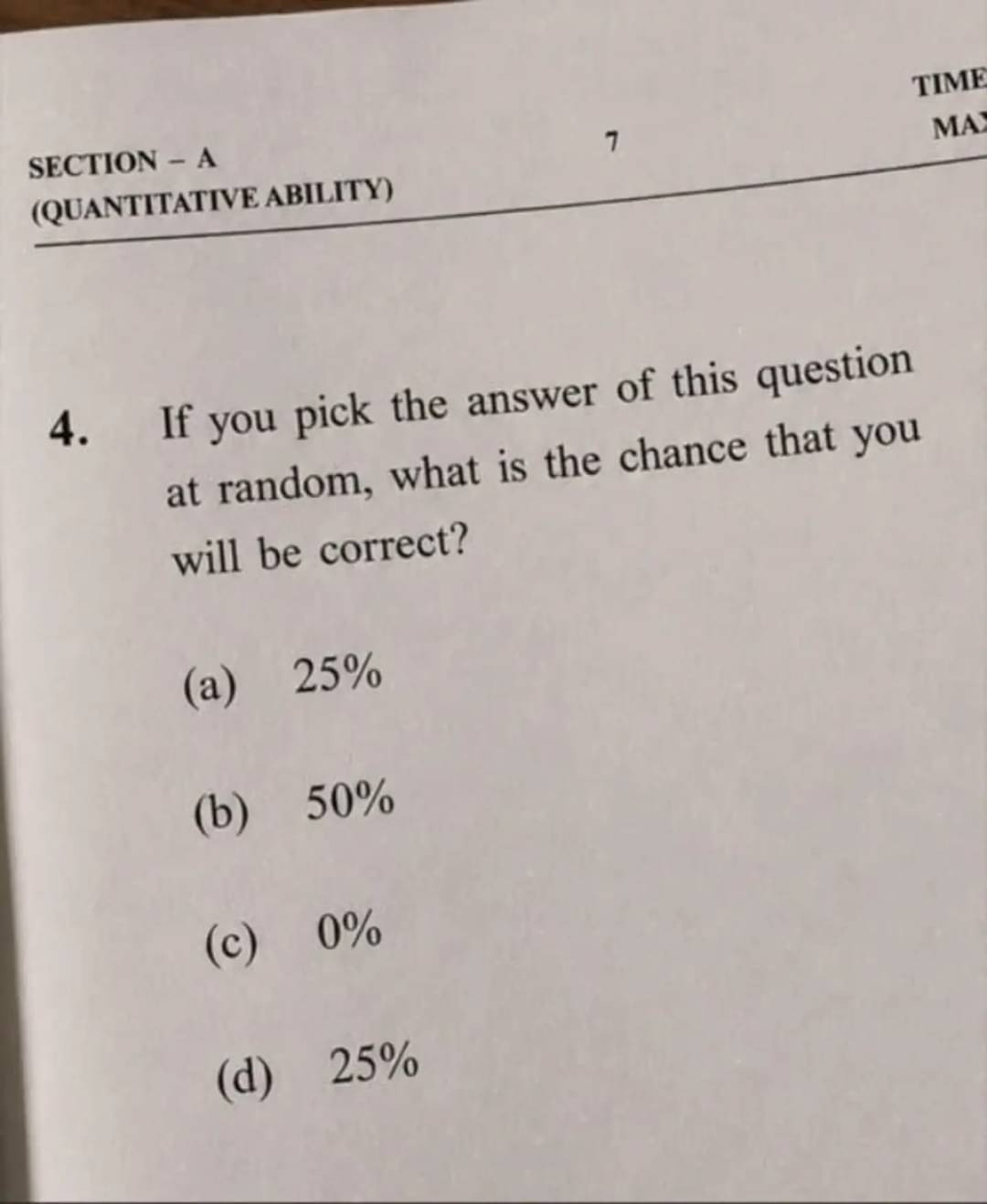
The answer "there is no correct answer" is correct, but the answer isn't 0%. It's a paradox. There isn't a solution, which isn't the same thing as saying there's a 0% chance of getting the right solution (when that is one of the choices).
Essentially there's a difference between "0% of answers will be correct (because none can be)" and "the listed 0%-option self-invalidates if selected". The problem is the interaction between answers that shouldn't be there in normal tests, which changes the values after selection.
If c is correct for you then it's also correct for those who answered at random. And if it is, then you're all wrong because you're answering about those who answered at random.
The only viable approach to actually answer is to argue that the question is ambiguous and that while the hypothetical test takers face infinite recursion you the real test taker don't have to resolve the infinite recursion and to then choose a place to halt evaluation. And if they disagree you invoke the all powerful "I'll talk to the principal".
It's not necessary to use recursion. Simple logic solves it. If a or c are true, that implies a and c are not true. If b is true, that implies b isn't true. If d is true, that implies d isn't true. No recursion needed and this is complete. You could take a recursive approach, but it doesn't halt, like you said, so it doesn't give a result.
(Also, the halting problem is determining if something halts, not what the value is at the end. This problem does not halt, if done recursively. The halting problem is easy to resolve for this particular problem.)
Nah it's a paradox. There's no such thing as just a freestanding Monte Carlo test that you can just "run" - you do actually need to define enough parameters to make it tell you anything.
This kind of self-referential stuff feels like a proof of Gödel's incompleteness theorems with extra steps.
The trick is that there is no paradox, only the implication of one. 'If' being the key word - you're not actually being asked to answer randomly, but you are being subtly trolled.
You do not need to pick at all for the paradox to exist. If either A or D is correct, the other is also correct, and the random odds of selecting the correct answer should have been 50%. This is a contradiction. Neither A nor D can be the correct answer.
If B is correct, the random odds of selecting it is only 25% - a contradiction, so B cannot be correct. Likewise, if C is correct, there is a 25% chance of randomly picking C. C is also not correct.
None of the four answers is correct, so there is a 0% chance of randomly picking the correct answer. C is correct, contradiction, C is not correct, C is correct, is not, is too, etc.
The paradox is resolved by knowing the the scantron answer key has A selected. D is not sufficiently identical to A in javascript, so only the students that randomly guessed the correct answer will get credit.
Because the paradox can only be resolved with either A or D as the selected answer, well informed students picking randomly would have a 50% success rate.
If you ignore self-referential nature of the question and stop the iteration at some point, sure, you can argue that any answer is correct.
If you ran a infite monte carlo test on it, you’d end up with 0% correct answers.
That would mean your Monte Carlo test is set up incorrectly because at least 1/4 of the results of the test would be the "correct" answer as per your own argument, thus invalidating it.
I would answer C) 0% - Ultimately I feel this isn't a "pick the correct answer" type of test and more of a "pick the best answer" type of test.
My reasoning is there are really two questions - one is being answered at random, the other I am answering. The one being answered at random is making any answer it chooses wrong - If it picks A or D (25%), then the correct answer is B (50%). If it picks B (50%), then the answer is either A or D (25%). If it chooses C (0%) then the correct answer is A or D (25%) again. No matter which one is chosen at random, it becomes wrong as soon as it is chosen. So then back to the question on the test that I am answering, the correct answer is C) 0%.
Also, if the teacher marks that wrong, then I am even more correct.
It’s definitely B ) 50%. Ignoring the values for answers, there can only be 1 “correct” answer. If you have 4 options and 1 can be correct, a random guess is 25%. Since there are 2 options for 25%, you have a 50% chance of guessing the correct 25%.
Ignoring the values for answers, there can only be 1 “correct” answer.
Only if you ignore the possibility of there being zero correct answers or more than one possible correct answer. Even a math problem can have more than one correct answer.
I'm not a math person(Dropped out of grade 12 math)
How could this be any answer other than five or negative five?
I understand that multiplying a negative will cancel out the negatives and give you a positive result but I don't understand how the equation could work with the other answers(i am assuming all your answers are examples of answers that can be correct)
You can’t separate the question like that. Whichever answer you circle indicates your assertion that this is the probability of getting the correct answer by uniform random chance.
This means that any answer you circle is wrong, and so the correct answer is to not circle any of them. You could even write e) none of the above to indicate that you have deliberately chosen not to circle one of them instead of skipping the question.
I have had plenty of exams with multiple choice questions that included the possibility of no correct answers, one correct answer, or even multiple correct answers, and we were expected to make that judgement (rather than blindly follow instructions).
They’re called multi-select questions and you’re warned about them by the professor ahead of time. Sometimes they have a “none of the above” option but sometimes they don’t.
The purpose is to get you to think critically. If you look at a question and all of the options seem wrong to you, making a guess because “one of them has to be right, it’s multiple choice” is lazy thinking and has nothing to do with the subject matter. In real life you don’t have the luxury of knowing that there’s one correct answer among a set of options.
The purpose of an exam is to test your knowledge of the course subject, not to test your ability to take multiple choice tests. Sometimes that’s hard to separate out, but the standard multiple choice question (where one and only one answer must be correct) is very game-able by guessers who don’t know the subject very well and risks the possibility of someone getting very lucky while not knowing anything.
Well, I suppose I fell into the trap of thinking that questions with no right answers meant nobody could get a perfect score, but I would imagine that 1) it's fair across the board and 2) accounted for in the scoring somehow.
I suppose I was always a fan of taking easy multiple choice tests as a student - some people write them such that by using the tiniest amount of logic, someone with zero knowledge of the subject could still probably ace them, versus someone writing a diabolical one that dives deep into the subject matter and has answers that are very very slightly different and you really do have to know the material strongly to have any hope. lol. But taking a diabolical test where some questions don't have ANY correct answers would be even MORE satisfying to ace if you really do know the material well enough, so that sounds like fun. :)
If your chance of getting the right answer is 0%, then the right answer is (c) 0%, giving you a 1/4 or 25% chance of being correct, thus the answer cannot be 0%.
The correct answer is to leave all the options unmarked.
If you do pick an answer, then you didn't do it randomly. When not marking the answers, the if-statement has the result of "false", but that's not the question.
If your teacher then asks why you didn't answer it, you can safely and unparadoxically claim that inaction is also an option.
Technically they're not even asking me to answer the statement.
It only states that if I pick an answer then something. And I just don't.
The idea that you must mark an answer is only implied by it being a standard test.
This might seem silly, but it happens in real life too.
For instance:
Please choose the correct answer to the question: Is Mitch McConnell dead or alive? Yes or no.
The republicans have chosen not to answer that test. Can we blame them? Yes, but for what, they didn't do anything?
They are avoiding the Schrödinger paradox by choosing inaction.
In some other kinds of cases it might be criminal to withhold information through inaction, but it's always difficult to prove such a case.
Buddhism also has a lot of these riddles, where the correct action or teaching is to not acknowledge the question.
If "no answer" is in the set of possible answers, then it is not a correct answer because there's then a 20% chance of it being picked at random. But usually that's not the case for tests anyways.
Not really but you're thinking in the right direction!
There is no correct answer because the question and the answers exclude themselves:
For four different options it is 25% but here two options are the same - so you have a 50% chance to land on a 25% - but this means that the correct answer is only in one of the four answers, therefore you're having a 25% chance.
It's a nice demonstration of what happens when the answer and question are intervined and any result changes an aspect of the answer - you're fucked, basically.
None of the answers are correct, though, because all of the answers are correct as you work through the problem solving for correctness, but once you have actually analyzed the problem for that answer being the answer to the question, it is no longer correct.
I'll do a boring and pointless breakdown of it here:
Statistically, if there are four answers and one of them is correct and it's picked at random, then you have a 25% chance of being correct.
There are two answers that are 25%. If you land on either one of them, that would be correct.
That means that you have a 50% chance of being correct.
There is only one 50% answer, which means you have a 25% chance of being correct.
But there are two 25% answers which means the correct answer is 50%.
But, since none of the answers are correct, then the correct answer is 0%.
But 0% is one of the answers.
So you have a 25% chance of being correct.
I personally would write in "E: None of the above, 20%."
Well wouldn't the correct answer for us to mark be 25% then? As we aren't marking it randomly but we are specifically choosing it, therefore you have a 25% random chance to pick 0% which makes us marking a 25% answer correct
I suppose that depends on how pedantic you want to be, cause based on how I read it, you need to "solve" the real answer, which is “c) 0%“, due to the paradoxical situation and then figure out what the chance of picking that correct answer is, if you were to randomly chose one of the 4 options, so either of the 25% options should be correct to mark as a chosen answer and not chosen randomly.
But yes, 25% is not equal to 0%, however English is a lovely language
If it's a part of the standardized test that actually does make it much easier. A standardized test only allows to mark one option and that option needs to be derived unambiguously from the question. As such, neither A nor B are actually possible answers under this framework, D is not a possible answer to the question, and we're left with C.
If I was given the original question as part of some standardized test, I would probably think about it for a while, flip a coin mentally, choose either A or D, and then contest it afterwards if it gets marked as being incorrect.
Its 25%. The rules of answering a question with a set of options is that you may only choose one and only one is right unless explicitly stated otherwise. Anything else is breaking the rules, which as the taker would be disqualifying. If you start narrowing it down, as in "its 25% and theres two so now i need to guess therefore its 50" you are no longer answering the question at random and you have answered wrong. But you do have to make that coin flip. Good luck.
This is the only correct answer to the question as stated.
That of course opens a second can of worms, since now you are actually forced to "pick the answer at random", now with the probability of 50%. But such double entendres are typically not considered for test questions unless explicitly specified.
Can't be 25% = it could be correct if the "other 25%" was 24 or 26 (or even 25.000001). Since there are two 25%, the 25% change is raised, nullify the 25% prediction.
Can't be 50%, because there are other two different options in addition to fifty in fifty-fifty; so 50% (or fifty-fifty) don't exist as option.
Can't be 0%, because 0% is a very specific assertion that can't ever be true due to paradox (if you "guessed", you nailed it 100%)
Result: malformed question, no one is valid... The best you can have is 25%, which is still wrong, but I thing is the closer to approximate.
Ideally the question would reform as:
The question asks "What is the likelihood that you will give the correct answer to this question?" But does not detail the question that it is asking.
As a hypothetical, if I came up to you and said
"What is the answer to my question?"
There are a number of ways you could answer, such as saying "What question?" Or even just "I don't know". But the fact of the matter is that you cannot give a knowledgeable answer in earnest because the question I gave you is malformed and lacking information.
Like, I get the point of the question pictures, it's a very funny "haha look at this mathematical conundrum, isn't that pretty funny guys?" And it's a good question for that
But I guess I'm just being a buzzkill by saying that technically none of these answers is correct because the premise of the question itself relies on a language error. Idk
“This question” means “the current question being g asked” and trying to argue otherwise is just silly. The only way you could be confused in that is if you’re not a native English speaker (and if you’re not, fair enough). My point being, you are given the full question, the question being referenced, and the possible answers.
It’s unanswerable not because of a language error, it’s because the second 25% makes it impossible to correctly answer as the answer is essentially a mathematical paradox. All answers are simultaneously correct and incorrect.
I am a native English speaker with a very good comprehension of the language.
So let's walk through the logic then, follow me on this one.
I walk up to you and ask
"What is the answer to my question?"
I claim you have been given full information as to what the question is, and you are able to knowingly answer it without saying "I don't know" or "What question?"
The question pictured is not “my question” it is “this question” you can’t change the language of the question then complain it means something it doesn’t.
So, syntactically speaking "My" question vs "this" question doesn't actually change anything about the example that I'm making. If making my example analogy closer to the question in the picture will help you understand the point, I can do that too, no worries.
So, let us word it like this then
"Is the answer to this question a bear, a moose, a lion, or a tiger?"
The question fails before it reaches the stage where an answer is chosen, because the question is not formatted correctly. It is nonsensical to attempt to determine which of the four animals is the answer to the question, because the question is a nonsense question.
In the same way, while it is a clever way to set up a question to imply a paradox, while it is a very fun way to contemplate how the answer might change given how the 'correct' answer changes based on which answer you choose; the reality of the situation is that the question actually fails before reaching the 'choose an answer' stage of the problem, because the self-referential language makes the question itself nonsensical.
You’re telling me that if the answer choices were 0%, 25%, 50% and 100% this question would be impossible to answer because it was formatted incorrectly?
Two answers being the same doesn't mean it's a 1 in 3. It's still 1 in 4 for each option. Basically if you rolled a d4 and chose based on that, you'd have a 50% chance to randomly pick 25, which would make 50% the right answer, but then change the likelihood of being correct 25% again. It's infinitely self referential with no correct answer.
No.
More like 0 % cause the answer is not here.
Like i would ask wich animal has 8 legs.
Dog. Cat. Horse. Millipede.
No right answer possible.
Bad question. Not counting to the total.
Maybe i should have said not 0% C but just 0%
Not a 0 % chance you guess right between the 4 choises.
Or not 0% like you say.
To me your way would make it the right answer intentionally. But if you read the other explenations...
There are to much ways to think.
So exept this is a filosofie exam...and you need to explain way you think. And the points are on the reasoning. This is not math than.
This is an error for me. Bad question. So the points from this question chould be taken out of the total.
It can't be 0 and 2 of the 3 remaining answers are the same number so there are really only 2 choices left. That gives you a 50% chance of guessing the right answer.
You say the answer is 50%. So 25% is not the right answer to the question, right? So you only have 25% chance of randomly selecting 50%, and therefore, 50% is the wrong answer.
So the answer is 25%, but you have 50% chance of picking 25%, so it's wrong again.
125 Comments
dis_da_mor@anarchist.nexus · 89 pts · 5d
arsCynic@piefed.social · 32 pts · 5d
This. I.e., there is no correct answer.
harmbugler@piefed.social · 13 pts · 5d
Sooo, C?
Klear@piefed.world · 8 pts · 5d
False
Untamed_Star@lemmy.blahaj.zone · 7 pts · 4d
if c was correct then it would be 25% then 50% and then 25% again ans 50% and 25%
recursivethinking@lemmy.world · 2 pts · 3d
Write -in, E, none of the above
Natanael@infosec.pub · 2 pts · 3d
E) actual 0%, the above C is a null value incorrectly written as a numeric 0%
Cethin@lemmy.zip · 4 pts · 4d
The answer "there is no correct answer" is correct, but the answer isn't 0%. It's a paradox. There isn't a solution, which isn't the same thing as saying there's a 0% chance of getting the right solution (when that is one of the choices).
Natanael@infosec.pub · 5 pts · 4d
Essentially there's a difference between "0% of answers will be correct (because none can be)" and "the listed 0%-option self-invalidates if selected". The problem is the interaction between answers that shouldn't be there in normal tests, which changes the values after selection.
Therefore, the only winning move is not to play.
harmbugler@piefed.social · 1 pts · 4d
Well I'm not picking it at random, so C is correct.
Natanael@infosec.pub · 2 pts · 4d
If c is correct for you then it's also correct for those who answered at random. And if it is, then you're all wrong because you're answering about those who answered at random.
The only viable approach to actually answer is to argue that the question is ambiguous and that while the hypothetical test takers face infinite recursion you the real test taker don't have to resolve the infinite recursion and to then choose a place to halt evaluation. And if they disagree you invoke the all powerful "I'll talk to the principal".
Cethin@lemmy.zip · 1 pts · 3d
It's not necessary to use recursion. Simple logic solves it. If a or c are true, that implies a and c are not true. If b is true, that implies b isn't true. If d is true, that implies d isn't true. No recursion needed and this is complete. You could take a recursive approach, but it doesn't halt, like you said, so it doesn't give a result.
(Also, the halting problem is determining if something halts, not what the value is at the end. This problem does not halt, if done recursively. The halting problem is easy to resolve for this particular problem.)
chuckleslord@lemmy.world · 4 pts · 5d
No, picking C makes A and D correct, which in turn makes B correct. There is no correct answer.
Natanael@infosec.pub · 1 pts · 4d
M137@lemmy.world · 2 pts · 5d
If there's no correct answer then all answers are correct.
Mikina@programming.dev · 54 pts · 5d
Couldn't you argue that 0% is correct?
It's a paradox, no of the answers can be correct, so the chance that you pick the correct one is 0%.
Sure, by picking it, it makes it wrong, but you don't care about that.
If you ran a infite monte carlo test on it, you'd end up with 0% correct answers.
Sure, picking the zero makes it not true again, but you don't care about that - it prooves that the statistical test holds.
airbreather@lemmy.world · 25 pts · 5d
Nah it's a paradox. There's no such thing as just a freestanding Monte Carlo test that you can just "run" - you do actually need to define enough parameters to make it tell you anything.
This kind of self-referential stuff feels like a proof of Gödel's incompleteness theorems with extra steps.
yakko@feddit.uk · 9 pts · 5d
The trick is that there is no paradox, only the implication of one. 'If' being the key word - you're not actually being asked to answer randomly, but you are being subtly trolled.
prime_number_314159@lemmy.world · 4 pts · 4d
You do not need to pick at all for the paradox to exist. If either A or D is correct, the other is also correct, and the random odds of selecting the correct answer should have been 50%. This is a contradiction. Neither A nor D can be the correct answer.
If B is correct, the random odds of selecting it is only 25% - a contradiction, so B cannot be correct. Likewise, if C is correct, there is a 25% chance of randomly picking C. C is also not correct.
None of the four answers is correct, so there is a 0% chance of randomly picking the correct answer. C is correct, contradiction, C is not correct, C is correct, is not, is too, etc.
The paradox is resolved by knowing the the scantron answer key has A selected. D is not sufficiently identical to A in javascript, so only the students that randomly guessed the correct answer will get credit.
Because the paradox can only be resolved with either A or D as the selected answer, well informed students picking randomly would have a 50% success rate.
harmbugler@piefed.social · 2 pts · 4d
But why is C a contradiction? I'm not randomly picking it.
Natanael@infosec.pub · 1 pts · 4d
Because your c is their c. If you were right then those randomly choosing test takers are also right.
harmbugler@piefed.social · 1 pts · 3d
Why is their C my C? They're randomly choosing, I'm picking the right answer which is 0%.
Natanael@infosec.pub · 2 pts · 3d
Because it's the same question and same options! Choosing 0% implies those who randomly selected it were right!
balsoft@lemmy.ml · 3 pts · 5d
If you ignore self-referential nature of the question and stop the iteration at some point, sure, you can argue that any answer is correct.
That would mean your Monte Carlo test is set up incorrectly because at least 1/4 of the results of the test would be the "correct" answer as per your own argument, thus invalidating it.
anas@lemmy.world · 27 pts · 4d
C; the question has two identical answers, it gets removed from the test based on that error
droans@lemmy.world · 9 pts · 4d
A crocodile has your toddler. It says it will return your child if you can guess its next move. What do you say?
nomy@lemmy.zip · 27 pts · 4d
"Holy fuck a talking crocodile‽"
droans@lemmy.world · 7 pts · 4d
Oof. Wrong time to get excited, buddy...
HeyThisIsntTheYMCA@lemmy.world · 13 pts · 4d
"It's your responsibility now you scaly sucker!" and then voom off on my dune buggy. Also in this scenario I have a dune buggy for reasons.
fizzbang@lemmy.world · 5 pts · 4d
Can I borrow your dune buggy?
cows_are_underrated@feddit.org · 2 pts · 4d
Would like to borrow the buggy too.
DonPiano@feddit.org · 1 pts · 4d
https://youtu.be/2jv2gSY7QB4
Abyssian@lemmy.world · 3 pts · 4d
"Return it? You think I just threw that little bastard into the lake on accident? It's your problem now."
1rre@discuss.tchncs.de · 3 pts · 4d
Distract it while someone sedates/shoots/whatevers it...
Even if you guess the move, it doesn't say it'll be alive or intact, so the safest thing to do is not to play.
Natanael@infosec.pub · 2 pts · 4d
"NOW YOU DIE, CROCODILE" as my drone army attacks
MutantTailThing@lemmy.world · 17 pts · 5d
Does anyone else smell pancakes?
sudoMakeUser@sh.itjust.works · 6 pts · 5d
Yeah, that's me. They're ready.
xia@lemmy.ca · 3 pts · 3d
So of your four pancakes, if you randomly ate one, but two of them looked the same...
Natanael@infosec.pub · 1 pts · 3d
Then I put more syrup on until they don't
SCmSTR@lemmy.blahaj.zone · 17 pts · 4d
Lmao that's fucked up hahaha
Warl0k3@lemmy.world · 15 pts · 5d
Trick question: One of the 25s is an imposter.
lugal@sopuli.xyz · 6 pts · 5d
It's actually 2S with S=12.5
jaybone@lemmy.zip · 5 pts · 5d
And 50 is 5O, where O=0
MJKee9@lemmy.world · 5 pts · 4d
It's a mimic-dark souls math. If you pick it, the test eats you.
yoriaiko@lemmy.blahaj.zone · 15 pts · 4d
It's B - 50%; either correct (50%) or false (50%), binary 0/1, yes/no, score or not.
Crozekiel@lemmy.zip · 14 pts · 5d
I would answer C) 0% - Ultimately I feel this isn't a "pick the correct answer" type of test and more of a "pick the best answer" type of test.
My reasoning is there are really two questions - one is being answered at random, the other I am answering. The one being answered at random is making any answer it chooses wrong - If it picks A or D (25%), then the correct answer is B (50%). If it picks B (50%), then the answer is either A or D (25%). If it chooses C (0%) then the correct answer is A or D (25%) again. No matter which one is chosen at random, it becomes wrong as soon as it is chosen. So then back to the question on the test that I am answering, the correct answer is C) 0%.
Also, if the teacher marks that wrong, then I am even more correct.
dogdeanafternoon@lemmy.ca · 14 pts · 4d
It’s definitely B ) 50%. Ignoring the values for answers, there can only be 1 “correct” answer. If you have 4 options and 1 can be correct, a random guess is 25%. Since there are 2 options for 25%, you have a 50% chance of guessing the correct 25%.
lemmyvore@feddit.nl · 16 pts · 4d
Yes but then 50% would not be the correct answer.
dogdeanafternoon@lemmy.ca · 7 pts · 4d
I fucking hate this game 😭
cuerdo@lemmy.world · 9 pts · 4d
But then the correct answer is b)50%, so the chances or picking that are 25%, my brain hurts now.
HeyThisIsntTheYMCA@lemmy.world · 3 pts · 4d
I think I remember solving this one with expected values but game theory was a few decades ago
bilb@lemmy.ml · 1 pts · 4d
WoodScientist@lemmy.world · 0 pts · 4d
Only if you ignore the possibility of there being zero correct answers or more than one possible correct answer. Even a math problem can have more than one correct answer.
Solve this equation:
x^2=25
a) 5
b) -5
c) 50
d) 625
e) undefined
Jarix@lemmy.world · 1 pts · 4d
I'm not a math person(Dropped out of grade 12 math)
How could this be any answer other than five or negative five?
I understand that multiplying a negative will cancel out the negatives and give you a positive result but I don't understand how the equation could work with the other answers(i am assuming all your answers are examples of answers that can be correct)
WoodScientist@lemmy.world · 2 pts · 4d
No. You're correct. It's just +/-5.
Jarix@lemmy.world · 1 pts · 4d
Thanks lol I thought you had all of them as correct answers but was mystified by c and d
chonglibloodsport@lemmy.world · 4 pts · 4d
You can’t separate the question like that. Whichever answer you circle indicates your assertion that this is the probability of getting the correct answer by uniform random chance.
This means that any answer you circle is wrong, and so the correct answer is to not circle any of them. You could even write e) none of the above to indicate that you have deliberately chosen not to circle one of them instead of skipping the question.
I have had plenty of exams with multiple choice questions that included the possibility of no correct answers, one correct answer, or even multiple correct answers, and we were expected to make that judgement (rather than blindly follow instructions).
daychilde@lemmy.world · 3 pts · 4d
What multiple choice test includes questions with no correct answer? That seems stupid to me.
chonglibloodsport@lemmy.world · 3 pts · 4d
They’re called multi-select questions and you’re warned about them by the professor ahead of time. Sometimes they have a “none of the above” option but sometimes they don’t.
The purpose is to get you to think critically. If you look at a question and all of the options seem wrong to you, making a guess because “one of them has to be right, it’s multiple choice” is lazy thinking and has nothing to do with the subject matter. In real life you don’t have the luxury of knowing that there’s one correct answer among a set of options.
The purpose of an exam is to test your knowledge of the course subject, not to test your ability to take multiple choice tests. Sometimes that’s hard to separate out, but the standard multiple choice question (where one and only one answer must be correct) is very game-able by guessers who don’t know the subject very well and risks the possibility of someone getting very lucky while not knowing anything.
daychilde@lemmy.world · 1 pts · 4d
Well, I suppose I fell into the trap of thinking that questions with no right answers meant nobody could get a perfect score, but I would imagine that 1) it's fair across the board and 2) accounted for in the scoring somehow.
I suppose I was always a fan of taking easy multiple choice tests as a student - some people write them such that by using the tiniest amount of logic, someone with zero knowledge of the subject could still probably ace them, versus someone writing a diabolical one that dives deep into the subject matter and has answers that are very very slightly different and you really do have to know the material strongly to have any hope. lol. But taking a diabolical test where some questions don't have ANY correct answers would be even MORE satisfying to ace if you really do know the material well enough, so that sounds like fun. :)
matlag@sh.itjust.works · 2 pts · 3d
The answer is 0%: no matter what you chose, it's wrong. Therefore, at random, you have 0% chance of picking the right answer randomly (or not).
chonglibloodsport@lemmy.world · 1 pts · 3d
If your chance of getting the right answer is 0%, then the right answer is (c) 0%, giving you a 1/4 or 25% chance of being correct, thus the answer cannot be 0%.
matlag@sh.itjust.works · 2 pts · 3d
0 not being the correct answer, your chances of picking the correct answer at random are 0.
chonglibloodsport@lemmy.world · 0 pts · 3d
Which makes 0 the correct answer, contradicting the assumption that 0 is not the correct answer.
bstix@feddit.dk · 10 pts · 5d
The correct answer is to leave all the options unmarked.
If you do pick an answer, then you didn't do it randomly. When not marking the answers, the if-statement has the result of "false", but that's not the question.
If your teacher then asks why you didn't answer it, you can safely and unparadoxically claim that inaction is also an option.
Jyek@sh.itjust.works · 6 pts · 4d
The question is not asking you to pick at random. It's asking you to suppose that you do pick at random and to mark the correct answer not at random.
bstix@feddit.dk · 1 pts · 4d
Technically they're not even asking me to answer the statement.
It only states that if I pick an answer then something. And I just don't.
The idea that you must mark an answer is only implied by it being a standard test.
This might seem silly, but it happens in real life too. For instance:
Please choose the correct answer to the question: Is Mitch McConnell dead or alive? Yes or no.
The republicans have chosen not to answer that test. Can we blame them? Yes, but for what, they didn't do anything? They are avoiding the Schrödinger paradox by choosing inaction. In some other kinds of cases it might be criminal to withhold information through inaction, but it's always difficult to prove such a case.
Buddhism also has a lot of these riddles, where the correct action or teaching is to not acknowledge the question.
YiddishMcSquidish@lemmy.today · 2 pts · 4d
They aren't asking them to pick an answer at random though.
balsoft@lemmy.ml · 1 pts · 5d
If "no answer" is in the set of possible answers, then it is not a correct answer because there's then a 20% chance of it being picked at random. But usually that's not the case for tests anyways.
naught101@lemmy.world · 1 pts · 5d
Severe programmer mentality 😂 I like it, but I doubt it would play out in the real world
bountygiver@lemmy.ml · 9 pts · 5d
add a e) 20%
Jambalaya@lemmy.zip · 8 pts · 5d
It's gotta be B, right?
fbs@lemmy.world · 35 pts · 5d
If the answer is B, that means there's a 25% chance of getting the right one. So the answer is A and D. But wait... that's 50%
50% means 25%
That means 50%
So it's 0% because it's impossible.
Meaning it's 25%
Damn it
Scipitie@lemmy.dbzer0.com · 7 pts · 5d
Not really but you're thinking in the right direction!
There is no correct answer because the question and the answers exclude themselves:
For four different options it is 25% but here two options are the same - so you have a 50% chance to land on a 25% - but this means that the correct answer is only in one of the four answers, therefore you're having a 25% chance.
It's a nice demonstration of what happens when the answer and question are intervined and any result changes an aspect of the answer - you're fucked, basically.
Marty_TF@lemmy.zip · 2 pts · 5d
well, you are either right or wrong which is 2 options, and 100%/2 is 50%. or something like that
bizarroland@lemmy.world · 9 pts · 5d
None of the answers are correct, though, because all of the answers are correct as you work through the problem solving for correctness, but once you have actually analyzed the problem for that answer being the answer to the question, it is no longer correct.
I'll do a boring and pointless breakdown of it here:
Statistically, if there are four answers and one of them is correct and it's picked at random, then you have a 25% chance of being correct.
There are two answers that are 25%. If you land on either one of them, that would be correct.
That means that you have a 50% chance of being correct.
There is only one 50% answer, which means you have a 25% chance of being correct.
But there are two 25% answers which means the correct answer is 50%.
But, since none of the answers are correct, then the correct answer is 0%.
But 0% is one of the answers.
So you have a 25% chance of being correct.
I personally would write in "E: None of the above, 20%."
Azteh@lemmy.world · 2 pts · 5d
Well wouldn't the correct answer for us to mark be 25% then? As we aren't marking it randomly but we are specifically choosing it, therefore you have a 25% random chance to pick 0% which makes us marking a 25% answer correct
bizarroland@lemmy.world · 1 pts · 4d
But if 0% was the correct answer, then there would not be a correct answer on the test.
25% != 0%
Azteh@lemmy.world · 2 pts · 4d
I suppose that depends on how pedantic you want to be, cause based on how I read it, you need to "solve" the real answer, which is “c) 0%“, due to the paradoxical situation and then figure out what the chance of picking that correct answer is, if you were to randomly chose one of the 4 options, so either of the 25% options should be correct to mark as a chosen answer and not chosen randomly.
But yes, 25% is not equal to 0%, however English is a lovely language
Marty_TF@lemmy.zip · 2 pts · 5d
i was doing a bit, shoulda marked it with an /s
sorry you spent valuable time on my bullshit typing that out lol
balsoft@lemmy.ml · 5 pts · 5d
Here's a more fun one:
And as another puzzle, what happens if you swap "at least one of the" for "all"?
WoodScientist@lemmy.world · 2 pts · 4d
First I need to figure out which answer always lies, and which one always tells the truth.
gezero@sopuli.xyz · 5 pts · 5d
A) 50% B) 50% C) 25% D) 0%
Doesn't make it much easier.
balsoft@lemmy.ml · 2 pts · 5d
If it's a part of the standardized test that actually does make it much easier. A standardized test only allows to mark one option and that option needs to be derived unambiguously from the question. As such, neither A nor B are actually possible answers under this framework, D is not a possible answer to the question, and we're left with C.
If I was given the original question as part of some standardized test, I would probably think about it for a while, flip a coin mentally, choose either A or D, and then contest it afterwards if it gets marked as being incorrect.
lugal@sopuli.xyz · 1 pts · 5d
Still too hard. I'll take the 50/50 joker. Which answers remain?
Natanael@infosec.pub · 2 pts · 3d
0% and 50%
UpperBroccoli@lemmy.blahaj.zone · 5 pts · 5d
The right answer is neither a nor b nor c nor d, but "beer with tzatziki".
jaybone@lemmy.zip · 1 pts · 5d
Mixed?
UpperBroccoli@lemmy.blahaj.zone · 1 pts · 5d
Aye.
Enekk@lemmy.world · 4 pts · 4d
Too bad Wrath of Math is probably not on here
Zizzy@lemmy.blahaj.zone · 4 pts · 5d
Its 25%. The rules of answering a question with a set of options is that you may only choose one and only one is right unless explicitly stated otherwise. Anything else is breaking the rules, which as the taker would be disqualifying. If you start narrowing it down, as in "its 25% and theres two so now i need to guess therefore its 50" you are no longer answering the question at random and you have answered wrong. But you do have to make that coin flip. Good luck.
balsoft@lemmy.ml · 4 pts · 5d
This is the only correct answer to the question as stated.
That of course opens a second can of worms, since now you are actually forced to "pick the answer at random", now with the probability of 50%. But such double entendres are typically not considered for test questions unless explicitly specified.
dogdeanafternoon@lemmy.ca · 1 pts · 4d
Yeah, in my opinion the answer is 50%. You got a 50/50 shot at picking the correct 25% answer.
Natanael@infosec.pub · 1 pts · 4d
What coin do you have with 4 sides
FishFace@piefed.social · 0 pts · 5d
I've never heard that rule. It sounds like an assumption you're making about the question!
Avicenna@programming.dev · 3 pts · 4d
hah I see what you did there!
Slashme@lemmy.world · 3 pts · 3d
There is no correct answer. The reason why there's no correct answer is that it's a self-referential paradox, but imagine you saw this:
There's no correct answer, so it's not a valid multiple choice question.
alessandro@lemmy.ca · 3 pts · 3d
Can't be 25% = it could be correct if the "other 25%" was 24 or 26 (or even 25.000001). Since there are two 25%, the 25% change is raised, nullify the 25% prediction. Can't be 50%, because there are other two different options in addition to fifty in fifty-fifty; so 50% (or fifty-fifty) don't exist as option.
Can't be 0%, because 0% is a very specific assertion that can't ever be true due to paradox (if you "guessed", you nailed it 100%)
Result: malformed question, no one is valid... The best you can have is 25%, which is still wrong, but I thing is the closer to approximate. Ideally the question would reform as:
Option A: 25% Option B: 50% Option C: 0%
=33.3~%
Simulation6@sopuli.xyz · 2 pts · 3d
Answer can be a,b,c or d. So could be a or d. Pick one at random and you have a 50% chance.
phonics@lemmy.world · 3 pts · 5d
I'd write out '25%' instead of choosing a,b,c or d.
NightFantom@slrpnk.net · 2 pts · 5d
Nobody said it was uniform random, there's probably infinite probability distributions that end up correct
Krudler@lemmy.world · 2 pts · 3d
It's a malformed question that cannot be answered
MehBlah@lemmy.world · 2 pts · 4d
I love this.
Tidesphere@lemmy.world · 2 pts · 3d
The answer is null because the question references information that we don't have. It can't be answered.
KairuByte@lemmy.dbzer0.com · 3 pts · 3d
Not quite. All information is present, but the answer changes in a way that makes this unanswerable.
Tidesphere@lemmy.world · 2 pts · 3d
The question asks "What is the likelihood that you will give the correct answer to this question?" But does not detail the question that it is asking.
As a hypothetical, if I came up to you and said
"What is the answer to my question?"
There are a number of ways you could answer, such as saying "What question?" Or even just "I don't know". But the fact of the matter is that you cannot give a knowledgeable answer in earnest because the question I gave you is malformed and lacking information.
Like, I get the point of the question pictures, it's a very funny "haha look at this mathematical conundrum, isn't that pretty funny guys?" And it's a good question for that
But I guess I'm just being a buzzkill by saying that technically none of these answers is correct because the premise of the question itself relies on a language error. Idk
KairuByte@lemmy.dbzer0.com · 1 pts · 3d
“This question” means “the current question being g asked” and trying to argue otherwise is just silly. The only way you could be confused in that is if you’re not a native English speaker (and if you’re not, fair enough). My point being, you are given the full question, the question being referenced, and the possible answers.
It’s unanswerable not because of a language error, it’s because the second 25% makes it impossible to correctly answer as the answer is essentially a mathematical paradox. All answers are simultaneously correct and incorrect.
Tidesphere@lemmy.world · 1 pts · 3d
I am a native English speaker with a very good comprehension of the language.
So let's walk through the logic then, follow me on this one.
I walk up to you and ask
"What is the answer to my question?"
I claim you have been given full information as to what the question is, and you are able to knowingly answer it without saying "I don't know" or "What question?"
How do you answer?
KairuByte@lemmy.dbzer0.com · 1 pts · 3d
The question pictured is not “my question” it is “this question” you can’t change the language of the question then complain it means something it doesn’t.
Tidesphere@lemmy.world · 1 pts · 3d
So, syntactically speaking "My" question vs "this" question doesn't actually change anything about the example that I'm making. If making my example analogy closer to the question in the picture will help you understand the point, I can do that too, no worries.
So, let us word it like this then
"Is the answer to this question a bear, a moose, a lion, or a tiger?"
The question fails before it reaches the stage where an answer is chosen, because the question is not formatted correctly. It is nonsensical to attempt to determine which of the four animals is the answer to the question, because the question is a nonsense question.
In the same way, while it is a clever way to set up a question to imply a paradox, while it is a very fun way to contemplate how the answer might change given how the 'correct' answer changes based on which answer you choose; the reality of the situation is that the question actually fails before reaching the 'choose an answer' stage of the problem, because the self-referential language makes the question itself nonsensical.
Is that clearer?
KairuByte@lemmy.dbzer0.com · 1 pts · 3d
🤦♂️
You’re telling me that if the answer choices were 0%, 25%, 50% and 100% this question would be impossible to answer because it was formatted incorrectly?
hperrin@lemmy.ca · 2 pts · 5d
The limit does not exist!
Nounka@lemmy.world · 1 pts · 5d
I was thinking otherwise. 4 answers possible would make idd 25% correct.
But since two answers are the same... 3 possible answers. So 33% is solution. That is not an option....
So 0% is the only right answer C
SkyezOpen@lemmy.world · 5 pts · 5d
Two answers being the same doesn't mean it's a 1 in 3. It's still 1 in 4 for each option. Basically if you rolled a d4 and chose based on that, you'd have a 50% chance to randomly pick 25, which would make 50% the right answer, but then change the likelihood of being correct 25% again. It's infinitely self referential with no correct answer.
jaybone@lemmy.zip · 5 pts · 5d
But if 0% is the right answer, then it is an available option. Which could be chosen at random.
Nounka@lemmy.world · 3 pts · 5d
No. More like 0 % cause the answer is not here. Like i would ask wich animal has 8 legs. Dog. Cat. Horse. Millipede. No right answer possible. Bad question. Not counting to the total. Maybe i should have said not 0% C but just 0%
Not a 0 % chance you guess right between the 4 choises.
Or not 0% like you say.
To me your way would make it the right answer intentionally. But if you read the other explenations... There are to much ways to think. So exept this is a filosofie exam...and you need to explain way you think. And the points are on the reasoning. This is not math than.
This is an error for me. Bad question. So the points from this question chould be taken out of the total.
Probably now all the math knowers are mad at me.
NocturnalMorning@lemmy.world · 1 pts · 3d
Ahh, I see you also have the blueprints to creating a black hole.
RememberTheApollo_@lemmy.world · 1 pts · 4d
MathiasTCK@lemmy.world · 1 pts · 4d
C, if there is a requirement to show your work and random guesses that don't show work get no credit.
itsgroundhogdayagain@lemmy.ml · 0 pts · 4d
It can't be 0 and 2 of the 3 remaining answers are the same number so there are really only 2 choices left. That gives you a 50% chance of guessing the right answer.
kepix@lemmy.world · 0 pts · 4d
kinda depends how stupid i am. how about 33%?
Jayve@lemmy.world · -1 pts · 3d
C: 50%, you have a 1 in 4 (25%) chance of guess the correct answer but there are two correct answers so 2 in 4 = 50%.
matlag@sh.itjust.works · 7 pts · 3d
I would answer 0%.
You say the answer is 50%. So 25% is not the right answer to the question, right? So you only have 25% chance of randomly selecting 50%, and therefore, 50% is the wrong answer.
So the answer is 25%, but you have 50% chance of picking 25%, so it's wrong again.
You can't solve it: the answer is 0%.
Coleslaw4145@lemmy.world · 5 pts · 3d
But that would mean 0% is the correct answer.
So theres a 25% chance of picking 0% as the correct answer.
The correct answer changes depending on what answer you picked.
Its a Schrodingers probability question.
matlag@sh.itjust.works · 1 pts · 3d
If 0% is not the right answer, that confirms that no matter what you pick at random, this is not the right answer: your chances of picking it are 0.
As much as you can loop to demonstrate the other answers are all wrong, you demonstrate 0 is the correct answer by a loop also.