The Man-in-the-middle's statement is akin to the following :
2 = 3 thus, by multiplying both sides by 0, we get 0 = 0, which is true !
He said it's in the middle because 2 people disagreed, and he states that the truth lies always in she middle in these situations. which is false, exactly as false as 2 = 3
I believe that's the same for every planet. And every moon. For every orbit.
Its just that the barycenter is inside the more massive object when one is much more massive than the other. Not that this makes much of a difference to anything.
If you have ever done a handstand then you have lifted over your head the weight that the entire mass of the earth has in your own gravitational field.
Pluto and it's biggest moon Charon about for the very center outside of each other. This means that you could build a space elevator directly between the surface of each of them and it would rotate around that point since they're also tightly locked.
Yeah, that's the first thing I checked reading the og post before I was about to write 'there is no was it's outside the sun!' ... its such a tiny supergassy mass.
Well, while we are being 'that guy', factoid is one of those words which has changed its meaning by being used wrongly for so long that the original meaning has all but vanished.
A factoid is technically supposed to be something resembling fact, but not actual fact. (The Greek suffix '-oid' normally being used for that purpose, like in paranoid, "like knowledge" or asteroid, "like a star").
The best thing about factoid, is that factoid is now a factoid. Because it resembles what it is not lol...
Anyway, nowadays, you are allowed to use it the way you did, at least in the descriptivist world view. The prescriptivists may disagree, however. And those people are often 'that guy' ;)
Well, now I want to know if there's a regular schedule to the Jupiter-Sun barycenter being in or outside of the Sun, and how we can schedule holidays around it.
The way this is phrased makes it sound like there's a certain threshold where this starts happening. That's not right. Even a grain of dust wouldn't orbit the sun, they still orbit their common barycenter. A less misleading way of phrasing would be that Jupiter is massive enough that the barycenter of it and the sun actually lies outside the sun, which is still a cool fun fact.
I mean, the sentence either implies what I said before, or it implies that the barycenter is a point outside the sun. I really don't see any other reading than those two.
That's the way I understood it at first. But after reading it again after reading the comments above, I can see the other way of viewing it.
I do agree with you that how the sentence is currently written it's confusing.
Yeah pretty much my point. I know you can maybe kinda construe it into the truth if you already know about the topic, like other commenters age saying, but it's presented as educational, and does a poor job at educating with how misleadingly it is phrased.
That's still not entierly mass dependant, the point is at a distance based on a ratio between the two masses, if Jupiter were closer to the sun then the point would be inside the sun. Its still impressively massive to pull the point outside of the sun at any functional distance but so could a grain of dust with sufficient distance and a big empty universe to prevent anything else from interupting things.
I was going to complain about the use of "barycenter" instead of the more commonly known "center of mass". But after some searching, I guess barycenter is more obscure because it's more specific. I'm ok with that.
No, this is actually really relevant. This is part of the logic applied to labeling Pluto a dwarf planet. Pluto and it's moon do this, Earth and our moon do not. Yes, obviously the center of mass of the two isn't the exact center of the earth but it's still within the earth.
Asking a physicist about the center of an object is like asking a Tumblr user about thr color of the sky. The only response will be "which one?" And a sigh of exhaustion
Center of volume ≠ center of mass ≠ center of systemic gravity ≠ center of lift…
but the density of an object is variable. i mean you can define the diffrence between an orbit and a co-spiral to be based on the physical size of the denser planetary body containing the orbit center point, though that seems arbitrary.
And Pluto knows that Pluto's
Hot shit
And you know Pluto knows it
"I won't ever be a planet
It don't matter 'cause I know that I'm still"
Hot shit
"And you're hot shit too, so get out of your brain
And just do what you're supposed to do"
Nah, there is no way any astronomer studying orbital mechanics in our solar system is rounding pi to 1. There is virtually no practical calculation you could do on the mechanics of the sun or planets where rounding a known constant by a factor of 3 would yield any useful result whatsoever.
Rounding pi to 1 only makes sense when the uncertainty in the numbers is large, not the magnitude of the numbers, and we know the masses and distances of the objects in our solar system to an amazing level of precision!
Plus, the fact that Jupiter is massive enough to actually exert an influence that large on the sun is pretty fucking cool!
The reason being, that once you go large enough, a multiplier of three is irrelevant, and they only really care about orders of magnitude. You might be tempted to argue that that doesn't happen inside the solar system, and you'd be right. Mostly.
Except that astronomy doesn't concern itself with just our system. So yes. Astronomers do frequently round to 1 because it really doesn't matter that much in the scheme of things. (particularly talking about distances.) it's even more so for cosmology.
Sure, I totally agree that when you're dealing many with orders of magnitude, the factor of 3 is dwarved by the other uncertainties.
But we're talking about our solar system, and specifically the orbital mechanics of our planets and sun, where the quantities and scales only span a couple orders of magnitude in total. A factor of 3 absolutely makes a difference. That's the difference between the orbit of Mercury and the orbit of Earth.
Then there's the practical point that, regardless of scale, rounding a known constant by that much makes no sense at all, unless you're trying to estimate huge numbers in your head. If you're using even the simplest of calculator, estimating pi as 1 is a deliberate choice to reduce accuracy.
Not when that definition of pi goes to all 300 trillion decimals that we have resolved. (To be fair, I don’t know of any that do… but eh…yeah. And I’m pretty sure it was defined by a masochist if one did.)
That leads to unnecessary time spent calculating even simple equations. That level of precision is almost never actually needed.
With fermi problems, usually that level of precision is moot and potentially a waste of time. (Particularly when the math is requiring some kind network cluster to do.)
Pi has it's own button on most graphing calculators, and those that don't usually only requure 2 button presses to get it. Meanwhile, there's some iteration of 'pi()', 'pi', etc. in most programming languages
But sometimes, the problems are complex enough that solve time becomes a concern. When they’re complex enough, you start asking “is everything these precise enough to justify that” and when the answer is “no”, then you don’t do that because runtime on networked clusters like AWS costs money.
And when you’re talking about scales that encompass the galaxy…. Well. There’s just not a lot of precision there to begin with.
fermi approximations happen all the time in astronomy. The numbers are frequently so large that the only meaningful quality is how many orders of magnitude it has.
More to the point, using pi makes calculating things much harder. For example, we don’t really need a precise distance for most things; so using “3” makes the calculation unnecessarily spend time in computation.
It’s like the old joke, “what’s the difference between a millionaire and a billionaire?” (“About a billion.”)
Is it more true to say that Jupiter (and the other planets and asteroid belts and dust clouds in our solar system) orbits the Sun, and the Sun orbits the barycenter? The barycenter that the sun revolves around is influenced (marginally) by the other bodies in the solar system and not just Jupiter. If the definition of a barycenter is to be interpreted as this image suggests, that would mean that no material object orbits another material object and they instead orbit their collective center of mass somewhere in space.
Edit: to clarify, I understand the physics and motion at play. The phrasing just seems misleading/incorrect to me.
I guess your conclusion is right. In situations where the barycenter of two (or more) objects is not sufficiently different from the center of mass of the heaviest object, we simplify the description by assuming that the barycenter and the center of mass of the heavier object are equal.
Just because I’ve already edited it, here’s an animation of Earth orbiting the Earth–Moon barycenter:
No, your earlier definitions are incorrect. All orbits happen around the barycenter. The only question is whether one of the bodies is large/massive enough that the barycenter is located within it
Just because a more accurate description exists, doesn't mean that the less accurate description is fundamentally wrong. Depending on context, the less accurate description may be perfectly suitable for the subject at hand. If your priority is to be the most correct, then by all means go ahead and use the more accurate description.
It's articulated as "it's wrong", while the message they're trying to convey is more like "it's not the entire truth". The latter is hard to get across is a handful of words though, likely leaving more questions than answers. I believe they did a decent enough job that most of us can read the point between the lines.
I guess they all orbit around the solar system's center of mass (negligibly affected by the universal CoM), but that CoM probably moves around as the planets themselves move.
Relative to what, you might ask? That depends who you're asking 😉
The barycenter is different for each planet-sun (or any two object) pairing.
The earth and moon have a barycenter which is beneath the surface of earth. Likewise, the barycenter of the sun-earth pair is below the surface of the sun
Edit:
The barycenter of our solar system orbits the center of our galaxy (again in a barycentric manner)
Technically speaking, no celestial body in our solar system orbits around a single point. The barycenter thing only works with two bodies. When there are more than two bodies, such as in our solar system, the orbits become chaotic. Granted, the influence between planets is small, so they all appear to orbit their barycenters with the sun, but there are small perturbations to the orbits caused by the locations and masses of all the other bodies in the solar system.
I misrembered, it remains roughly the same volume, until 1.6 juipiters of mass, at which point the effect of gravity from each additional hydrogen is greater than the intermolecular forces and additional hydrogen would cause it to compress more than it would grow.
The increased mass increases the force of gravity on the outer particles which ends up reducing the radius more than the increase due to the layer of new hydrogen, IIRC.
The volume of Jupiter is mostly gas. If you increase the mass enough, at some point the higher gravity and thus higher pressure at the center causes a phase change of enough mass (from gas to liquid or liquid to solid) that the lost volume from the phase change exceeds the original volume of the added mass.
It's like pushing a bunch of origami paper into a box until a bunch of them collapse and fall flat instead of filling the volume.
Fun fact: if I threw a rock hard enough, it and the sun would orbit around their "barycenter" which would happen to be just about the center of the sun (probably, i dont work here).
When I was a kid, we were taught there's 9 and only 9 planets, they all orbit the sun, and humans have existed for at least 30 years.
Now I find out 1 of those 9 planets was a fraud. Theres also thousands of OTHER planets outside our solar system. And also, time is an illusion only placed in our reality to distract us from the concept of a realized immortality. We die when we want. We come into this world naked, bloody, covered in goo, and getting spanked until we cry. And we die the same way....when we WANT to!
School is all a bunch of lies man! Trust your instincts! Consume prilosec!
I mean, sure, but you can reasonably glean that I'm just talking about the fact that any 2 objects with mass exert gravity on each other. The OP is facebook-tier
You're being pedantic to levels most redditors could only dream of. A barycenter isn't even necessarily outside the 2 objects, if you took the OP to mean that, it's incorrect information anyways.
The OP does not claim that all barycenters are outside of the sun. OP correctly claims that Jupiter & Sun orbit a certain point, and that point is known as the "barycenter," and that point is outside the sun. I'll admit they could have gone further to convey the additional curiosity that for other planets the sun-planet barycenter is within the sun, but then it might not be facebook-tier anymore.
I literally do not understand why you think I'm being pedantic here. The OP text is short and contains no obvious errors that I can see. Perhaps to someone who has made a mistake and doesn't want to admit it, attempts by others to point out this mistake must resemble pedanticism.
I really want a space station in the barycenter of Pluto or something. It would be as close to true neutral of gravity instead of the gravity negated by acceleration of mass that may or may not screw up gravity experiments
There are a few more problems than material strength
For one, the moon isn't geostationary, and my napkin math says its ground track probably progresses at over 1000 kilometers per hour. Not to mention the inclination of the moon's orbit (about 5°) and the obliquity of earth's axis (about 23°) mean the track wouldn't be a single track around earth, but instead would wander anywhere between the 28°N/S latitude lines over the course of the year
Geosynchronous means the orbital period is a day and relatively circular. Satellites with these orbits basically look down at the same part of the Earth.
Lagrange points are locations along an orbit where gravitational forces balance out with the centrifugal force of the orbit. This does allow less fuel expenditure to maintain.
For the Earth-Sun or Earth-Moon systems, the Lagrange points do not occur at the altitude of the geosynchronous orbit. The Lagrange points are either significantly further away or at a different orbital phase.

152 Comments
LarsIsCool@lemmy.world · 178 pts · 363d
Related: https://xkcd.com/2898/
mEEGal@lemmy.world · 31 pts · 363d
Jokes aside : being right for the wrong reasons is being wrong
Natanael@infosec.pub · 25 pts · 363d
https://en.wikipedia.org/wiki/Gettier_problem
Unjustified true belief
mEEGal@lemmy.world · 9 pts · 363d
Thanks for the read !
unwarlikeExtortion@lemmy.ml · 2 pts · 362d
It's not wrong. The "common center" lies inside the Sun.
Therefore, the Sun orbits itself and the Earth orbits the Sun.
mEEGal@lemmy.world · 2 pts · 362d
The Man-in-the-middle's statement is akin to the following :
2 = 3 thus, by multiplying both sides by 0, we get 0 = 0, which is true !
He said it's in the middle because 2 people disagreed, and he states that the truth lies always in she middle in these situations. which is false, exactly as false as 2 = 3
TipsyMcGee@lemmy.dbzer0.com · 1 pts · 362d
essell@lemmy.world · 150 pts · 363d
I believe that's the same for every planet. And every moon. For every orbit.
Its just that the barycenter is inside the more massive object when one is much more massive than the other. Not that this makes much of a difference to anything.
deadbeef79000@lemmy.nz · 65 pts · 363d
Correct.
I also believe that one of the criteria for a binary planet is that the barycenter is outside either body. Like Pluto/Charon.
mnemonicmonkeys@sh.itjust.works · 15 pts · 363d
Don't forget the other 3 bodies in the Pluto/Charon system
SpaceNoodle@lemmy.world · 28 pts · 363d
Is that a problem?
9bananas@feddit.org · 12 pts · 363d
depends! do you wanna know how the system will evolve over long periods of time?
... then yes!
SpaceNoodle@lemmy.world · 6 pts · 363d
So you're saying it's a Three-Body Problem
mnemonicmonkeys@sh.itjust.works · 9 pts · 362d
Technically 5, but yes
panda_abyss@lemmy.ca · 6 pts · 363d
I’ve always preached inclusivity and would welcome 3 more planets
deadbeef79000@lemmy.nz · 4 pts · 363d
I just can't remember their names :-(
mnemonicmonkeys@sh.itjust.works · 2 pts · 362d
Same. That's why I was lazy and didn't even mention them ;)
Denvil@lemmy.ml · 2 pts · 362d
The only one I remember is Styx cause I remember the river from mythology cause I thought it was cool. Not a damn clue what the others were.
deadbeef79000@lemmy.nz · 1 pts · 362d
Oh yeah! Also Nix and Hygea i think.
stevedice@sh.itjust.works · 17 pts · 363d
I mean, sure, but that'd be like saying I'm pulling the earth towards me when I jump.
LifeInMultipleChoice@lemmy.dbzer0.com · 31 pts · 363d
You don't have to jump, you're already doing it. Some of us more than others... *Looks in mirror and hangs head
davidgro@lemmy.world · 3 pts · 362d
If you have ever done a handstand then you have lifted over your head the weight that the entire mass of the earth has in your own gravitational field.
exasperation@lemmy.dbzer0.com · 3 pts · 363d
Isn't that canceled out by the pushing you do when you start to jump?
stevedice@sh.itjust.works · 2 pts · 362d
Yeah, but then I pull it back as I'm falling.
fluffykittycat@slrpnk.net · 11 pts · 363d
Pluto and it's biggest moon Charon about for the very center outside of each other. This means that you could build a space elevator directly between the surface of each of them and it would rotate around that point since they're also tightly locked.
BurgerBaron@piefed.social · 3 pts · 363d
Asteroids everything does to some degree even if miniscule I'd assume.
Eranziel@lemmy.world · 129 pts · 363d
The barycenter is sometimes outside the diameter of the sun. Not always, and I believe not even usually.
Yes, today I'm being that guy. Still a cool factoid.
bdonvr@thelemmy.club · 39 pts · 363d
I'm kinda stunned that it's EVER outside the sun.
Evil_Shrubbery@thelemmy.club · 7 pts · 363d
Yeah, that's the first thing I checked reading the og post before I was about to write 'there is no was it's outside the sun!' ... its such a tiny supergassy mass.
Zuriz@sh.itjust.works · 4 pts · 363d
Outside the sun? Typical Visiblist. The Alfvén surface would like to have a word. https://en.m.wikipedia.org/wiki/Alfv%C3%A9n_surface
setInner234@lemmy.ml · 17 pts · 363d
Well, while we are being 'that guy', factoid is one of those words which has changed its meaning by being used wrongly for so long that the original meaning has all but vanished.
A factoid is technically supposed to be something resembling fact, but not actual fact. (The Greek suffix '-oid' normally being used for that purpose, like in paranoid, "like knowledge" or asteroid, "like a star").
The best thing about factoid, is that factoid is now a factoid. Because it resembles what it is not lol...
Anyway, nowadays, you are allowed to use it the way you did, at least in the descriptivist world view. The prescriptivists may disagree, however. And those people are often 'that guy' ;)
TipsyMcGee@lemmy.dbzer0.com · 6 pts · 362d
setInner234@lemmy.ml · 3 pts · 362d
I like this
davidgro@lemmy.world · 4 pts · 362d
I'd say that the original statement not including "sometimes" does in fact make it the 'not a fact' type of factoid!
setInner234@lemmy.ml · 3 pts · 362d
Good point!
GraniteM@lemmy.world · 4 pts · 362d
Well, now I want to know if there's a regular schedule to the Jupiter-Sun barycenter being in or outside of the Sun, and how we can schedule holidays around it.
Droggelbecher@lemmy.world · 92 pts · 363d
The way this is phrased makes it sound like there's a certain threshold where this starts happening. That's not right. Even a grain of dust wouldn't orbit the sun, they still orbit their common barycenter. A less misleading way of phrasing would be that Jupiter is massive enough that the barycenter of it and the sun actually lies outside the sun, which is still a cool fun fact.
BillBurBaggins@lemmy.world · 36 pts · 363d
I mean that's literally the point the image is trying to make. The last sentence says the point is outside the sun for Jupiter.
I don't think nitpicking the title achieves anything and it's not even misleading unless it's only taken in isolation.
Droggelbecher@lemmy.world · 5 pts · 362d
It says it's so massive they orbit a common point. That directly implies this only happens over a certain mass.
CannonFodder@lemmy.world · 5 pts · 362d
It says it's so massive they orbit a common point outside the sun. Smaller planets don't have their common point outside the sun.
Droggelbecher@lemmy.world · 1 pts · 362d
I mean, the sentence either implies what I said before, or it implies that the barycenter is a point outside the sun. I really don't see any other reading than those two.
Garric@lemmy.world · 1 pts · 361d
That's the way I understood it at first. But after reading it again after reading the comments above, I can see the other way of viewing it. I do agree with you that how the sentence is currently written it's confusing.
Droggelbecher@lemmy.world · 2 pts · 361d
Yeah pretty much my point. I know you can maybe kinda construe it into the truth if you already know about the topic, like other commenters age saying, but it's presented as educational, and does a poor job at educating with how misleadingly it is phrased.
CheeseNoodle@lemmy.world · 2 pts · 362d
That's still not entierly mass dependant, the point is at a distance based on a ratio between the two masses, if Jupiter were closer to the sun then the point would be inside the sun. Its still impressively massive to pull the point outside of the sun at any functional distance but so could a grain of dust with sufficient distance and a big empty universe to prevent anything else from interupting things.
bitjunkie@lemmy.world · 19 pts · 363d
Orbiting a point within the sun is still orbiting the sun.
sus@programming.dev · 1 pts · 362d
But orbiting a point 1 meter outside the sun is not orbiting the sun?
BeardedGingerWonder@feddit.uk · 5 pts · 362d
Kinda feels intuitively correct
bitjunkie@lemmy.world · 2 pts · 361d
The sun isn't a perfect sphere.
technocrit@lemmy.dbzer0.com · 5 pts · 362d
I was going to complain about the use of "barycenter" instead of the more commonly known "center of mass". But after some searching, I guess barycenter is more obscure because it's more specific. I'm ok with that.
nuko147@lemmy.world · 62 pts · 363d
[ ]
]
So the Sun is wobbling arround, because of the 3 giants. Fascinating.
bleistift2@sopuli.xyz · 46 pts · 363d
Here’s an animation
Universe Sandbox
nuko147@lemmy.world · 10 pts · 363d
3D makes it 100 times better!
ItemWrongStory@midwest.social · 37 pts · 363d
Well, mostly Jupiter and a little bit of Saturn.
yogurtwrong@lemmy.world · 14 pts · 363d
Like a brick in a washing machine
bleistift2@sopuli.xyz · 2 pts · 363d
The link in your post links to a different image. Was that on purpose?
nuko147@lemmy.world · 4 pts · 363d
Oopsy, fixed.
BrundleFly2077@sh.itjust.works · 1 pts · 363d
Links to some AI slop
nuko147@lemmy.world · 5 pts · 363d
Yeah, i forgot how to post an image here without uploading it, so i used a random pic from that site to copy the Markdown code.
davidgro@lemmy.world · 1 pts · 362d
I wish that was updated for the current year (and beyond) It's important to know when giving OP's statement whether it's outside the sun at the moment
SimpleMachine@sh.itjust.works · 4 pts · 362d
Here you go: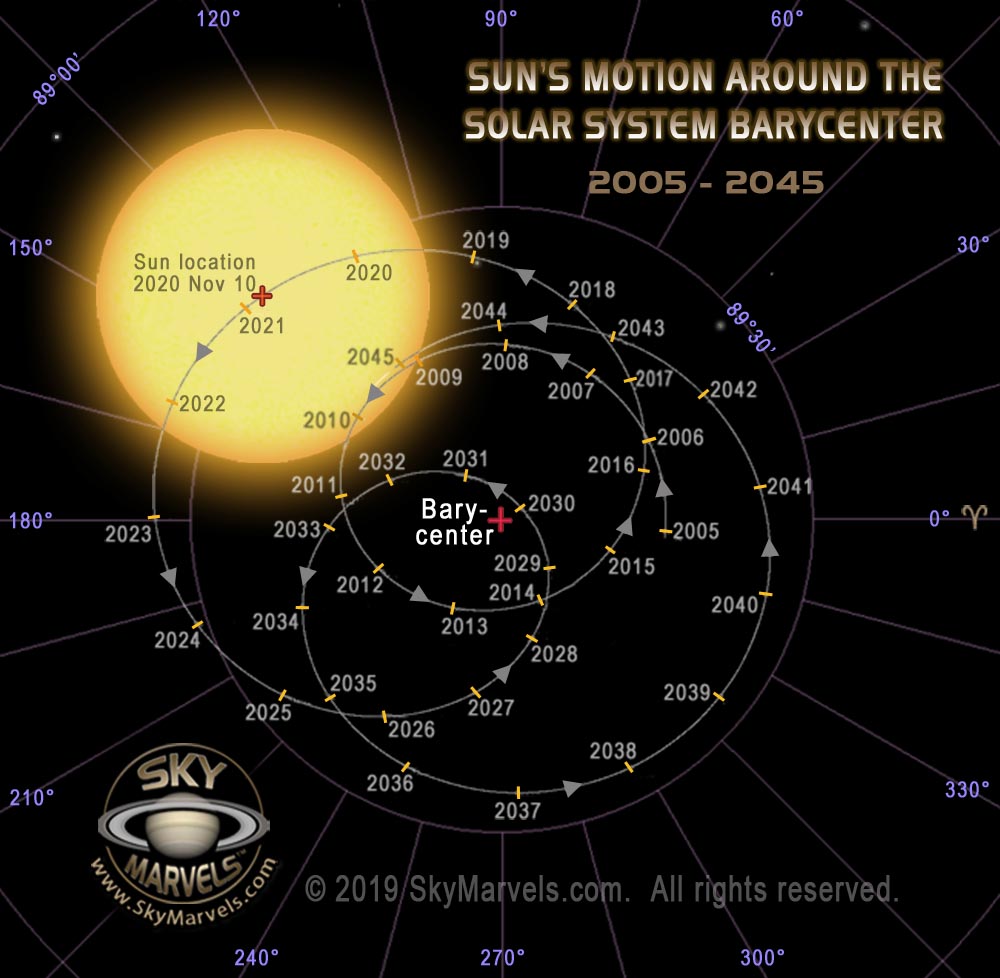
Thorry@feddit.org · 50 pts · 363d
Your mom's so fat, she pushes the barycenter of the solar system outside of the diameter of the Sun
WraithGear@lemmy.world · 45 pts · 363d
i mean, with that logic, nothing orbits anything
pixeltree@lemmy.blahaj.zone · 54 pts · 362d
For most bodies the barycenter, while not the same as the center of mass, is still inside the sun. This one isn't, making it notable
JackbyDev@programming.dev · 27 pts · 363d
No, this is actually really relevant. This is part of the logic applied to labeling Pluto a dwarf planet. Pluto and it's moon do this, Earth and our moon do not. Yes, obviously the center of mass of the two isn't the exact center of the earth but it's still within the earth.
captainlezbian@lemmy.world · 10 pts · 363d
Asking a physicist about the center of an object is like asking a Tumblr user about thr color of the sky. The only response will be "which one?" And a sigh of exhaustion
Center of volume ≠ center of mass ≠ center of systemic gravity ≠ center of lift…
MajorasTerribleFate@lemmy.zip · 2 pts · 362d
Not to mention "an object" is just a construct describing a collection of molecules that themselves don't necessarily sit still or all stick around.
WraithGear@lemmy.world · 1 pts · 362d
but the density of an object is variable. i mean you can define the diffrence between an orbit and a co-spiral to be based on the physical size of the denser planetary body containing the orbit center point, though that seems arbitrary.
deltapi@lemmy.world · 1 pts · 362d
And Pluto knows that Pluto's
Hot shit
And you know Pluto knows it
"I won't ever be a planet
It don't matter 'cause I know that I'm still"
Hot shit
"And you're hot shit too, so get out of your brain And just do what you're supposed to do"
Boddhisatva@lemmy.world · 17 pts · 362d
fedditter@feddit.org · 14 pts · 362d
Fun fact: You actually pull the Earth up with the same force it pulls you down.. Newton’s Third Law.
vic_rattlehead@lemmy.world · 15 pts · 362d
I've been told that certain peoples mothers happen to pull the earth with a bit more force than others.
fedditter@feddit.org · 4 pts · 362d
Thats a pretty thick attraction. Newtons 7. Street Law.
MajorasTerribleFate@lemmy.zip · 2 pts · 362d
FuglyDuck@lemmy.world · 23 pts · 363d
In a field of study where it’s not just acceptable, but prudent to round pi to “1” because the numbers are that big….
I gotta say, it’s close enough to say Jupiter orbits Sol. Just saying.
dmention7@midwest.social · 20 pts · 363d
Nah, there is no way any astronomer studying orbital mechanics in our solar system is rounding pi to 1. There is virtually no practical calculation you could do on the mechanics of the sun or planets where rounding a known constant by a factor of 3 would yield any useful result whatsoever.
Rounding pi to 1 only makes sense when the uncertainty in the numbers is large, not the magnitude of the numbers, and we know the masses and distances of the objects in our solar system to an amazing level of precision!
Plus, the fact that Jupiter is massive enough to actually exert an influence that large on the sun is pretty fucking cool!
FuglyDuck@lemmy.world · 24 pts · 363d
The reason being, that once you go large enough, a multiplier of three is irrelevant, and they only really care about orders of magnitude. You might be tempted to argue that that doesn't happen inside the solar system, and you'd be right. Mostly.
Except that astronomy doesn't concern itself with just our system. So yes. Astronomers do frequently round to 1 because it really doesn't matter that much in the scheme of things. (particularly talking about distances.) it's even more so for cosmology.
dmention7@midwest.social · 3 pts · 363d
Sure, I totally agree that when you're dealing many with orders of magnitude, the factor of 3 is dwarved by the other uncertainties.
But we're talking about our solar system, and specifically the orbital mechanics of our planets and sun, where the quantities and scales only span a couple orders of magnitude in total. A factor of 3 absolutely makes a difference. That's the difference between the orbit of Mercury and the orbit of Earth.
Then there's the practical point that, regardless of scale, rounding a known constant by that much makes no sense at all, unless you're trying to estimate huge numbers in your head. If you're using even the simplest of calculator, estimating pi as 1 is a deliberate choice to reduce accuracy.
mnemonicmonkeys@sh.itjust.works · 2 pts · 362d
This. Most calculators and programming languages already have pi defined, there is no reason to round it nowadays
FuglyDuck@lemmy.world · 1 pts · 362d
Not when that definition of pi goes to all 300 trillion decimals that we have resolved. (To be fair, I don’t know of any that do… but eh…yeah. And I’m pretty sure it was defined by a masochist if one did.)
That leads to unnecessary time spent calculating even simple equations. That level of precision is almost never actually needed.
With fermi problems, usually that level of precision is moot and potentially a waste of time. (Particularly when the math is requiring some kind network cluster to do.)
mnemonicmonkeys@sh.itjust.works · 1 pts · 362d
Pi has it's own button on most graphing calculators, and those that don't usually only requure 2 button presses to get it. Meanwhile, there's some iteration of 'pi()', 'pi', etc. in most programming languages
FuglyDuck@lemmy.world · 1 pts · 362d
Sure.
But sometimes, the problems are complex enough that solve time becomes a concern. When they’re complex enough, you start asking “is everything these precise enough to justify that” and when the answer is “no”, then you don’t do that because runtime on networked clusters like AWS costs money.
And when you’re talking about scales that encompass the galaxy…. Well. There’s just not a lot of precision there to begin with.
davidagain@lemmy.world · 3 pts · 363d
You've got to be a little bit careful, surely, because then one squared is ten in the sense that log pi is about half.
InternetCitizen2@lemmy.world · 7 pts · 363d
Just wait until you see their periodic table of elements.
deegeese@sopuli.xyz · 11 pts · 363d
H, He, Z
janus2@lemmy.zip · 3 pts · 363d
this disgruntled me as a biochem grad and we think the periodic table is
H C N O P S Na Mg Cl K Ca Mn Fe Co Cu Zn Se Mo I F
JackbyDev@programming.dev · 2 pts · 362d
Rounding pi to 1? Not even 3? Source please? Because what?
FuglyDuck@lemmy.world · 2 pts · 362d
fermi approximations happen all the time in astronomy. The numbers are frequently so large that the only meaningful quality is how many orders of magnitude it has.
More to the point, using pi makes calculating things much harder. For example, we don’t really need a precise distance for most things; so using “3” makes the calculation unnecessarily spend time in computation.
It’s like the old joke, “what’s the difference between a millionaire and a billionaire?” (“About a billion.”)
s@piefed.world · 20 pts · 363d
Is it more true to say that Jupiter (and the other planets and asteroid belts and dust clouds in our solar system) orbits the Sun, and the Sun orbits the barycenter? The barycenter that the sun revolves around is influenced (marginally) by the other bodies in the solar system and not just Jupiter. If the definition of a barycenter is to be interpreted as this image suggests, that would mean that no material object orbits another material object and they instead orbit their collective center of mass somewhere in space.
Edit: to clarify, I understand the physics and motion at play. The phrasing just seems misleading/incorrect to me.
bleistift2@sopuli.xyz · 21 pts · 363d
That’s exactly what happens. Why do you think this is incorrect?
s@piefed.world · 9 pts · 363d
It seems to fundamentally change what it means “to orbit” something.
As I understood the term, orbiting would be used correctly in these cases:
A lighter object orbits a heavier object, and both of their paths of motion are elliptical about their barycenter
Two objects of identical mass orbit each other, and their paths of motion are circular about their barycenter
In contrast, the image above implies the following:
A lighter object does not orbit a heavier object; they both orbit their barycenter with an elliptical path of motion
Two objects of identical mass do not orbit each other; they both orbit their barycenter with a circular path of motion
Even the Wikipedia page for barycenter, which OP linked to, opens with the following:
“the barycenter… is the center of mass of two or more bodies that orbit one another and is the point about which the bodies orbit.”
Perhaps “orbit” as a verb has two meanings, depending on the specificity of the context.
bleistift2@sopuli.xyz · 14 pts · 363d
I guess your conclusion is right. In situations where the barycenter of two (or more) objects is not sufficiently different from the center of mass of the heaviest object, we simplify the description by assuming that the barycenter and the center of mass of the heavier object are equal.
Just because I’ve already edited it, here’s an animation of Earth orbiting the Earth–Moon barycenter:
mnemonicmonkeys@sh.itjust.works · 11 pts · 363d
No, your earlier definitions are incorrect. All orbits happen around the barycenter. The only question is whether one of the bodies is large/massive enough that the barycenter is located within it
s@piefed.world · 2 pts · 363d
I mean, the Wikipedia page for Jupiter says “Jupiter orbits the Sun”
glitchdx@lemmy.world · 12 pts · 363d
Just because a more accurate description exists, doesn't mean that the less accurate description is fundamentally wrong. Depending on context, the less accurate description may be perfectly suitable for the subject at hand. If your priority is to be the most correct, then by all means go ahead and use the more accurate description.
I think this logic applies to a lot of things.
s@piefed.world · 0 pts · 363d
I take issue with how the meme says “Jupiter doesn’t orbit the Sun”, which rejects one valid and common way of using the verb “to orbit”.
flughoernchen@feddit.org · 7 pts · 363d
It's articulated as "it's wrong", while the message they're trying to convey is more like "it's not the entire truth". The latter is hard to get across is a handful of words though, likely leaving more questions than answers. I believe they did a decent enough job that most of us can read the point between the lines.
saltesc@lemmy.world · 6 pts · 363d
I thought it was a like Jerryboree but for Barys, which I think makes way more sense.
s@piefed.world · 6 pts · 363d
Jerry loves Pluto, but Bary thinks very little of it
bennypr0fane@discuss.tchncs.de · 13 pts · 362d
Do all the planets also orbit around that same barycenter, or does each planet have a different one?
badcommandorfilename@lemmy.world · 8 pts · 362d
I guess they all orbit around the solar system's center of mass (negligibly affected by the universal CoM), but that CoM probably moves around as the planets themselves move.
Relative to what, you might ask? That depends who you're asking 😉
deltapi@lemmy.world · 1 pts · 362d
untorquer@lemmy.world · 7 pts · 362d
All the solar system matter contributes to an object's orbital center but that's constantly moving as the system moves.
I think (?) most planets have their barycenter inside the sun's surface
The gravitational pull of system matter pales in comparison to the sun so you don't need to consider it for amateur purposes.
You can try KSP (Vanilla) versus Kopernicus mod if you want to feel the difference.
Also called n-body
deltapi@lemmy.world · 5 pts · 362d
The barycenter is different for each planet-sun (or any two object) pairing.
The earth and moon have a barycenter which is beneath the surface of earth. Likewise, the barycenter of the sun-earth pair is below the surface of the sun
Edit:
The barycenter of our solar system orbits the center of our galaxy (again in a barycentric manner)
CompassRed@discuss.tchncs.de · 5 pts · 362d
Technically speaking, no celestial body in our solar system orbits around a single point. The barycenter thing only works with two bodies. When there are more than two bodies, such as in our solar system, the orbits become chaotic. Granted, the influence between planets is small, so they all appear to orbit their barycenters with the sun, but there are small perturbations to the orbits caused by the locations and masses of all the other bodies in the solar system.
saimen@feddit.org · 3 pts · 361d
Isn't that the 3-body-problem? That already with 3 bodies affecting each other a system is chaotic.
vestigeofgreen@lemmy.dbzer0.com · 13 pts · 363d
I found it super helpful to have the Sun's center of mass labeled!
I only wish Jupiter's center of mass was also labeled in this graphic. I've been trying to puzzle it out myself, but I'm stumped!
davidagain@lemmy.world · 9 pts · 363d
I think if it's to scale, Jupiter is way offscreen, like in another room in your building far away.
Alcoholicorn@mander.xyz · 11 pts · 363d
Jupiter is so massive, if you give it more hydrogen, it gets smaller.
pulsewidth@lemmy.world · 11 pts · 363d
My dumb friend wants to know why adding more mass would make Jupiter smaller, can you help explain it to him?
Alcoholicorn@mander.xyz · 13 pts · 363d
I misrembered, it remains roughly the same volume, until 1.6 juipiters of mass, at which point the effect of gravity from each additional hydrogen is greater than the intermolecular forces and additional hydrogen would cause it to compress more than it would grow.
pulsewidth@lemmy.world · 2 pts · 361d
Thanks for the explanation, clears it up completely.
bss03@infosec.pub · 12 pts · 363d
The increased mass increases the force of gravity on the outer particles which ends up reducing the radius more than the increase due to the layer of new hydrogen, IIRC.
pulsewidth@lemmy.world · 2 pts · 361d
Thank you - my friend was only thinking in terms of smaller by mass not thinking about volume.
Natanael@infosec.pub · 4 pts · 363d
The volume of Jupiter is mostly gas. If you increase the mass enough, at some point the higher gravity and thus higher pressure at the center causes a phase change of enough mass (from gas to liquid or liquid to solid) that the lost volume from the phase change exceeds the original volume of the added mass.
It's like pushing a bunch of origami paper into a box until a bunch of them collapse and fall flat instead of filling the volume.
pulsewidth@lemmy.world · 1 pts · 361d
My friend is silly - he was thinking of smaller as in by mass, not by volume. Thanks for explaining it to him.
JackbyDev@programming.dev · 4 pts · 363d
Imagine a stack of glass cups. It gets tall enough that the bottom glasses break under the weight of the new glasses. Tada!
scrubbles@poptalk.scrubbles.tech · -1 pts · 363d
Is your friend the same crazy person I know who doesn't eat meat? Are they crazy?
_i don't know why your comment made me think of that reference _
mnemonicmonkeys@sh.itjust.works · 2 pts · 362d
...
Lots of people don't eat meat.
scrubbles@poptalk.scrubbles.tech · 3 pts · 362d
It's a Simpsons quote.
ABetterTomorrow@sh.itjust.works · 10 pts · 363d
That’s why I lose my balance!
Sidhean@piefed.social · 9 pts · 363d
Fun fact: if I threw a rock hard enough, it and the sun would orbit around their "barycenter" which would happen to be just about the center of the sun (probably, i dont work here).
SCmSTR@lemmy.blahaj.zone · 7 pts · 362d
Jeeezzz...Gravity is relentless.
some_kind_of_guy@lemmy.world · 4 pts · 362d
Gravity always wins
MajorasTerribleFate@lemmy.zip · 2 pts · 362d
Dark energy would like a word
magnetosphere@fedia.io · 6 pts · 363d
I’m no astronomical guru, but I’m surprised I didn’t know this.
Lost_My_Mind@lemmy.world · 15 pts · 363d
When I was a kid, we were taught there's 9 and only 9 planets, they all orbit the sun, and humans have existed for at least 30 years.
Now I find out 1 of those 9 planets was a fraud. Theres also thousands of OTHER planets outside our solar system. And also, time is an illusion only placed in our reality to distract us from the concept of a realized immortality. We die when we want. We come into this world naked, bloody, covered in goo, and getting spanked until we cry. And we die the same way....when we WANT to!
School is all a bunch of lies man! Trust your instincts! Consume prilosec!
InternetCitizen2@lemmy.world · 12 pts · 363d
True
Phen@lemmy.eco.br · 4 pts · 363d
I'm actually faithful to the Church of Last Thursdayism, so I do not believe that.
Gladaed@feddit.org · 5 pts · 363d
No one objects orbits another. There are no stable orbits since there are no examples of two perfect point masses in an isolated space.
gandalf_der_12te@discuss.tchncs.de · 12 pts · 363d
just assume a spherical cow, dude
ProgrammingSocks@pawb.social · 5 pts · 362d
This is true about any 2 objects with mass.
jsomae@lemmy.ml · 26 pts · 362d
No, it is not true in general that the barycenter lies outside both objects.
ProgrammingSocks@pawb.social · 0 pts · 361d
I mean, sure, but you can reasonably glean that I'm just talking about the fact that any 2 objects with mass exert gravity on each other. The OP is facebook-tier
jsomae@lemmy.ml · 2 pts · 361d
I can't reasonably glean that, because the OP clearly says this:
I agree that OP is facebook-tier but your reply is reddit-tier :P
ProgrammingSocks@pawb.social · 1 pts · 361d
You're being pedantic to levels most redditors could only dream of. A barycenter isn't even necessarily outside the 2 objects, if you took the OP to mean that, it's incorrect information anyways.
jsomae@lemmy.ml · 1 pts · 360d
The OP does not claim that all barycenters are outside of the sun. OP correctly claims that Jupiter & Sun orbit a certain point, and that point is known as the "barycenter," and that point is outside the sun. I'll admit they could have gone further to convey the additional curiosity that for other planets the sun-planet barycenter is within the sun, but then it might not be facebook-tier anymore.
I literally do not understand why you think I'm being pedantic here. The OP text is short and contains no obvious errors that I can see. Perhaps to someone who has made a mistake and doesn't want to admit it, attempts by others to point out this mistake must resemble pedanticism.
kerrigan778@lemmy.blahaj.zone · 11 pts · 362d
"outside the objects"
SippyCup@feddit.nl · 7 pts · 362d
It was outside the environment.
OhStopYellingAtMe@lemmy.world · 4 pts · 361d
A wave hit it.
boonhet@sopuli.xyz · 3 pts · 362d
The front is not supposed to fall off
ProgrammingSocks@pawb.social · 1 pts · 361d
Barycenters are not necessarily outside the objects, either.
ProbablyBaysean@lemmy.ca · 4 pts · 363d
I really want a space station in the barycenter of Pluto or something. It would be as close to true neutral of gravity instead of the gravity negated by acceleration of mass that may or may not screw up gravity experiments
Allero@lemmy.today · 5 pts · 363d
Except there are all the other planets swinging in the way, with their own gravitational influence.
brown567@sh.itjust.works · 4 pts · 363d
I think what you're looking for is a Lagrange point, specifically L1, where the gravitational pull from both bodies are equal, so they cancel out
mnemonicmonkeys@sh.itjust.works · 1 pts · 362d
Fun fact, we can theoretically use that to build a space elevator on the moon. Last I checked, Nylon was strong enough to build the needed cables
brown567@sh.itjust.works · 1 pts · 362d
There are a few more problems than material strength
For one, the moon isn't geostationary, and my napkin math says its ground track probably progresses at over 1000 kilometers per hour. Not to mention the inclination of the moon's orbit (about 5°) and the obliquity of earth's axis (about 23°) mean the track wouldn't be a single track around earth, but instead would wander anywhere between the 28°N/S latitude lines over the course of the year
mnemonicmonkeys@sh.itjust.works · 1 pts · 362d
Not a space elevator between the Earth and Moon. A space elevator for just the moon.
While a railgun is a more practical option to set up, it's still fun to think about.
And for non-rocket launches feom Earth, we're probably better off setting up orbital rings
humanspiral@lemmy.ca · 4 pts · 362d
how much wobble does the earth add to sun? over 1m?
ODuffer@lemmy.world · 3 pts · 363d
Your mom....
altphoto@lemmy.today · 1 pts · 363d
Simeon's cousin is definitely going to say that their dad owns the Gary Center.
shalafi@lemmy.world · -1 pts · 363d
Aren't we simply talking about LaGrange points? Or am I misunderstanding?
onslaught545@lemmy.zip · 4 pts · 363d
I think Lagrange points are where geosynchronous orbits are possible without constant corrections.
CookieOfFortune@lemmy.world · 7 pts · 363d
Geosynchronous means the orbital period is a day and relatively circular. Satellites with these orbits basically look down at the same part of the Earth.
Lagrange points are locations along an orbit where gravitational forces balance out with the centrifugal force of the orbit. This does allow less fuel expenditure to maintain.
For the Earth-Sun or Earth-Moon systems, the Lagrange points do not occur at the altitude of the geosynchronous orbit. The Lagrange points are either significantly further away or at a different orbital phase.