Private businesses being allowed to buy up the market to artificially increase prices and scarcity. How else can you ensure real estate is a solid investment stream?
I think that's part of it, but a larger part--having been a local reporter--is that government is run by people trying to keep property values high. In cities, that's real estate developers and landlords. In suburbs, it's typical homeowners.
Most construction brings down property values: increase supply=lower demmand=lower prices. There is therefore a strong political will to oppose ALL new construction.
The second concern is: how do we keep poor people out? Things like minimal lot sizes are designed to keep the prices up and limit the amount of new citizens.
The third concern is: how can we spend the most of our money on OUR children's education. Many suburbs are spiritually and economically designed to do ONE thing: get kids into good colleges. That means high property valuations across the board so the most money can go to individual children's education. There are very many suburbs people don't even move to UNLESS they're having children, and they move out when their kids leave school.
If you build an affordable apartment building in one of these suburbs and children start moving in, what happens? THe money from the rich houses is now diverted away from the rich children and towards the poor children, who are now paying much less in taxes. With schools less valuable, the property value of ALL the houses go down. "We're all in this together," the rich people realize, refering only to themselves, of course.
I do like the oligopoly narrative, but we have to face that we are facing MASSIVE FAILURES on a social and political levels. Everybody is scrapping for themselves and building walls and pulling up ladders and basically being as self-interested me-and-mine as possible, at the same time money is becoming the dominant form of political activity with which the masses of regular people can not compete.
The other factor with much of our development is that it requires an automobile, automobiles that are consistently getting more expensive to buy and repair. We've really fucked up.
Right now, the folks keeping an empty unit for speculation can afford to keep it empty.
When the less wealthy investors who need to pay a mortgage for their micro-estate empire of 3 units realize the demand is fading, they'll be forced into lowering rental cost and maybe even selling.
China has seen a ginormous housing value appreciation over decades. The population is shrinking and the correction is happening. It is brutal.
And these cancerous parasites are doing it to everything possible, sucking the goodness and value out of the entire planet and life itself, because their greed is a terminal mental illness.
There's probably another 10% owned by individual landlords with 3+ properties as well. It's driving prices far more than you think. I'm my town something like 37% of single family homes are rental properties, if you don't think that's causing insane inflation of house prices in my area you're crazy.
Really basic 100m2 house is 450.000€ here. No basement no lot. Construction is stupid expensive since ukraine war started. Add to this, everytime there's a sale several people demand processing fees in % of the value including state... This drives prices only up.
Doesnt help that china built their economy on real estate in the last decades, consuming lots of the raw materials. Also ever stricter regulations like insulation, heating, electricity is a point.
Companies buying homes shouldnt exist but we are at 650-750k for a 4 person home with barely any lot without that already.
Here's the history of US inflation in a nutshell.*
Lyndon Johnson wanted to have a Great Society and have a quick win in Vietnam. He thought that a big buildup could give the US a knockout blow, but it turned into an expensive quagmire. The US was dropping a dozen Hiroshimas worth of bombs on the jungle every week. This meant that US steel mills were working 24/7 and not getting updated. LBJ is printing money to pay for this, because he doesn't want to raise taxes.
Nixon comes in in 1969, promising to end the war. Instead he triples down on the policy of printing money and overworking the factories. Then the Arab Oil Boycott hits. Prices of everything jumps. Many small manufacturing businesses either go broke or relocate to non-Union states. All those fancy Manhattan lofts you see today started as factory buildings.
And while the US steel mills were running day and night, Japan and Germany couldn't get American steel, so they started building their own mills. Mills that needed a lot less power than the aging US mills. Suddenly Americans were willing to buy a tiny Japanese car instead of a Detroit model that got 6 mile to a gallon.
Jimmy Carter gets one term as President before the Iran Hostage Crisis ruins him. Carter hires Paul Volker to run the Fed and save the economy. Volker's plan works, but it's Ronald Reagan who gets the credit. Ronnie kept Volker in place.
Reagan has his own version of Nixon's print and spend policy. Tax cuts for the rich and bank deregulation create an artificial boom in the 1980s that lead to a stock market 'correction' in 1987.
When Nixon came into office, 'middle class' was one Union job paying for a family of four and $1 million was considered a vast fortune that could buy a dozen houses.
By the time Bush Sr. was done, 'middle class' was two incomes to support the household, and $1 million was what a rich guy paid for a party.
*this is a very brief description, leaving out many details.
Eh..... I think this puts a bit more emphasis on the economic impact of US Steel to the overall economic outlook during the post war period.
The steel industry was more important to the US economy from the later 1800s to the post war boom, but a lot of the growth in the US market started to diversify way before the Vietnam war. Automation and the popularization of mini mills hit the US steel industry harder than anything.
The same thing goes for the accusation of "printing money" being the real cause of inflation. In reality the rapid rise in inflation was one of the reasons Nixon moved to fiat currency. The Brenton Woods system was leading to American gold reserves being drained by other nations right when Germany and Japan began to recover during the post war period.
Tax cuts for the rich and bank deregulation create an artificial boom in the 1980s that lead to a stock market 'correction' in 1987.
Tax cuts and deregulation is probably the most significant reason we see the wealth gap start to take off. As well as a general change in attitude of CEO like Jack Welch who popularized the shareholder value movement in American business. He pioneered mass layoffs, cuts to pension, and investment cuts to increase paper prophets. Combined with the legalization of stock buy backs and you have today's modern economy.
That would be interesting, but I'm not sure how useful it would be given that "inflation" itself is a heavily massaged and manipulated metric. It's one of the many layers of the illusion that the powers that be craft to separate us from the physical reality of why so many more of us have to work harder for the same or less. It only reflects actual reality to the extent it is politically necessary to so it can maintain some semblance of legitimacy. It may be better than nothing for adjusting such charts but it's also misleading in its own way.
People figured out they could buy more than one house and rent it to other people, paired with a housing shortage partially due to people/companies owning all the houses, paired with technology to allow you to rent your houses out for a few days here and there to make income.
We allowed house ownership to become entangled with entrepreneurship.
that’s not broken though. this is how capitalism works at a temporal scale. we were marketed to and sold lies. on purpose. by monsters who have spent centuries making us think we can achieve a “dream.”
Even before that there was a boom in people using houses as an investment opportunity instead of just a place for people to live. Land ownership became the get rich quick opportunity that people who don't play the stock market could put their money into. Then the people who do play the stock market got into it.
the same reason they'll never ever ever go to a 4 day work week, or allow work from home, even though those things are proven to increase productivity-- maximum possible suffering
Yep. With the repeal of Glass-Steagal, the commercial banks used for things like mortgages, checking accounts, and car loans were able to merge with investment banks. The Act was out into place in 1933 because having retail banks mixed with investment banks was why Black Tuesday lead to the Great Depression.
That allowed houses and mortgages to be combined into investment packages for the speculators, and lead to prices skyrocketing.
It's what caused the 2008 crash, and in all the aftermath of that, nothing was actually done to fix the issue. The fix was simple - re-divorce them and reinstate Glass Steagall.
Housing became an investment so people bought more than one.
Houses are twice the size they used to be. So they cost twice as much for that.
Houses have a lot more regulations and codes they must comply with. Your 1970s wiring is out of code and the new stuff is more expensive. 1970s plumbing is out of code and more expensive. Your 1970s insulation is woefully insufficient and cost more money. Your 1970s house didn't come with an AC unit. Your 1970s house did not have built-in fire suppression.
We build less houses now than we did in the 1970s.
Any one of these four factors would have caused house prices to move up faster than inflation. All three of them together created a perfect storm.
That just increases rental prices (making buying more attractive, but that's not an option for many people, and also supply is constrained).
I think the best is just to not allow buying a home for the purpose of renting it out. If you want to rent out a property, sure, but you need to build one first.
It's not just size and quality though - my house is the same size as my mom's house was, hers was 13,000 in the 1960s. It's the same size as the old one I bought for 36k in the housing crash in the 1990s, and sold for 80k in 2010ish, after an addition and metal roof. It is actually for sale again now by someone else after more renovations, they are asking half a million and will probably get close to that.
The one we have now (same square footage, half built in 1940, addition in 1990s) we had to pay almost 300k and is "worth" (market, not underlying value obviously) like half a million, we did improve it with hurricane windows and metal roof and roof attachments.
I have never bought as an investment, only as housing. Something is broken, I DO think my house is worth maybe 200k as a real value, I think we overpaid. but the prices now are so much worse than that.
Yes Florida building code is serious so new houses do have additional utility. But I have only lived in older houses and they are also out of control price wise.
The big new ones around here go for 1.5 million now - I could have bought every house on my block in the 1990s for less than that.
Now imagine that house burned down. How much would it cost to replace it under current code compliance and construction costs? How much is it insured for? For example, my house is currently valued at about $200,000. I could not rebuild this house for $200,000. I'd be lucky to be able to rebuild it for $260,000.
Anyway, let's get back to the main point. There's more than inflation going on here. There are multiple factors, not just one.
Yeah my husband thinks 350k would rebuild it, because part of the value is the land. But we could not rebuild what we have for any price, because the wood it's made of is not available anymore.
And yes - some of the increase is apples to oranges, just like with cars - the 1967 mustang I had was good for about 100k miles, maybe. New cars last easily 3x that, and safer and more efficient.
But no way is that most of the increase. There needs to be some relationship between pay and housing that makes sense. With insurance and tax, those million dollar homes would cost nearly 8k per month even if no repairs or maintenance- that is so much more than the netpay for a good job, I don't know who is buying them.
I have seen several crashes already, and know price doesn't just increase forever. Am watching with interest to see what happens here.
Housing became an investment so people bought more than one.
Second homes are far less of an issue than tenth homes or hundredth homes, what with the rise of rental property consolidation and AirBnB-ification.
Houses are twice the size they used to be. So they cost twice as much for that.
That's not how homes are priced, though. The real raw materials for construction are a fraction of the total cost. Which is why you'll see old ranch homes broken up into clusters of three-story townhomes the closer you get to growing downtown districts. Also, why you see increasingly shoddy construction jobs in new-builds, as compressed lumber and stucco replace concrete, steel, and hardwood. Nevermind the cost of labor, which is all over the map depending on whether ICE has decided to raid you recently.
Houses have a lot more regulations and codes they must comply with.
They've also become more cookie-cutter standard. Far fewer custom homes. Far more big developers who get a rubber stamp (or pay bribes to the right people) to roll out a thousand-unit development.
We build less houses now than we did in the 1970s.
We have less undeveloped real estate connected to highway access points than we did in the 1970s. And we have more Boomer-vacated housing re-entering the market.
The single biggest proximate cause to the housing price boom has been the ZIRP interest rate policy, flirted with after the Dot-Com bust of '01 and bought whole-hog after '08. We've been living in an era of low wages and cheap lending. This has resulted in a historic consolidation of private ownership under banks and hedge funds that have proximate access to the Fed credit window.
The end result is housing units being bought for a market rate and rented for a profit, until the market saturates and you have a sudden forced liquidation. These long drawn-out real estate famines punctuated with sudden windfalls reward people who just happen to be in the market at the right moment. But they otherwise stack the deck in favor of people with the most borrowing power.
Materials require labor. Labor requires inspections. The more material the more everything else. And those materials cost more because they are to much tighter specifications than they were in the 70s. The lumber might be cheap but a fire suppression system in a 4000 square foot house costs a lot more than no suppression system in a 1200 one.
But as you point out it's not really about materials though. It's about square footage. You don't get a bulk discount for buying a 5000 square foot house instead of a 1200. You pay even more. And zoning won't let you build a 1200 anymore because they tax based on square footage so they jacked up the smallest house size they will approve.
There is no single cause for houses being more expensive. It's a whole host of them and that's why prices climbed faster than inflation.
You don’t get a bulk discount for buying a 5000 square foot house instead of a 1200.
Per sqft? You absolutely do. Buying one 5000 sqft house will almost certainly run you less than buying four separate 1200 sqft units, all else being equal. If anything, larger houses are a result of cheaper material inputs. PVC and compressed lumber make manufactured homes easier to produce than their historical brick and mortar and copper pipe counterparts.
So I think you have it backwards. Houses have expanded in size to justify their inflated costs. But the real price inflation is happening at the ground floor.
There is no single cause for houses being more expensive
Privatization and financialization are both but-for drivers of price-inflation. Cheap lending means more dollars are chasing the same number of goods, despite flat wages. The functional extinction of public housing means there's no price ceiling for entry level housing units established by the state. So prices compress around the median purchase rate, while low-income households are entirely priced out of the marketplace and middle-income households are larded up with debt.
If you think building a city from scratch is expensive you should see what it takes to make an apple pie from scratch. You must first invent the universe.
I do have to agree with you. It's a demand issue, combined with the rate that it is being built.
I think it would be fully okay to have the cost of a house be multiplicative, based off how many you own after the second house. So, if you are looking to buy a third house, the price is actually double than what you would be expecting, and then your fourth house would be triple what you're expecting, etc.
The price of the house will be the cost the seller lists it as, and the seller gets the cost that they listed it as. However, anything over the cost it was listed, if you are affected by that multiplier, has that money go straight into the government.
The reason I say after the second house is because I do personally think it's fair for someone to want a vacation home somewhere, I just don't think it's fair for someone to have an interest into having a second, third, fourth, or sometimes even fifth vacation home. And there are many cases where you would want to own a second property such as if you run a self-employed job such as a computer repair specialist, you will probably own a shop, and having a office that's at twice the cost of what it normally would be is extremely cost prohibitive to someone wanting to get into the market.
I also firmly believe that there should be quite extortionate taxes for buildings that are labeled residential but have an owner who primarily rents it out for more than a quarter of the year. The whole Airbnb our property is technically zoned residential but are actually commercial loophole is absolutely ridiculous and a huge problem. If you aren't allowed to put a motel or a hotel there, you shouldn't be allowed to have an Airbnb there.
That's trickier than it sounds.
The places where people buy third homes are the same places where NIMBYs can stop development of poor people housing. Even though those rich people need servants and servants need quarters.
If we’re already living in a world where we can tax homes at 100%, 200%, etc. then we’re also living in a world where we can pretty easily tell NIMBYs to go fuck themselves.
Catch 22. As a politician you gotta please the people with money. The people buying homes taxed 200% have the money. Until we reach Star Trek levels of selfless post scarcity society that's not going to happen and by that point it won't be necessary.
The 1974 Tax Code re-write, that baked Trickle Down Economics into our tax code, created the Oligarch class, giving them the disposable income to manipulate political policy to their further benefit.
The Rand Corp issued a report on income inequality, and the situation is far worse than most people think.
The median salary of $43K in 1975 has increased to only $50K today, while they would have been making $92K if the tax code hadn't been steadily re-written to enrich the wealthy at the cost of the middle class and poor.
In that same time period, the mean income for the top 1% went from $289K to $1.384 million, while they would have been making $630K under the old tax codes.
Thats a 17.4% increase in the lower median, and an increase of 321.6% in the 1% median. Clearly there has been an upwards distribution of wealth at the expense of the middle class since the tax codes started to be re-written in 1974 to favor the top economic tier.
Yes our earning power is trash compared to the 70s, and I think there are more reasons for that than what you stated. But your answer didn't really address why homes specifically have dramatically outpaced the general rate of inflation.
Probably because land is one of the best non-fungible assets around. You buy land and you have something whose upper limit on price is only limited by what someone else wants to build on it. And premium space around existing economic centers (cities) doesn't just spring up.
The wealthy aren't paying their fair share. They pay way less than they should in taxes and keep accumulating wealth and buying up shit, which of course is coming from us. That then increases prices because more normal people need it.
This is exactly it. All of the other answers in this thread are dancing around this issue without even knowing it. Some happen upon it, but move on like it's a side item when it should instead be lit up with lights and sirens as the main event.
Regular people spend the majority of their income on the things they need to survive; food, shelter, energy, clothing, etc. The wealthy and ultra wealthy spend only a miniscule fraction of their money on the same things, so they put that pile of remaining money into investments/assets (stocks/shares, housing, etc), which make them even more money, which they put into more assets which make them even more money, and so on. But the money flowing to them doesn't come from nowhere, it comes from YOU.
Collectively speaking, you go to buy a home, they outcompete you on the price, and then gladly rent it to you, all while jacking up the rent over time. They use that extra money from you to buy even more assets. You somehow manage to buy a home, but at a highly inflated price, the money is lent to you by... guess who. And they charge you interest every month, which is money flowing from you, so they can spend it on... even more assets.
Higher prices at the corporate owned grocery store because the shareholders demand even more dividends. Because goods at the store coming from corporate producers raised the price for the same reason. Because little producers that used to compete in the market are being bought up by big ones that can afford it because they pay next to no corporate tax. But who are the shareholders receiving the dividends? 80% (and rising) of the stock market is owned by the 1%, the people who already have more money than they could ever spend.
Now we've got higher prices for energy for a multitude of reasons, but a fresh new hell is it's all being gobbled to power data centers. Whose ultimate purpose is an attempt to replace people's jobs with "thinking" computers. Whether they'll succeed or not is yet to be seen, but we do know it is being funded by billions of dollars that someone has... guess who again. If they do succeed, then that's even more money sucked away from you in the form of lower wages at minimum. If it blows up in a catastrophic bubble, they will demand a bailout again, just like the sub prime bubble.
Our failure to tax the obscenely rich allows them to walk all over us, taking money from us which they use to build the machinery to walk all over us with even greater pressure, which takes even more money from us, and so on. It's literally exponential, which is why nobody appreciates nor understands it.
You are not rich, will never be rich. The ones who actually are, are doing everything they can to keep you out of their club. You'll know because you'll be paying taxes and they won't. Which are going to go up soon by the way, to pay for that bailout.
According to the alleged dynamics of capitalism, housing prices should be somewhat flat. Build houses that are too big and expensive? Demand is down for that market subset, gotta drop your prices or stop making such but houses. Housing supply is low? Prices go up, so companies will build more housing to make money off of that, increasing supply and stabilizing prices!
So the dynamics are not working like that. Now of course real estate has a "natural monopoly" aspect, certain land is less valuable because it is just too hard to get to and from relative to what people need to do: work, eat, go to school. So land rents are higher in some places more than others because of this. Am economist might call this a distortion.
But there is a much more important aspect in the US and similar economies, and that is financialization. Some comments here say prices are very high because houses are treated as an investment. That is true, but also incomplete, and it might make you wrongly think that it is individual homeowners saying, "this house will be worth more later so I will buy it". This is not enough! The financialization is by the bank that sells you a mortgage, that takes a nice percentage of your money in exchange. They can then make your house into a form of equity that can be seized later as needed if you're not profitable enough, which they carefully calculate to decide on your initial interest rate. And then they can gamble on that equity on the market. That equity is only worth something if the actual house has value and it has value because they will still loan you that amount on a new house. So an individual home buyer might buy based on the ability to be financed, sure, and the expectation that it will be worth it. But this is only possible because the mortgage lender themselves sees it as profitable for them to do so. If those high mortgages were not available, nobody could buy the expensive houses, land values would plummet, and so would housing prices, etc. of course because the dynamic is capitalist, this would involve a massive disposession and immense suffering if done at their hands and potentially threaten mass organizing and a threat to real estate profits, so whenever that threatens to happen (like 2008) the state keeps finance (and therefore real estate) afloat with free money.
So why aren't more and lower cost homes built, especially in the locations that need them? They bring down property values that have been gambled on by huge institutions. Only luxury apartments can be built, not affordable housing units. And real estate basically owns your local government, and every politician above that level is still beholden to them. Ultimately they can crash the entire "economy" if needed.
I think this is way too complicated, a much simpler effect describes the housing cost:
Wealth inequality drastically worsened over the last 40 years. The uber rich got even richer: while the vast majority of people has little to no money and can’t afford a house or other assets.
Rich people have (compared to their wealth) low consumer spending, but they massively accumulate wealth.
What’s the wealth spent on? Assets.
That’s why you see all the assets go up - stock market highs, gold price up, housing prices up, everything up.
It’s as simple as that. Rich people don’t know where to put their money except buying more assets, which drives their prices up massively.
Where I live they don’t make starter homes, everything is 800k and up, 2,000+ sqft. People can live in 1,200 sqft and are good starter homes. Have them start at 400k (CA so everything is expensive)
Yes and that is the logical conclusion of what I said above.
If regular people and families have no buying power, then houses that suit their needs will not be built. Rich people have buying power, so luxury apartments and suites will be built.
A guy bought the property next to my house. He was going to tear down the house that was there, but our historic district stopped him. He had to restore that house and convert it to a duplex. Then he squeezed another house in the strip of land in between.
It is hideous. When my mother-in-law visited, she asked why they were building an office building next door.
We had an investor do that to us, it was 3 houses down and built 3 units with no parking. Plus the house could look down in our pool and all other homes in the neighborhood were single story. Then they painted it hot pink. It was an eye soar
Individual rich people don't lend the mortgages, it is large financial institutions that do that and then use the equity to do even more gambling. Individual rich people own a few expensive properties, sure, but this accounts for very little of the overall residential real estate "market".
But when nations restrict the financialization of housing, prices flatten or even go down.
The finance side of things has also enabled a kind of house size inflation. Anecdotally, I've seen new tract housing go up in areas that need housing, which were all 3000 sq/ft each. They could have developed for higher density and sell more units, but I guess the margins are better on houses that sell for 700k and up. Especially if folks are willing to go into deep debt to pull it off. Plus that does little to ease demand, so the cycle can continue.
Real estate development tends to be done on loan. Before the decision to buildi a house is made, it is pitched to the lenders. The lenders also lended mortgages for other houses in the area and own a few, they want values to go up. The lenders approve the more expensive developments expected to increase real estate prices, not the lower income housing. The lenders can always choose a different developer to give the money to, the one that will pitch the higher perceived value development.
There is their economy (meaning the billionaires economy of venture capital, real estate investment firms, speculative markets, etc...) It's a market that exists on paper only. Theoretical billionaires with assets instead of bank accounts, capital instead of paycheques. Money isn't a real concept in that economy, it's simply a measure of profit and loss. It's just a score keeping device and something used to leverage power.
Then there is our economy. (meaning the rest of us, who get a paycheque, spend that paycheque, etc...) Maybe we'd be able to put something aside for retirement or college for the kids. . Money itself has a real, tangible impact in our lives. It's not theoretical.
Maybe we have enough to play in the paddling pool of the speculation market, telling ourselves that "we're shareholders!" like our 10 shares means squat against the 10,000 shares owned by the investment firms and LLCs run by the billionaires. Employers like to do things like offering you stock options, selling it as "you'll be an owner and have a say in the company". Yeah...no...you'll have a piece of paper and a sense of self-importance because you "dabble in stocks".
The idea being that if we invest hard enough, and risk enough, we'll make enough to jump us from one economy into the other. But we won't. That's the lie they tell to keep us mollified.
Because the truth is that their economy, only works at the expense of our economy. Profit in their economy, only comes from loss in ours. A corporation can't make more profit without taking it from somewhere. And that somewhere invariably is us; our health benefits, our cost of living, the quality of the products that we use, our lack of raises, etc...
By and large, I agree with what you wrote, but they can always chose to have us shot, "suicided," imprisoned, institutionalized or simply disappeared. No, they need us to keep their big MLM scheme called "capitalism" running. No base, no top.
If you actually look at the cost of labor and materials to build a house today, its not far off. The difference you see is the cost of allowing enormous corporate development companies to exist and do business in this country. The false scarcity on top is a product of the greed that keeps people out of housing to begin with.
I have recently had an estimate made for materials to construct a 1200 square ft home and it was a little over 135k. Add in labor and its looking like $175-200k. Compare that to the $800k starter homes in the area and you see a huge disconnect.
You attacked me for not knowing the price for construction materials, implying that my statement of the cost of homes being close to the $138K in the OP was way off. Then I showed i knew what I was talking about, and your argument became land price and hidden costs of construction. Thats exactly what a straw man does. You move the goalposts and create a new argument instead of addressing how you got called out on your bullshit.
I mean, no offense to the OP, but this is a constant game of bullshit in a country as large and sprawling as the United States. The problem with housing prices isn't simply "median price", it's "proximity to the work site" and "proximity to public services" and "size sufficient to host my whole family". You can show me a house for $80k out in the de-industrialized Midwest or the boonies of rural Wyoming. I won't buy it, because I have nowhere to commute to work or send my son to school or a grocery store to shop at or potable water that won't kill me. You can show me a high rise in walking distance to everything I need, but if it's $1.5M I can't afford it.
If it's $100k for one of a hundred vacant rotted out homes in the slum and $300k for a single unsold 70 year old ranch house in the burbs and $500k for one of the fifty newly built 600 ft condos in city, taking the "average price" doesn't answer the question "Where am I going to live?"
This is an important aspect. Someone above this said “houses are twice the size now so they cost twice as much” and I just had to shake my head. It’s not only new construction that’s expensive.
But whether it’s the cost of all homes or the pricing of homes where they’re in demand, the ultimate question is still the same: why haven’t we had enough housing where it’s needed for prices to be more stable?
But any good answer to this is going to hit 20 different points. Urbanization. NIMBYism. Private equity. Foreign buyers. Empty homes. Changing codes. Suitable land. And on and on.
the ultimate question is still the same: why haven’t we had enough housing where it’s needed for prices to be more stable?
"Enough housing" is a bad way to frame it. Because - again - we have plenty of vacant housing in the deindustrialized midwest. We have plenty of vacant real estate in the Great Plains. We have a dormant cache of vacant units in large dense metropoles. Why aren't these being filled?
No jobs
No infrastructure
Speculative rent-seeking
In that order.
But any good answer to this is going to hit 20 different points.
You can drill down to any individual location and ask why the current housing situation exists/persists. But this YIMBY attitude that the solution is always more New Build constructions on the suburban periphery or massive teardowns of inner city occupied real estate is just six developers in a trench coat putting one over on you.
Yeah, there's complexity in these markets. But private sector finance driven central planning really does boil down to "profit maximization" wherever you are. The real question, at any given region, is whether you have a housing surplus (because absent demand) or deficit (because excess supply) and how that shapes the prices of units. And a lot of that comes back to who has access to easy credit and who does.
Among many other things, people now vote in local elections according to “what will be good for my property value” and this often (usually) doesn’t mean making more affordable housing available. It’s a very specific case of NIMBYism. Luxury condo building with 15% affordable units? Not where it will affect my property value!
Who is "we"?
People listened to a bench of folks telling them how great it is that their home value will appreciate.
Most of them owning 1, that didn't benefit them at all: you sell to buy another one that appreciated just the same, but they were happy to be told about their wealth magically increasing exponentially, punching way above their weight.
A few owned more than 1 and think of themselves genius and wise investors as they made quite some money.
The people who told these stories owned legions of them, or built more thanks to large capital availability, their wealth considerably increased, and they laughed at the commoners who were --once again-- fooled.
The younger generation now pay the price of this deception as they've been driven out of the market, and the same people who told stories yesterday suck them dry through ridiculous renting prices now. A lot of the young have 0 chance to ever own a home in these conditions, they're giving up on home, on having children (multiple factors here), and with that, they also give the middle finger to hard work (when they can…) as they know too well they'll never be rewarded for it. But no worry: inflation going faster than wages will force them into hard work just to barely survive, and eventually they'll be enslaved by their debt.
And the same people who were fooled about the benefit of house value insane appreciation now scold them about "how hard they were working at their age".
And the same people who told all of the stories look at them fighting among generations and laugh even more while drinking Champagne: their financial future looks brighter than ever!
Average can mean so many things. A lot of people want it to be synonymous with mean as a measure of central tendency, but there's a reason data people use mean. It avoids folk definitions meaning typical or expected. In those senses it can also be synonymous with modal values or an area around the median etc. It's not a precise word.
I was born into a house in the 70's that was massive. Sure it was dilapidated but there were big houses. Watch caddy shack and look at the house the main character lives in that you see at the start of the movie.
3% mortgages did this. If mortgages were kept around historical averages of 7 percent, the asset inflation wouldn't have occurred. The monthly costs at 7 percent currently are unaffordable except for the top 20%.
That's with 7% being an average, they were in the high teens in the 80's. Funny how that works. Rates go up, house prices go down and vice versa. Supply and demand of course but it's as if cost of living is based on what you can afford to pay not what the product is worth. Throw in property taxes and there's another pesky variable affecting the price. I once considered buying a vacation cabin in NY state because the price was remarkably cheap until I saw the property taxes. A mortgage gets paid off but property taxes are forever. I guess my long, rambling point I've piggyback onto yours is it's more complicated than "capitalism sucks"
Allowing the Fed to artificially keep interest rates down for 15 years is not "Capitalism sucks". Its pure, unadulterated asset inflation purposely done. ZIRP policies were a choice made that have gotten us to where we are with asset prices.
We got rid of pensions, scaled back social security (both spending and taxing wise).
Homes and 401ks thus became financial retirement plans.
And we allowed significant interplay between the 401ks, and homes, in financial markets. It became an entire speculative industry, all intertwined and intermingled, a free for all for both old money finance and 'entrepenuerial' home flippers and petty landlords.
So that's why they inflated more, basically.
Yeah it is more complicated than that, there are other important factors ... but... that is the ultimate truth of it, imo, the main driving causality.
We turned homes into speculative financial assets, so obviously, their prices became inflated and volatile.
And then that, the broad price increase, using homes as a basis for financial returns... well that perverts the incentive structure for new home builds and pricing.
You don't build affordable homes any more.
You build homes that are min-maxxed at a 'perfect price point'... and size, and feature set... so they function best as investments: McMansions.
You now you have an oversupply of pricier homes... and an undersupply of cheaper ones.
This dynamic compounds upon the other dynamics, feed themselves... makes prices rise more, and prices be more volatile.
Gotta throw in the reminder, that Jon Brooks himself will tell you:
Large Fin Insts only directly own around 10% of US residential properties.
The vast majority are owned by 'small time landlords', meaning basically they own 5 homes or less, down to 1.
Its the entire Boomer generation, who could afford to play a small part in this, that did.
Yeah, the big guys set the market tenor... the 'dumb retail' investors follow, and do most of the actual financial 'work' of it.
Like yeah don't get me wrong, we should cap the ability of large firms to directly own homes... but that alone would be putting a bandaid on a sliced jugular vein.
Houses should be investments... in the same sense that a good, durable pair of shoes is an investment.
In a well designed system, the value of property should stay pretty flat over time, and the value of a structure built on that property should slowly go down over time as wear and tear sets in.
It's ridiculous that it makes sense to buy more home than you need, and to hold onto a house longer than you need it because it's one of the best and safest money-earning investments you can make. It's especially annoying as someone in a position to make that investment gets to live inside their investment and enjoy it even as it appreciates in value.
Nothing else works that way. Can you imagine if you bought a classic car and drove it on the road as a daily driver and it went up in value? Or, if you bought a rare Magic the Gathering card, used it in your regular deck, and somehow it only became more valuable?
I’m mean, once you’re comfortable with a monthly payment why would you leave if the house suits your needs? Or payoff the asset and not have a payment. The being, you shouldn’t think of housing as something that depreciates over time, it’s not a car, you can fix it up, you can repair it to make it last 30 more years. Cars not always
I’m mean, once you’re comfortable with a monthly payment why would you leave if the house suits your needs?
You could say the same about a pair of shoes. If they're in good shape, why not keep using them as long as they still suit your needs? If you get a good pair of leather shoes they can last decades needing only the occasional repair.
The difference is that you wouldn't expect your shoes to go up in value every year even while you're wearing them.
The reason why it matters is that someone with a good job can't afford a house anymore, and shelter is right there at the bottom of Maslow's Hierarchy of Needs.
The corporations owning thousands and thousands of houses and buying out the markets, for sure. They've done it for all types of housing,
They buy out the extra homes in major markets and then control the excess
They price fix the ones they rent out
They go the AirBNB route for some
If the homes that were owned by corporations were out in the market, there would be a very small housing crisis, if any.
There were articles about Microsoft, Amazon, and all the other techy companies in the Seattle area buying up small apartment buildings so they could house their H1B visa people in the early 2010s. Talk about a company town.
Seattle also took software companies to court and won that were price fixing our rentals. I'm sure they didn't catch them all. There are a lot of shenanigans behind the scene.
Meanwhile luxuries are cheaper than ever. But also something you could easily cut down on if you needed to. We are stuck paying increasingly higher proportions of our income to the banks in interest rates on higher mortgages and can't really even opt out.
But I do wonder where it will go. Increasing the number of people to a household makes it far more affordable. So larger polycules are the optimal solution to the housing crisis. Don't work 2 jobs. Split 2 jobs across 4 people all working part time.
Most housing costs change very little when you add more. Food is the most and even that you can benefit a bit with buying and cooking in bulk.
The Fed lowered interest rates. Now your savings pay nothing, and your home is too expensive. Works for boomers though. Their home being too expensive is a good thing. But they won't live to enjoy that wealth. And now we are in a Faustian trap. Make housing affordable (important and right thing to do) and with it we have to see the a ton of normal people go underwater on a leveraged investment.
But if we slowly raise interest rates we could avoid the shock.
Side benefit. AI's hype train depends on being able to operate at a mammoth loss for the foreseeable future. That also depends on artificially low interest rates. Raise them, not only can you make housing affordable, but you also might kill AI.
There would be some job loss. All the AI jobs would go. I'm ok with this.
This is one of those places I understand wanting what my parents had, but I don't think that's actually what we need. We need homes to be cheaper, but I also believe homes being appreciating assets is not sustainabe. Moving past car dependence will require building at densities where homes don't carry enough land to naturally appreciate.
1 inflation definition and actually inflation are two different things. Real inflation is m2 money supply.
2 us debt and money devaluing makes assets raise in price.
3 is permitting costs. The first to build a house has gone up a ton.
4 supply. Permitting restrictions and requirements make building small houses not viable for most. Tiny homes today are pretty close to the price of a house 2 or 3 times the size for only 20-30% more money.
5 low interest rates for too long. Low interest rates cause prices of assets to rise incredibly fast.
Loan term requirements becoming relaxed. 30-45 yr loans are the norm now because consumers are willing to take on life long debt terms. In a limited supply situation you are competing with people willing to pay more with longer terms.
6 speculation. This is mostly from the low interest rate environments. People buy assets to beat the interest rates. Companies buying houses for profit from flipping or renting also contribute.
The only way we get adorable housing is 10% interest rates, abolishing the 30-45 yr loans, and remove permitting costs and restrictions.
The biggest reason is the number of households grew far faster than the number of houses. In constrained areas the number of households tripled, while the number of houses grew 20%. There's no financial reform that fixes that. In remote areas cheap financing and increasing costs for construction are the largest factors.
There's no single fix to home prices being insane. It's going to take multiple reforms, and time for markets to adjust, plus homes to be constructed.
So the thing is the post new deal social contract only existed because the wealthy were afraid we’d guillotine them. They aren’t afraid anymore and they’re building mass surveillance and AI infrastructure to protect themselves against us.
I assume it's mainly that the amount of people went up more quickly than the amount of homes. Demand goes up while supply stays low, and the result is predictable.
I also assume that this is driven by perverse incentive: pre-existing homeowners want their property to appreciate in value, and so they will oppose attempts to build in order to drive scarcity. They will be particularly incentivized to do this if they bought the property as a speculative investment instead of as a home for themselves.
This type of rampant speculation is driven by the market being largely unregulated. Everywhere in the world but especially in the USA, people are forced to seek reliable high-yield investment in order to fund non-state pensions and afford a decent retirement. Governments desperately need to aid this in order for society to not collapse, and so they are held hostage by their own economies, forced to clear a path for pension funds to seek as much profit as possible.
My guess is an increase in wealth concentration and foreign investiture leading to homes being used as monetary assets and driving their price up above what normal people can afford.
Home have different material requirements and construction requirements that means they are(should be if built correctly...) safer and more complex. Also houses are MUCH bigger than they used to be.
That's not to say there isn't a problem but it's not just inflation that has made housing costs more expensive
Housing is an investment, so the supply of housing is artificially constrained to ensure investments stay green.
For the boomers, the house they bought was an equity vehicle designed to keep them out of poverty in their old age.
There's also the issue of you, reading this this comment, who doesn't want a condo or townhouse but a very specific home with a driveway, lawn, and backyard with lots of privacy. The most costly property to provide services and infrastructure for and is crippling every city's finances for the past 50 years of white flight.
The private corporations buying homes are basically a rounding error. Human desire at scale is what's doing this to us. Everyone wants a life sold to them as 'normal' by Madison Avenue executives in the 50s.
While we're here, it's also not data centers killing the planet - it's billions of people who want to eat beef every day.
Private equity buyers absolutely are contributing to housing prices skyrocketing. The percentage of their effect is up for debate, but as someone who bought a home in the last few years, I was fighting big investors that were making cash offers left and right on every house I tried to get.
Meat production is one of the largest green house gas emitters, but data centers aren't helping either. BOTH can be a problem. It's and AND statement, not an OR.
Which is why I said that these things aren't mutually exclusive. Diet adjustments to reduce or eliminate meat consumption is one of MANY global warming things that we should be doing. Not allowing data centers to fire up 20-40+ unregulated natural gas turbines is another. Promoting public transit in all cities is another.
It's not an easy solution that you can just point a single finger at, but you can point at several big ones.
While we're here... it's consumerism that's killing the planet. Waste driven by mass production (this includes beef) are the driving force behind our accelerated climate issues. The company that makes 2 million plastic landfill fodder per day, and dumps chemicals into whatever nearby future super-fund site it can find, is doing a lot more damage to the planet.
Eat less or no beef, yes...but consume A LOT less of all the other shit that outweighs cattle farming for global damage.
"There’s also the issue of you, reading this this comment, who doesn’t want a condo or townhouse"
I get this is a popular argument but when someone buys a condo or a townhouse in a shiny new development (granted you didn't specify new but I see new condo developments being built left and right lately) where does that money go? Developers, many of which are large corporations, are making money hand over fist.
We push for more affordable housing by adding to the supply but that's helping fatten the pockets of large development firms, further funneling money away from the people who are scraping barely enough money together to buy the units in the first place.
I'm pointing out a problem and not a solution but I think this gets lost in the "more people should be ok with condos and apartments" argument.
The decomodification is housing is extremely important, but individuals also have to adjust their expectations of what a good and fulfilling life for themselves will look like.
We're all going to need to become enthusiastic advocates for high density living spaces.
I don't think the post said anything about inflation but I suppose it kinda relates because both things do cost more dollars than they used to.
Keynes predicted we'd have a 15-hour work week by now-ish. This was not the plan. Hell, we only adopted the Keynesian rationale after Tricky Dick ""temporarily"" broke the Bretton Woods Agreement in 1971.
Several things. Unrestricted illegal immigration through our completely open border during the Bush and Biden years put dramatically more demand on our system. Corporate and private investment added to that pressure. COVID and the related emergency spending and shutdowns rapidly increased the cost of new construction. I don't know how many of you needed to buy wood in that time frame, but the cost quadrupled.
The rules of supply and demand are still king in the market, and in a relatively short period of time we ramped up demand and increased the scarcity and cost of new supply. I read earlier today about a study that showed rents have gone down in areas that ICE has targeted. I know that isn't a popular reality for many on Lemmy but whatever.
Yeah. Fuck it. Let's blame immigrants. Any ol' port in a storm to avoid acknowledging the role of commodified housing and bipartisan neoliberalism for forty fuckin years amirite?
Supply and demand mean nothing in the market unless someone can use them as an excuse to price gouge. That goes dou ly for housing. Build hundreds of new units every month and rents still don't fall, because landleeches know that "every seller in the market wants too much, I'll do without until prices fall" isn't a valid choice for housing.
I read earlier today about a study that showed rents have gone down in areas that ICE has targeted.
Go ahead and drop a link to that study here, we'll all disembowel it for you and have a good laugh at how gullible you'd have to be to attribute it to fewer immigrants and not to the massive loss in desireability for a neighborhood where masked secret police are disappearing neighbors in the middle of the night.
Quite probably the dumbest post I've read. But yeah, blame immigrants with demonstrably false talking points and covid (which was so pants-shittingly mishandled by the folks whose talking points you're utilizing). None of this factors into the drastic increase in home prices over a period of time in which wages have stagnated. Somehow this is probably Obamas fault too... read a book ya mook.
Ah, yes, illegal immigrants with their high paying jobs buying up all the houses. Even assuming rent goes down when you remove tenants from an area (supply and demand, because how do you convince people to move into the path of the brown shirts) the question is about HOME prices. Rents are impacted by home prices, yes, but after the cost of permitting and materials, it's 'cheaper' to build a second floor and raise the price by $200k than it is to build affordable homes - meanwhile the cost of smaller homes has exploded because venture capital buys them up for rentals.
If that study had any legs, or you any confidence in it, you would've linked it in the first place.
11-15% of foreign born individuals own homes in the US.
Half of that group has naturalized as citizens.
So you are telling me some even smaller portion of the 7% of home ownership that is illegal immigrants is the cause of a housing crisis nationwide where universally we see increases in home pricing?
I also know that if law enforcement locked up the business owners and executives who hire these “illegals”, then they wouldn’t have a reason to come here in the first place. Guess what? There’s a reason why that has never happened and there is a reason why none of what you said is the actual cause of income inequality. You could make an argument against H1Bs or outsourcing since those programs and business decisions actually affect high earning jobs…
181 Comments
unitedwithme@lemmy.today · 141 pts · 15h
Private businesses being allowed to buy up the market to artificially increase prices and scarcity. How else can you ensure real estate is a solid investment stream?
schipelblorp@sh.itjust.works · 54 pts · 13h
I think that's part of it, but a larger part--having been a local reporter--is that government is run by people trying to keep property values high. In cities, that's real estate developers and landlords. In suburbs, it's typical homeowners.
Most construction brings down property values: increase supply=lower demmand=lower prices. There is therefore a strong political will to oppose ALL new construction.
The second concern is: how do we keep poor people out? Things like minimal lot sizes are designed to keep the prices up and limit the amount of new citizens.
The third concern is: how can we spend the most of our money on OUR children's education. Many suburbs are spiritually and economically designed to do ONE thing: get kids into good colleges. That means high property valuations across the board so the most money can go to individual children's education. There are very many suburbs people don't even move to UNLESS they're having children, and they move out when their kids leave school.
If you build an affordable apartment building in one of these suburbs and children start moving in, what happens? THe money from the rich houses is now diverted away from the rich children and towards the poor children, who are now paying much less in taxes. With schools less valuable, the property value of ALL the houses go down. "We're all in this together," the rich people realize, refering only to themselves, of course.
I do like the oligopoly narrative, but we have to face that we are facing MASSIVE FAILURES on a social and political levels. Everybody is scrapping for themselves and building walls and pulling up ladders and basically being as self-interested me-and-mine as possible, at the same time money is becoming the dominant form of political activity with which the masses of regular people can not compete.
AdolfSchmitler@lemmy.world · 9 pts · 12h
Don't worry, with birth rates dropping like a rock we'll have plenty of extra houses in a couple generations, assuming humanity can make it that far.
schipelblorp@sh.itjust.works · 11 pts · 12h
The other factor with much of our development is that it requires an automobile, automobiles that are consistently getting more expensive to buy and repair. We've really fucked up.
Frozengyro@lemmy.world · 6 pts · 9h
No, we'll destroy houses for freeways and data centers. There won't be extra supply.
chonglibloodsport@lemmy.world · 4 pts · 6h
Or they’ll be bought up and turned into rentals. Student houses, Airbnb, etc.
caseyweederman@lemmy.ca · 4 pts · 8h
Doubt it. There are plenty of empty houses right now.
matlag@sh.itjust.works · 1 pts · 5h
Right now, the folks keeping an empty unit for speculation can afford to keep it empty.
When the less wealthy investors who need to pay a mortgage for their micro-estate empire of 3 units realize the demand is fading, they'll be forced into lowering rental cost and maybe even selling.
China has seen a ginormous housing value appreciation over decades. The population is shrinking and the correction is happening. It is brutal.
givesomefucks@lemmy.world · 20 pts · 14h
They realized someday people pay off mortgages. No one's ever paid so much in rent that they stopped having to pay.
WhatAmLemmy@lemmy.world · 20 pts · 14h
And these cancerous parasites are doing it to everything possible, sucking the goodness and value out of the entire planet and life itself, because their greed is a terminal mental illness.
13igTyme@piefed.social · 2 pts · 12h
Unfortunately it isn't terminal.
Sidhean@piefed.social · 2 pts · 7h
Good luck curing it before it kills us all :(
makeshift0546@lemmy.today · 14 pts · 13h
This is nonsense. Corporations own 10% of housing. There is pressure but it's not a primary driver people need to stop parroting this
Homes are treated as speculation and investments. NIMBY ism abound when it comes to density. Expensive labor for new home construction.
These are the primary drivers.
Zannsolo@lemmy.world · 3 pts · 11h
There's probably another 10% owned by individual landlords with 3+ properties as well. It's driving prices far more than you think. I'm my town something like 37% of single family homes are rental properties, if you don't think that's causing insane inflation of house prices in my area you're crazy.
chonglibloodsport@lemmy.world · 4 pts · 6h
The biggest issue is lack of construction. We’re building fewer units now than we were in the 1960s, despite having double the population today.
Waterpumpee@lemmus.org · 3 pts · 13h
Really basic 100m2 house is 450.000€ here. No basement no lot. Construction is stupid expensive since ukraine war started. Add to this, everytime there's a sale several people demand processing fees in % of the value including state... This drives prices only up.
Doesnt help that china built their economy on real estate in the last decades, consuming lots of the raw materials. Also ever stricter regulations like insulation, heating, electricity is a point.
Companies buying homes shouldnt exist but we are at 650-750k for a 4 person home with barely any lot without that already.
DagwoodIII@piefed.social · 96 pts · 14h
Here's the history of US inflation in a nutshell.*
Lyndon Johnson wanted to have a Great Society and have a quick win in Vietnam. He thought that a big buildup could give the US a knockout blow, but it turned into an expensive quagmire. The US was dropping a dozen Hiroshimas worth of bombs on the jungle every week. This meant that US steel mills were working 24/7 and not getting updated. LBJ is printing money to pay for this, because he doesn't want to raise taxes.
Nixon comes in in 1969, promising to end the war. Instead he triples down on the policy of printing money and overworking the factories. Then the Arab Oil Boycott hits. Prices of everything jumps. Many small manufacturing businesses either go broke or relocate to non-Union states. All those fancy Manhattan lofts you see today started as factory buildings.
And while the US steel mills were running day and night, Japan and Germany couldn't get American steel, so they started building their own mills. Mills that needed a lot less power than the aging US mills. Suddenly Americans were willing to buy a tiny Japanese car instead of a Detroit model that got 6 mile to a gallon.
Jimmy Carter gets one term as President before the Iran Hostage Crisis ruins him. Carter hires Paul Volker to run the Fed and save the economy. Volker's plan works, but it's Ronald Reagan who gets the credit. Ronnie kept Volker in place.
Reagan has his own version of Nixon's print and spend policy. Tax cuts for the rich and bank deregulation create an artificial boom in the 1980s that lead to a stock market 'correction' in 1987.
When Nixon came into office, 'middle class' was one Union job paying for a family of four and $1 million was considered a vast fortune that could buy a dozen houses.
By the time Bush Sr. was done, 'middle class' was two incomes to support the household, and $1 million was what a rich guy paid for a party.
*this is a very brief description, leaving out many details.
HubertManne@piefed.social · 32 pts · 13h
for a brief description this is very impressive.
DagwoodIII@piefed.social · 10 pts · 13h
Thank you.
TranscendentalEmpire@lemmy.today · 7 pts · 12h
Eh..... I think this puts a bit more emphasis on the economic impact of US Steel to the overall economic outlook during the post war period.
The steel industry was more important to the US economy from the later 1800s to the post war boom, but a lot of the growth in the US market started to diversify way before the Vietnam war. Automation and the popularization of mini mills hit the US steel industry harder than anything.
The same thing goes for the accusation of "printing money" being the real cause of inflation. In reality the rapid rise in inflation was one of the reasons Nixon moved to fiat currency. The Brenton Woods system was leading to American gold reserves being drained by other nations right when Germany and Japan began to recover during the post war period.
Tax cuts and deregulation is probably the most significant reason we see the wealth gap start to take off. As well as a general change in attitude of CEO like Jack Welch who popularized the shareholder value movement in American business. He pioneered mass layoffs, cuts to pension, and investment cuts to increase paper prophets. Combined with the legalization of stock buy backs and you have today's modern economy.
DagwoodIII@piefed.social · 5 pts · 9h
It's a little ambiguous, because US Steel was actually the name of one of the biggest companies.
And yes, I could have written a lot more about Reaganomics, but I wanted to go with a very general outline.
TranscendentalEmpire@lemmy.today · 2 pts · 7h
Yes, I also could have clarified better, I was referring to the US steel industry as a whole.
DagwoodIII@piefed.social · 1 pts · 4h
Back in the day, Asimov named it US Robots because of US Steel.
Today, they are barely remembered.
snooggums@piefed.world · 51 pts · 14h
Income growth broke as it hasn't followed economic growth since the 70s.
slaacaa@lemmy.world · 50 pts · 13h
Nothing broke, everything is working as intended
24_at_the_withers@lemmy.world · 2 pts · 9h
Not trying to refute this at all, but I'd love to see this same graph normalized for inflation.
cecilkorik@piefed.ca · 5 pts · 7h
That would be interesting, but I'm not sure how useful it would be given that "inflation" itself is a heavily massaged and manipulated metric. It's one of the many layers of the illusion that the powers that be craft to separate us from the physical reality of why so many more of us have to work harder for the same or less. It only reflects actual reality to the extent it is politically necessary to so it can maintain some semblance of legitimacy. It may be better than nothing for adjusting such charts but it's also misleading in its own way.
explodicle@sh.itjust.works · 1 pts · 1h
Needs log scale
rumba@lemmy.zip · 44 pts · 9h
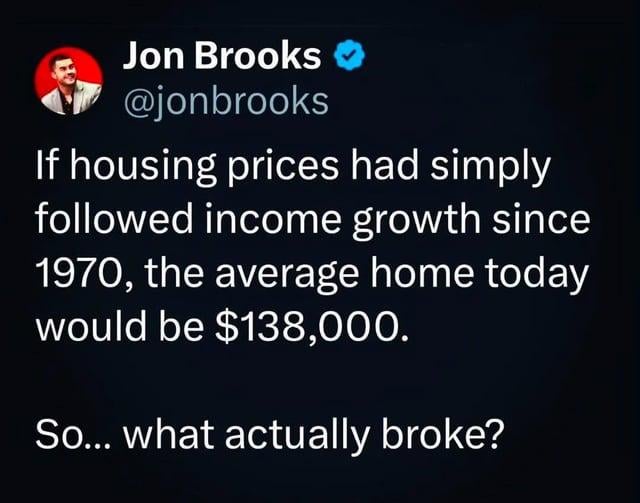
What actually broke?
People figured out they could buy more than one house and rent it to other people, paired with a housing shortage partially due to people/companies owning all the houses, paired with technology to allow you to rent your houses out for a few days here and there to make income.
We allowed house ownership to become entangled with entrepreneurship.
flandish@lemmy.world · 17 pts · 8h
that’s not broken though. this is how capitalism works at a temporal scale. we were marketed to and sold lies. on purpose. by monsters who have spent centuries making us think we can achieve a “dream.”
stringere@sh.itjust.works · 3 pts · 6h
Gotta be asleep to dream!
thisorthatorwhatever@lemmy.world · 7 pts · 8h
...and it screwed EVERYTHING up;
People can't afford kids because the rents are too high,
Rents too high for cool spaces to hangout in, so everybody's at home and miserable.
Rents too high for a cheap restaurant to open, so everybody's mad and pointing fingers,
Can't find daycare, because it's too expense for the daycare to rent a commercial property,
buddascrayon@lemmy.world · 3 pts · 7h
Even before that there was a boom in people using houses as an investment opportunity instead of just a place for people to live. Land ownership became the get rich quick opportunity that people who don't play the stock market could put their money into. Then the people who do play the stock market got into it.
Z745812939054@lemmy.zip · 29 pts · 15h
"until we reestablish old-school legit full blown slavery (which we will), we have to make do with debt slavery"
-oligarch fascists
Blue_Morpho@lemmy.world · 14 pts · 14h
They don't want full slavery. Debt slavery is more cost effective. Why buy a depreciating asset?
Z745812939054@lemmy.zip · 2 pts · 7h
the same reason they'll never ever ever go to a 4 day work week, or allow work from home, even though those things are proven to increase productivity-- maximum possible suffering
ZombieCyborgFromOuterSpace@piefed.ca · 27 pts · 5h
What broke is they allowed housing to be a commodity allowing speculators to bid on.
chiliedogg@lemmy.world · 8 pts · 5h
Yep. With the repeal of Glass-Steagal, the commercial banks used for things like mortgages, checking accounts, and car loans were able to merge with investment banks. The Act was out into place in 1933 because having retail banks mixed with investment banks was why Black Tuesday lead to the Great Depression.
That allowed houses and mortgages to be combined into investment packages for the speculators, and lead to prices skyrocketing.
It's what caused the 2008 crash, and in all the aftermath of that, nothing was actually done to fix the issue. The fix was simple - re-divorce them and reinstate Glass Steagall.
FauxPseudo@lemmy.world · 26 pts · 12h
Housing became an investment so people bought more than one.
Houses are twice the size they used to be. So they cost twice as much for that.
Houses have a lot more regulations and codes they must comply with. Your 1970s wiring is out of code and the new stuff is more expensive. 1970s plumbing is out of code and more expensive. Your 1970s insulation is woefully insufficient and cost more money. Your 1970s house didn't come with an AC unit. Your 1970s house did not have built-in fire suppression.
We build less houses now than we did in the 1970s.
Any one of these four factors would have caused house prices to move up faster than inflation. All three of them together created a perfect storm.
baltakatei@sopuli.xyz · 24 pts · 11h
People should be taxed up the wazoo for any property they personally do not occupy.
qat@feddit.nl · 3 pts · 10h
That just increases rental prices (making buying more attractive, but that's not an option for many people, and also supply is constrained).
I think the best is just to not allow buying a home for the purpose of renting it out. If you want to rent out a property, sure, but you need to build one first.
yeahiknow3@lemmy.dbzer0.com · 5 pts · 9h
Rental units are occupied (untaxed). The tax would punish unoccupied rental units and drive down prices.
Tja@programming.dev · 3 pts · 8h
Or it will increase supply (there are millions of unoccupied units purely for speculation) and lower rent prices.
RBWells@lemmy.world · 7 pts · 10h
It's not just size and quality though - my house is the same size as my mom's house was, hers was 13,000 in the 1960s. It's the same size as the old one I bought for 36k in the housing crash in the 1990s, and sold for 80k in 2010ish, after an addition and metal roof. It is actually for sale again now by someone else after more renovations, they are asking half a million and will probably get close to that.
The one we have now (same square footage, half built in 1940, addition in 1990s) we had to pay almost 300k and is "worth" (market, not underlying value obviously) like half a million, we did improve it with hurricane windows and metal roof and roof attachments.
I have never bought as an investment, only as housing. Something is broken, I DO think my house is worth maybe 200k as a real value, I think we overpaid. but the prices now are so much worse than that.
Yes Florida building code is serious so new houses do have additional utility. But I have only lived in older houses and they are also out of control price wise.
The big new ones around here go for 1.5 million now - I could have bought every house on my block in the 1990s for less than that.
FauxPseudo@lemmy.world · 1 pts · 10h
It's important that we use inflation adjusted numbers here. 13,000 from 1965 would be $137,000 now.
You only bought it as a house, but people around you bought as an investment.
RBWells@lemmy.world · 2 pts · 9h
Right. It was like 2 years of pay for her so 100- 200k seems about right for a house. Not a million dollars.
FauxPseudo@lemmy.world · 2 pts · 9h
Now imagine that house burned down. How much would it cost to replace it under current code compliance and construction costs? How much is it insured for? For example, my house is currently valued at about $200,000. I could not rebuild this house for $200,000. I'd be lucky to be able to rebuild it for $260,000.
Anyway, let's get back to the main point. There's more than inflation going on here. There are multiple factors, not just one.
RBWells@lemmy.world · 2 pts · 8h
Yeah my husband thinks 350k would rebuild it, because part of the value is the land. But we could not rebuild what we have for any price, because the wood it's made of is not available anymore.
And yes - some of the increase is apples to oranges, just like with cars - the 1967 mustang I had was good for about 100k miles, maybe. New cars last easily 3x that, and safer and more efficient.
But no way is that most of the increase. There needs to be some relationship between pay and housing that makes sense. With insurance and tax, those million dollar homes would cost nearly 8k per month even if no repairs or maintenance- that is so much more than the netpay for a good job, I don't know who is buying them.
I have seen several crashes already, and know price doesn't just increase forever. Am watching with interest to see what happens here.
UnderpantsWeevil@lemmy.world · 4 pts · 11h
Second homes are far less of an issue than tenth homes or hundredth homes, what with the rise of rental property consolidation and AirBnB-ification.
That's not how homes are priced, though. The real raw materials for construction are a fraction of the total cost. Which is why you'll see old ranch homes broken up into clusters of three-story townhomes the closer you get to growing downtown districts. Also, why you see increasingly shoddy construction jobs in new-builds, as compressed lumber and stucco replace concrete, steel, and hardwood. Nevermind the cost of labor, which is all over the map depending on whether ICE has decided to raid you recently.
They've also become more cookie-cutter standard. Far fewer custom homes. Far more big developers who get a rubber stamp (or pay bribes to the right people) to roll out a thousand-unit development.
We have less undeveloped real estate connected to highway access points than we did in the 1970s. And we have more Boomer-vacated housing re-entering the market.
The single biggest proximate cause to the housing price boom has been the ZIRP interest rate policy, flirted with after the Dot-Com bust of '01 and bought whole-hog after '08. We've been living in an era of low wages and cheap lending. This has resulted in a historic consolidation of private ownership under banks and hedge funds that have proximate access to the Fed credit window.
The end result is housing units being bought for a market rate and rented for a profit, until the market saturates and you have a sudden forced liquidation. These long drawn-out real estate famines punctuated with sudden windfalls reward people who just happen to be in the market at the right moment. But they otherwise stack the deck in favor of people with the most borrowing power.
FauxPseudo@lemmy.world · -2 pts · 11h
Materials require labor. Labor requires inspections. The more material the more everything else. And those materials cost more because they are to much tighter specifications than they were in the 70s. The lumber might be cheap but a fire suppression system in a 4000 square foot house costs a lot more than no suppression system in a 1200 one.
But as you point out it's not really about materials though. It's about square footage. You don't get a bulk discount for buying a 5000 square foot house instead of a 1200. You pay even more. And zoning won't let you build a 1200 anymore because they tax based on square footage so they jacked up the smallest house size they will approve.
There is no single cause for houses being more expensive. It's a whole host of them and that's why prices climbed faster than inflation.
UnderpantsWeevil@lemmy.world · 5 pts · 11h
Per sqft? You absolutely do. Buying one 5000 sqft house will almost certainly run you less than buying four separate 1200 sqft units, all else being equal. If anything, larger houses are a result of cheaper material inputs. PVC and compressed lumber make manufactured homes easier to produce than their historical brick and mortar and copper pipe counterparts.
So I think you have it backwards. Houses have expanded in size to justify their inflated costs. But the real price inflation is happening at the ground floor.
Privatization and financialization are both but-for drivers of price-inflation. Cheap lending means more dollars are chasing the same number of goods, despite flat wages. The functional extinction of public housing means there's no price ceiling for entry level housing units established by the state. So prices compress around the median purchase rate, while low-income households are entirely priced out of the marketplace and middle-income households are larded up with debt.
BigDiction@lemmy.world · 3 pts · 11h
Yeah there just isnt a ton farm land at the edge of towns you can quickly flip into a new community.
We have tons of land, but not much that can quickly hook into existing utilities. Creating a city from scratch is expensive.
FauxPseudo@lemmy.world · 4 pts · 11h
If you think building a city from scratch is expensive you should see what it takes to make an apple pie from scratch. You must first invent the universe.
BigDiction@lemmy.world · 0 pts · 10h
Really? You just need to pick some wild apples and then invent modern agriculture for the rest of the bits.
FauxPseudo@lemmy.world · 2 pts · 10h
Carl Sagan
BigDiction@lemmy.world · 2 pts · 10h
Oh shit. Didn’t know I was dealing with an Antique meme
FauxPseudo@lemmy.world · 1 pts · 9h
It happens.
kamee@lemmy.zip · 2 pts · 12h
Also Urbanization, guessing there is quite a few houses where people don’t actually want to live
Pika@sh.itjust.works · 2 pts · 11h
I do have to agree with you. It's a demand issue, combined with the rate that it is being built.
I think it would be fully okay to have the cost of a house be multiplicative, based off how many you own after the second house. So, if you are looking to buy a third house, the price is actually double than what you would be expecting, and then your fourth house would be triple what you're expecting, etc.
The price of the house will be the cost the seller lists it as, and the seller gets the cost that they listed it as. However, anything over the cost it was listed, if you are affected by that multiplier, has that money go straight into the government.
The reason I say after the second house is because I do personally think it's fair for someone to want a vacation home somewhere, I just don't think it's fair for someone to have an interest into having a second, third, fourth, or sometimes even fifth vacation home. And there are many cases where you would want to own a second property such as if you run a self-employed job such as a computer repair specialist, you will probably own a shop, and having a office that's at twice the cost of what it normally would be is extremely cost prohibitive to someone wanting to get into the market.
I also firmly believe that there should be quite extortionate taxes for buildings that are labeled residential but have an owner who primarily rents it out for more than a quarter of the year. The whole Airbnb our property is technically zoned residential but are actually commercial loophole is absolutely ridiculous and a huge problem. If you aren't allowed to put a motel or a hotel there, you shouldn't be allowed to have an Airbnb there.
Soup@lemmy.world · 2 pts · 11h
And all that extra money goes to building social housing.
FauxPseudo@lemmy.world · 1 pts · 11h
That's trickier than it sounds. The places where people buy third homes are the same places where NIMBYs can stop development of poor people housing. Even though those rich people need servants and servants need quarters.
Soup@lemmy.world · 2 pts · 11h
If we’re already living in a world where we can tax homes at 100%, 200%, etc. then we’re also living in a world where we can pretty easily tell NIMBYs to go fuck themselves.
FauxPseudo@lemmy.world · 1 pts · 11h
Catch 22. As a politician you gotta please the people with money. The people buying homes taxed 200% have the money. Until we reach Star Trek levels of selfless post scarcity society that's not going to happen and by that point it won't be necessary.
Soup@lemmy.world · 2 pts · 10h
I like how we’re making a scenario where things might actually go well and you’re still trying to find ways to lose.
FauxPseudo@lemmy.world · 2 pts · 10h
I'm trying to find realistic solutions. And if we don't red team premortem then we are building to fail.
BarneyPiccolo@lemmy.today · 25 pts · 3h
The 1974 Tax Code re-write, that baked Trickle Down Economics into our tax code, created the Oligarch class, giving them the disposable income to manipulate political policy to their further benefit.
The Rand Corp issued a report on income inequality, and the situation is far worse than most people think.
Chart
The median salary of $43K in 1975 has increased to only $50K today, while they would have been making $92K if the tax code hadn't been steadily re-written to enrich the wealthy at the cost of the middle class and poor.
In that same time period, the mean income for the top 1% went from $289K to $1.384 million, while they would have been making $630K under the old tax codes.
Thats a 17.4% increase in the lower median, and an increase of 321.6% in the 1% median. Clearly there has been an upwards distribution of wealth at the expense of the middle class since the tax codes started to be re-written in 1974 to favor the top economic tier.
Read more about it :
New York Mag: http://nymag.com/intelligencer/amp/2020/09/rand-study-how-high-is-inequality-us.html
Fast Money: https://www.fastcompany.com/90550015/we-were-shocked-rand-study-uncovers-massive-income-shift-to-the-top-1
doingthestuff@lemy.lol · 2 pts · 2h
Yes our earning power is trash compared to the 70s, and I think there are more reasons for that than what you stated. But your answer didn't really address why homes specifically have dramatically outpaced the general rate of inflation.
qarbone@lemmy.world · 3 pts · 2h
Probably because land is one of the best non-fungible assets around. You buy land and you have something whose upper limit on price is only limited by what someone else wants to build on it. And premium space around existing economic centers (cities) doesn't just spring up.
Earthwormjim91@lemmy.world · 0 pts · 2h
Why use nearly decade old data though?
That article is 6 years old, and uses data through 2018.
Median household income today is $83k.
And that’s adjusted for ”productivity”. Not exactly a concrete metric.
atro_city@fedia.io · 22 pts · 14h
The wealthy aren't paying their fair share. They pay way less than they should in taxes and keep accumulating wealth and buying up shit, which of course is coming from us. That then increases prices because more normal people need it.
!twnw@fedia.io #TaxWealth
August27th@lemmy.ca · 5 pts · 11h
This is exactly it. All of the other answers in this thread are dancing around this issue without even knowing it. Some happen upon it, but move on like it's a side item when it should instead be lit up with lights and sirens as the main event.
Regular people spend the majority of their income on the things they need to survive; food, shelter, energy, clothing, etc. The wealthy and ultra wealthy spend only a miniscule fraction of their money on the same things, so they put that pile of remaining money into investments/assets (stocks/shares, housing, etc), which make them even more money, which they put into more assets which make them even more money, and so on. But the money flowing to them doesn't come from nowhere, it comes from YOU.
Collectively speaking, you go to buy a home, they outcompete you on the price, and then gladly rent it to you, all while jacking up the rent over time. They use that extra money from you to buy even more assets. You somehow manage to buy a home, but at a highly inflated price, the money is lent to you by... guess who. And they charge you interest every month, which is money flowing from you, so they can spend it on... even more assets.
Higher prices at the corporate owned grocery store because the shareholders demand even more dividends. Because goods at the store coming from corporate producers raised the price for the same reason. Because little producers that used to compete in the market are being bought up by big ones that can afford it because they pay next to no corporate tax. But who are the shareholders receiving the dividends? 80% (and rising) of the stock market is owned by the 1%, the people who already have more money than they could ever spend.
Now we've got higher prices for energy for a multitude of reasons, but a fresh new hell is it's all being gobbled to power data centers. Whose ultimate purpose is an attempt to replace people's jobs with "thinking" computers. Whether they'll succeed or not is yet to be seen, but we do know it is being funded by billions of dollars that someone has... guess who again. If they do succeed, then that's even more money sucked away from you in the form of lower wages at minimum. If it blows up in a catastrophic bubble, they will demand a bailout again, just like the sub prime bubble.
Our failure to tax the obscenely rich allows them to walk all over us, taking money from us which they use to build the machinery to walk all over us with even greater pressure, which takes even more money from us, and so on. It's literally exponential, which is why nobody appreciates nor understands it.
You are not rich, will never be rich. The ones who actually are, are doing everything they can to keep you out of their club. You'll know because you'll be paying taxes and they won't. Which are going to go up soon by the way, to pay for that bailout.
DudleyMason@lemmy.ml · 22 pts · 6h
Nothing broke.
This is capitalism working as intended.
TheOubliette@lemmy.ml · 15 pts · 10h
According to the alleged dynamics of capitalism, housing prices should be somewhat flat. Build houses that are too big and expensive? Demand is down for that market subset, gotta drop your prices or stop making such but houses. Housing supply is low? Prices go up, so companies will build more housing to make money off of that, increasing supply and stabilizing prices!
So the dynamics are not working like that. Now of course real estate has a "natural monopoly" aspect, certain land is less valuable because it is just too hard to get to and from relative to what people need to do: work, eat, go to school. So land rents are higher in some places more than others because of this. Am economist might call this a distortion.
But there is a much more important aspect in the US and similar economies, and that is financialization. Some comments here say prices are very high because houses are treated as an investment. That is true, but also incomplete, and it might make you wrongly think that it is individual homeowners saying, "this house will be worth more later so I will buy it". This is not enough! The financialization is by the bank that sells you a mortgage, that takes a nice percentage of your money in exchange. They can then make your house into a form of equity that can be seized later as needed if you're not profitable enough, which they carefully calculate to decide on your initial interest rate. And then they can gamble on that equity on the market. That equity is only worth something if the actual house has value and it has value because they will still loan you that amount on a new house. So an individual home buyer might buy based on the ability to be financed, sure, and the expectation that it will be worth it. But this is only possible because the mortgage lender themselves sees it as profitable for them to do so. If those high mortgages were not available, nobody could buy the expensive houses, land values would plummet, and so would housing prices, etc. of course because the dynamic is capitalist, this would involve a massive disposession and immense suffering if done at their hands and potentially threaten mass organizing and a threat to real estate profits, so whenever that threatens to happen (like 2008) the state keeps finance (and therefore real estate) afloat with free money.
So why aren't more and lower cost homes built, especially in the locations that need them? They bring down property values that have been gambled on by huge institutions. Only luxury apartments can be built, not affordable housing units. And real estate basically owns your local government, and every politician above that level is still beholden to them. Ultimately they can crash the entire "economy" if needed.
HaiZhung@feddit.org · 4 pts · 9h
I think this is way too complicated, a much simpler effect describes the housing cost:
Wealth inequality drastically worsened over the last 40 years. The uber rich got even richer: while the vast majority of people has little to no money and can’t afford a house or other assets.
Rich people have (compared to their wealth) low consumer spending, but they massively accumulate wealth.
What’s the wealth spent on? Assets.
That’s why you see all the assets go up - stock market highs, gold price up, housing prices up, everything up.
It’s as simple as that. Rich people don’t know where to put their money except buying more assets, which drives their prices up massively.
Polisheocket@lemmy.zip · 3 pts · 8h
Where I live they don’t make starter homes, everything is 800k and up, 2,000+ sqft. People can live in 1,200 sqft and are good starter homes. Have them start at 400k (CA so everything is expensive)
HaiZhung@feddit.org · 2 pts · 6h
Yes and that is the logical conclusion of what I said above.
If regular people and families have no buying power, then houses that suit their needs will not be built. Rich people have buying power, so luxury apartments and suites will be built.
Polisheocket@lemmy.zip · 1 pts · 4h
It’s unfortunate, my uncle likes smaller places and he’s really struggling to find one.
NABDad@lemmy.world · 1 pts · 6h
A guy bought the property next to my house. He was going to tear down the house that was there, but our historic district stopped him. He had to restore that house and convert it to a duplex. Then he squeezed another house in the strip of land in between.
It is hideous. When my mother-in-law visited, she asked why they were building an office building next door.
It sold for $799,000.
Polisheocket@lemmy.zip · 2 pts · 4h
We had an investor do that to us, it was 3 houses down and built 3 units with no parking. Plus the house could look down in our pool and all other homes in the neighborhood were single story. Then they painted it hot pink. It was an eye soar
TheOubliette@lemmy.ml · 1 pts · 8h
Individual rich people don't lend the mortgages, it is large financial institutions that do that and then use the equity to do even more gambling. Individual rich people own a few expensive properties, sure, but this accounts for very little of the overall residential real estate "market".
But when nations restrict the financialization of housing, prices flatten or even go down.
dejected_warp_core@lemmy.world · 2 pts · 9h
The finance side of things has also enabled a kind of house size inflation. Anecdotally, I've seen new tract housing go up in areas that need housing, which were all 3000 sq/ft each. They could have developed for higher density and sell more units, but I guess the margins are better on houses that sell for 700k and up. Especially if folks are willing to go into deep debt to pull it off. Plus that does little to ease demand, so the cycle can continue.
TheOubliette@lemmy.ml · 3 pts · 8h
Real estate development tends to be done on loan. Before the decision to buildi a house is made, it is pitched to the lenders. The lenders also lended mortgages for other houses in the area and own a few, they want values to go up. The lenders approve the more expensive developments expected to increase real estate prices, not the lower income housing. The lenders can always choose a different developer to give the money to, the one that will pitch the higher perceived value development.
Formfiller@lemmy.world · 15 pts · 9h
It’s the end of the monopoly game
WhyIHateTheInternet@lemmy.world · 10 pts · 8h
Someone should get mad and flip the board and say fuck this shit
Formfiller@lemmy.world · 8 pts · 8h
I think Luigi did that
WhyIHateTheInternet@lemmy.world · 6 pts · 8h
He should do it again. Or at least his brother, Mario, since Luigi is a bit tied up at the moment.
Formfiller@lemmy.world · 6 pts · 8h
It needs to be be collectively accomplished
WhyIHateTheInternet@lemmy.world · 3 pts · 8h
Sounds like a job for smash bros
Gumus@lemmy.dbzer0.com · 4 pts · 6h
Smash Bros. would be a fire name for a revolutionary movement
WhyIHateTheInternet@lemmy.world · 1 pts · 6h
If it ever happens we'll know that we started it all right here. Feels good to be part of history.
HulkSmashBurgers@reddthat.com · 10 pts · 9h
Housing can't be affordable and be a good investment.
https://web.archive.org/web/20210130004720/https://cityobservatory.org/housing-cant-be-affordable_and_be-a-good-investment/
nieceandtows@programming.dev · 9 pts · 14h
Accountability
Adderbox76@lemmy.ca · 8 pts · 12h
Nothing broke. It's working exactly as intended.
There have always been two distinct economies.
There is their economy (meaning the billionaires economy of venture capital, real estate investment firms, speculative markets, etc...) It's a market that exists on paper only. Theoretical billionaires with assets instead of bank accounts, capital instead of paycheques. Money isn't a real concept in that economy, it's simply a measure of profit and loss. It's just a score keeping device and something used to leverage power.
Then there is our economy. (meaning the rest of us, who get a paycheque, spend that paycheque, etc...) Maybe we'd be able to put something aside for retirement or college for the kids. . Money itself has a real, tangible impact in our lives. It's not theoretical.
Maybe we have enough to play in the paddling pool of the speculation market, telling ourselves that "we're shareholders!" like our 10 shares means squat against the 10,000 shares owned by the investment firms and LLCs run by the billionaires. Employers like to do things like offering you stock options, selling it as "you'll be an owner and have a say in the company". Yeah...no...you'll have a piece of paper and a sense of self-importance because you "dabble in stocks".
The idea being that if we invest hard enough, and risk enough, we'll make enough to jump us from one economy into the other. But we won't. That's the lie they tell to keep us mollified.
Because the truth is that their economy, only works at the expense of our economy. Profit in their economy, only comes from loss in ours. A corporation can't make more profit without taking it from somewhere. And that somewhere invariably is us; our health benefits, our cost of living, the quality of the products that we use, our lack of raises, etc...
PartyAt15thAndSummit@lemmy.zip · 2 pts · 10h
By and large, I agree with what you wrote, but they can always chose to have us shot, "suicided," imprisoned, institutionalized or simply disappeared. No, they need us to keep their big MLM scheme called "capitalism" running. No base, no top.
jumping_redditor@sh.itjust.works · 0 pts · 2h
don't worry, they are trying to install anti gravity thrusters on the top of the pyramid
KingGimpicus@sh.itjust.works · 8 pts · 9h
If you actually look at the cost of labor and materials to build a house today, its not far off. The difference you see is the cost of allowing enormous corporate development companies to exist and do business in this country. The false scarcity on top is a product of the greed that keeps people out of housing to begin with.
Tja@programming.dev · 3 pts · 8h
Tell me you haven't looked at the price of construction material without telling me you haven't looked a t price of construction material.
KingGimpicus@sh.itjust.works · 4 pts · 7h
I have recently had an estimate made for materials to construct a 1200 square ft home and it was a little over 135k. Add in labor and its looking like $175-200k. Compare that to the $800k starter homes in the area and you see a huge disconnect.
Tja@programming.dev · -2 pts · 7h
Tell us more once it's completed. And don't forget to add the land.
KingGimpicus@sh.itjust.works · 1 pts · 7h
Keep moving your goal posts, straw man. The rest of us are actually making progress.
Tja@programming.dev · 2 pts · 6h
That's not how fallacies work....
KingGimpicus@sh.itjust.works · 2 pts · 3h
You attacked me for not knowing the price for construction materials, implying that my statement of the cost of homes being close to the $138K in the OP was way off. Then I showed i knew what I was talking about, and your argument became land price and hidden costs of construction. Thats exactly what a straw man does. You move the goalposts and create a new argument instead of addressing how you got called out on your bullshit.
explodicle@sh.itjust.works · 1 pts · 1h
That's just moving the goalposts. A straw man is when one misrepresents their opponent's argument as something weaker.
explodicle@sh.itjust.works · 1 pts · 1h
Why don't you run back to your motte and bailey, you ad hominem?
Vandals_handle@lemmy.world · 1 pts · 4h
@kinggimpicus did the math, he did the mortgage math
https://www.thecostbreakdown.com/average-cost-per-square-foot-build-house-us/
Average construction cost $183 sqft, 1,200 sqft Cost $219,600
P1k1e@lemmy.world · 1 pts · 7h
Depends on where you live and what your building.
In some areas you need a full foundation on others it may not be necessary
Don't need a garage? Then you save money just having an exposed asphalt driveway
Cellar? Fireplace? Attic? Even a 1000 square foot home has a lot of variation in design and material requirements
If anything I'd say it's the labor that drives the price into the stratosphere. But even that varies county to county, even more so state to state.
Tja@programming.dev · 2 pts · 6h
Labor varies a lot, construction materials are expensive as hell everywhere.
birdwing@lemmy.blahaj.zone · 1 pts · 5h
1000 ft₂ ≈ 93 m₂ for those concerned.
I don't think it's the labour costs, but rather the enormous tariffs that landlords and estate agents demand.
childOfMagenta@jlai.lu · 8 pts · 5h
https://wtfhappenedin1971.com/
Etterra@discuss.online · 7 pts · 5h
Nothing broke - the capitalist system is working exactly as designed. We're just not the tiny sliver of the populace that benefits from it.
UnderpantsWeevil@lemmy.world · 6 pts · 11h
I mean, no offense to the OP, but this is a constant game of bullshit in a country as large and sprawling as the United States. The problem with housing prices isn't simply "median price", it's "proximity to the work site" and "proximity to public services" and "size sufficient to host my whole family". You can show me a house for $80k out in the de-industrialized Midwest or the boonies of rural Wyoming. I won't buy it, because I have nowhere to commute to work or send my son to school or a grocery store to shop at or potable water that won't kill me. You can show me a high rise in walking distance to everything I need, but if it's $1.5M I can't afford it.
If it's $100k for one of a hundred vacant rotted out homes in the slum and $300k for a single unsold 70 year old ranch house in the burbs and $500k for one of the fifty newly built 600 ft condos in city, taking the "average price" doesn't answer the question "Where am I going to live?"
stickyprimer@lemmy.world · 2 pts · 10h
This is an important aspect. Someone above this said “houses are twice the size now so they cost twice as much” and I just had to shake my head. It’s not only new construction that’s expensive.
But whether it’s the cost of all homes or the pricing of homes where they’re in demand, the ultimate question is still the same: why haven’t we had enough housing where it’s needed for prices to be more stable?
But any good answer to this is going to hit 20 different points. Urbanization. NIMBYism. Private equity. Foreign buyers. Empty homes. Changing codes. Suitable land. And on and on.
UnderpantsWeevil@lemmy.world · 2 pts · 6h
"Enough housing" is a bad way to frame it. Because - again - we have plenty of vacant housing in the deindustrialized midwest. We have plenty of vacant real estate in the Great Plains. We have a dormant cache of vacant units in large dense metropoles. Why aren't these being filled?
No jobs
No infrastructure
Speculative rent-seeking
In that order.
You can drill down to any individual location and ask why the current housing situation exists/persists. But this YIMBY attitude that the solution is always more New Build constructions on the suburban periphery or massive teardowns of inner city occupied real estate is just six developers in a trench coat putting one over on you.
Yeah, there's complexity in these markets. But private sector finance driven central planning really does boil down to "profit maximization" wherever you are. The real question, at any given region, is whether you have a housing surplus (because absent demand) or deficit (because excess supply) and how that shapes the prices of units. And a lot of that comes back to who has access to easy credit and who does.
stickyprimer@lemmy.world · 1 pts · 3h
Sure, cutting my sentence in half IS a bad way to frame it. So bad that I’m not even going to read the remainder of your comment.
jumping_redditor@sh.itjust.works · 0 pts · 2h
have you tried living off investment so you can live out in rural Wyoming?
whoisearth@lemmy.ca · 6 pts · 11h
Multiple things broke and anyone, including and especially politicians, trying to sell you on a single narrative is a lying POS.
stickyprimer@lemmy.world · 6 pts · 10h
Among many other things, people now vote in local elections according to “what will be good for my property value” and this often (usually) doesn’t mean making more affordable housing available. It’s a very specific case of NIMBYism. Luxury condo building with 15% affordable units? Not where it will affect my property value!
jumping_redditor@sh.itjust.works · 0 pts · 3h
It's completely logical, if most of your wealth is in your home you want it to keep it's value so you can move somewhere else if you want.
Amnesigenic@lemmy.ml · 6 pts · 10h
Nothing broke, this is capitalism working as intended
nednobbins@lemmy.zip · 6 pts · 6h
We insisted on our homes being investments.
The only way for that to work is for houses to appreciate faster than inflation.
Otherwise, people would have to sell their houses for less than the inflation adjusted cost of what they put in.
matlag@sh.itjust.works · 2 pts · 5h
Who is "we"? People listened to a bench of folks telling them how great it is that their home value will appreciate.
Most of them owning 1, that didn't benefit them at all: you sell to buy another one that appreciated just the same, but they were happy to be told about their wealth magically increasing exponentially, punching way above their weight.
A few owned more than 1 and think of themselves genius and wise investors as they made quite some money.
The people who told these stories owned legions of them, or built more thanks to large capital availability, their wealth considerably increased, and they laughed at the commoners who were --once again-- fooled.
The younger generation now pay the price of this deception as they've been driven out of the market, and the same people who told stories yesterday suck them dry through ridiculous renting prices now. A lot of the young have 0 chance to ever own a home in these conditions, they're giving up on home, on having children (multiple factors here), and with that, they also give the middle finger to hard work (when they can…) as they know too well they'll never be rewarded for it. But no worry: inflation going faster than wages will force them into hard work just to barely survive, and eventually they'll be enslaved by their debt.
And the same people who were fooled about the benefit of house value insane appreciation now scold them about "how hard they were working at their age".
And the same people who told all of the stories look at them fighting among generations and laugh even more while drinking Champagne: their financial future looks brighter than ever!
farmgineer@nord.pub · 5 pts · 14h
I fully agree with the point but is "a erage" the right metric? I also have to imagine even the average house is much larger than in 1970.
DrBob@lemmy.ca · 5 pts · 14h
Average can mean so many things. A lot of people want it to be synonymous with mean as a measure of central tendency, but there's a reason data people use mean. It avoids folk definitions meaning typical or expected. In those senses it can also be synonymous with modal values or an area around the median etc. It's not a precise word.
HubertManne@piefed.social · 2 pts · 13h
I was born into a house in the 70's that was massive. Sure it was dilapidated but there were big houses. Watch caddy shack and look at the house the main character lives in that you see at the start of the movie.
ILikeBoobies@lemmy.ca · 4 pts · 5h
It was seen as an investment.
mlg@lemmy.world · 4 pts · 8h
This is technically backwards. It should be if income growth had followed inflation, the average income should hsve been ~$300,000 by now.
Kurtismayfield@lemmy.zip · 4 pts · 5h
3% mortgages did this. If mortgages were kept around historical averages of 7 percent, the asset inflation wouldn't have occurred. The monthly costs at 7 percent currently are unaffordable except for the top 20%.
Hikermick@lemmy.world · 2 pts · 4h
That's with 7% being an average, they were in the high teens in the 80's. Funny how that works. Rates go up, house prices go down and vice versa. Supply and demand of course but it's as if cost of living is based on what you can afford to pay not what the product is worth. Throw in property taxes and there's another pesky variable affecting the price. I once considered buying a vacation cabin in NY state because the price was remarkably cheap until I saw the property taxes. A mortgage gets paid off but property taxes are forever. I guess my long, rambling point I've piggyback onto yours is it's more complicated than "capitalism sucks"
Kurtismayfield@lemmy.zip · 0 pts · 3h
Allowing the Fed to artificially keep interest rates down for 15 years is not "Capitalism sucks". Its pure, unadulterated asset inflation purposely done. ZIRP policies were a choice made that have gotten us to where we are with asset prices.
mechoman444@lemmy.world · 3 pts · 6h
Nothing broke everything worked exactly as it was supposed to.
This is what corporatocracy looks like. Absolutely no regulation or control over the industries that sell things.
sp3ctr4l@lemmy.dbzer0.com · 3 pts · 5h
We got rid of pensions, scaled back social security (both spending and taxing wise).
Homes and 401ks thus became financial retirement plans.
And we allowed significant interplay between the 401ks, and homes, in financial markets. It became an entire speculative industry, all intertwined and intermingled, a free for all for both old money finance and 'entrepenuerial' home flippers and petty landlords.
So that's why they inflated more, basically.
Yeah it is more complicated than that, there are other important factors ... but... that is the ultimate truth of it, imo, the main driving causality.
We turned homes into speculative financial assets, so obviously, their prices became inflated and volatile.
And then that, the broad price increase, using homes as a basis for financial returns... well that perverts the incentive structure for new home builds and pricing.
You don't build affordable homes any more.
You build homes that are min-maxxed at a 'perfect price point'... and size, and feature set... so they function best as investments: McMansions.
You now you have an oversupply of pricier homes... and an undersupply of cheaper ones.
This dynamic compounds upon the other dynamics, feed themselves... makes prices rise more, and prices be more volatile.
Gotta throw in the reminder, that Jon Brooks himself will tell you:
Large Fin Insts only directly own around 10% of US residential properties.
The vast majority are owned by 'small time landlords', meaning basically they own 5 homes or less, down to 1.
Its the entire Boomer generation, who could afford to play a small part in this, that did.
Yeah, the big guys set the market tenor... the 'dumb retail' investors follow, and do most of the actual financial 'work' of it.
Like yeah don't get me wrong, we should cap the ability of large firms to directly own homes... but that alone would be putting a bandaid on a sliced jugular vein.
sniggleboots@europe.pub · 3 pts · 14h
Me, I'm broke
Zephyr@sh.itjust.works · 3 pts · 3h
E-corps playing games with housing.
melsaskca@lemmy.ca · 3 pts · 14h
The same thing that broke when our cars and food prices got so high. We need to find out what broke before it finally affects the Pokeman cards! /s
merc@sh.itjust.works · 3 pts · 2h
Houses should be investments... in the same sense that a good, durable pair of shoes is an investment.
In a well designed system, the value of property should stay pretty flat over time, and the value of a structure built on that property should slowly go down over time as wear and tear sets in.
It's ridiculous that it makes sense to buy more home than you need, and to hold onto a house longer than you need it because it's one of the best and safest money-earning investments you can make. It's especially annoying as someone in a position to make that investment gets to live inside their investment and enjoy it even as it appreciates in value.
Nothing else works that way. Can you imagine if you bought a classic car and drove it on the road as a daily driver and it went up in value? Or, if you bought a rare Magic the Gathering card, used it in your regular deck, and somehow it only became more valuable?
Polisheocket@lemmy.zip · -1 pts · 2h
I’m mean, once you’re comfortable with a monthly payment why would you leave if the house suits your needs? Or payoff the asset and not have a payment. The being, you shouldn’t think of housing as something that depreciates over time, it’s not a car, you can fix it up, you can repair it to make it last 30 more years. Cars not always
merc@sh.itjust.works · 4 pts · 2h
You could say the same about a pair of shoes. If they're in good shape, why not keep using them as long as they still suit your needs? If you get a good pair of leather shoes they can last decades needing only the occasional repair.
The difference is that you wouldn't expect your shoes to go up in value every year even while you're wearing them.
The reason why it matters is that someone with a good job can't afford a house anymore, and shelter is right there at the bottom of Maslow's Hierarchy of Needs.
Polisheocket@lemmy.zip · -1 pts · 2h
I’m mean all the examples I’ve seen have very limited life spans, houses can last hundreds of years. It’s apples and oranges
merc@sh.itjust.works · 1 pts · 49m
That's not the reason it's apples and oranges.
Cherry@piefed.social · 2 pts · 12h
2 family income (women started earning full wages)
Malyca@lemmy.zip · 2 pts · 8h
Older people wanting to tie their wealth to their homes
pelespirit@sh.itjust.works · 2 pts · 11h
The corporations owning thousands and thousands of houses and buying out the markets, for sure. They've done it for all types of housing,
If the homes that were owned by corporations were out in the market, there would be a very small housing crisis, if any.
There were articles about Microsoft, Amazon, and all the other techy companies in the Seattle area buying up small apartment buildings so they could house their H1B visa people in the early 2010s. Talk about a company town.
Seattle also took software companies to court and won that were price fixing our rentals. I'm sure they didn't catch them all. There are a lot of shenanigans behind the scene.
dropped_the_chief@lemmy.world · 2 pts · 9h
Lack of worker power
billwashere@lemmy.world · 2 pts · 9h
Greed.
explodicle@sh.itjust.works · 1 pts · 1h
People were greedy before 1970! Something changed systematically, not the human psyche.
Professorozone@lemmy.world · 2 pts · 10h
Source?
raze2012@lemmy.world · 2 pts · 9h
Math.
https://fred.stlouisfed.org/data/MSPUS
Plug 23900 into an inflation calculator
https://data.bls.gov/cgi-bin/cpicalc.pl?cost1=23900&year1=197001&year2=202606
I got 211,149.54.
Guess they had different numbers or calculator, but similar sentiment. Housing grew some 5x+ faster than inflation.
uriel238@lemmy.blahaj.zone · 2 pts · 3h
Also in 1971, the Powell memorandum was written and submitted to the Chamber of Commerce.
HerbGrower@slrpnk.net · 2 pts · 5h
Meanwhile luxuries are cheaper than ever. But also something you could easily cut down on if you needed to. We are stuck paying increasingly higher proportions of our income to the banks in interest rates on higher mortgages and can't really even opt out.
But I do wonder where it will go. Increasing the number of people to a household makes it far more affordable. So larger polycules are the optimal solution to the housing crisis. Don't work 2 jobs. Split 2 jobs across 4 people all working part time.
Most housing costs change very little when you add more. Food is the most and even that you can benefit a bit with buying and cooking in bulk.
x0x7@lemmy.world · 2 pts · 12h
The Fed lowered interest rates. Now your savings pay nothing, and your home is too expensive. Works for boomers though. Their home being too expensive is a good thing. But they won't live to enjoy that wealth. And now we are in a Faustian trap. Make housing affordable (important and right thing to do) and with it we have to see the a ton of normal people go underwater on a leveraged investment.
But if we slowly raise interest rates we could avoid the shock.
Side benefit. AI's hype train depends on being able to operate at a mammoth loss for the foreseeable future. That also depends on artificially low interest rates. Raise them, not only can you make housing affordable, but you also might kill AI.
There would be some job loss. All the AI jobs would go. I'm ok with this.
hash@slrpnk.net · 1 pts · 13h
This is one of those places I understand wanting what my parents had, but I don't think that's actually what we need. We need homes to be cheaper, but I also believe homes being appreciating assets is not sustainabe. Moving past car dependence will require building at densities where homes don't carry enough land to naturally appreciate.
krisevol@lemmus.org · 1 pts · 8h
A few things broke.
1 inflation definition and actually inflation are two different things. Real inflation is m2 money supply.
2 us debt and money devaluing makes assets raise in price.
3 is permitting costs. The first to build a house has gone up a ton.
4 supply. Permitting restrictions and requirements make building small houses not viable for most. Tiny homes today are pretty close to the price of a house 2 or 3 times the size for only 20-30% more money.
5 low interest rates for too long. Low interest rates cause prices of assets to rise incredibly fast.
Loan term requirements becoming relaxed. 30-45 yr loans are the norm now because consumers are willing to take on life long debt terms. In a limited supply situation you are competing with people willing to pay more with longer terms.
6 speculation. This is mostly from the low interest rate environments. People buy assets to beat the interest rates. Companies buying houses for profit from flipping or renting also contribute.
The only way we get adorable housing is 10% interest rates, abolishing the 30-45 yr loans, and remove permitting costs and restrictions.
NikkiDimes@lemmy.world · 3 pts · 8h
All I ever wanted was adorable housing...
krisevol@lemmus.org · 1 pts · 6h
Me too, me too 😢
VitoRobles@lemmy.today · 1 pts · 7h
I'll settle for affordable housing but cutey patooty housing is a bonus!
WudgieLore@lemmy.zip · 1 pts · 20m
So did you fix it?
Skyrmir@lemmy.world · 1 pts · 14h
The biggest reason is the number of households grew far faster than the number of houses. In constrained areas the number of households tripled, while the number of houses grew 20%. There's no financial reform that fixes that. In remote areas cheap financing and increasing costs for construction are the largest factors.
There's no single fix to home prices being insane. It's going to take multiple reforms, and time for markets to adjust, plus homes to be constructed.
Formfiller@lemmy.world · 1 pts · 8h
So the thing is the post new deal social contract only existed because the wealthy were afraid we’d guillotine them. They aren’t afraid anymore and they’re building mass surveillance and AI infrastructure to protect themselves against us.
Tango@piefed.ca · 1 pts · 13h
I assume it's mainly that the amount of people went up more quickly than the amount of homes. Demand goes up while supply stays low, and the result is predictable.
I also assume that this is driven by perverse incentive: pre-existing homeowners want their property to appreciate in value, and so they will oppose attempts to build in order to drive scarcity. They will be particularly incentivized to do this if they bought the property as a speculative investment instead of as a home for themselves.
This type of rampant speculation is driven by the market being largely unregulated. Everywhere in the world but especially in the USA, people are forced to seek reliable high-yield investment in order to fund non-state pensions and afford a decent retirement. Governments desperately need to aid this in order for society to not collapse, and so they are held hostage by their own economies, forced to clear a path for pension funds to seek as much profit as possible.
otacon239@lemmy.world · 5 pts · 13h
https://www.self.inc/info/empty-homes/ (original sources cited at the bottom)
theacharnian@lemmy.ca · 1 pts · 5h
Gary Stevenson's got a theory about asset inflation driven by inequality.
FiniteBanjo@feddit.online · 0 pts · 12h
My guess is an increase in wealth concentration and foreign investiture leading to homes being used as monetary assets and driving their price up above what normal people can afford.
LodeMike@lemmy.today · 0 pts · 8h
Not enough housing supply.
Jarix@lemmy.world · 0 pts · 7h
Home have different material requirements and construction requirements that means they are(should be if built correctly...) safer and more complex. Also houses are MUCH bigger than they used to be.
That's not to say there isn't a problem but it's not just inflation that has made housing costs more expensive
arrow74@lemmy.zip · 0 pts · 13h
Reagan happened
kandoh@reddthat.com · -1 pts · 13h
Housing is an investment, so the supply of housing is artificially constrained to ensure investments stay green.
For the boomers, the house they bought was an equity vehicle designed to keep them out of poverty in their old age.
There's also the issue of you, reading this this comment, who doesn't want a condo or townhouse but a very specific home with a driveway, lawn, and backyard with lots of privacy. The most costly property to provide services and infrastructure for and is crippling every city's finances for the past 50 years of white flight.
The private corporations buying homes are basically a rounding error. Human desire at scale is what's doing this to us. Everyone wants a life sold to them as 'normal' by Madison Avenue executives in the 50s.
While we're here, it's also not data centers killing the planet - it's billions of people who want to eat beef every day.
chronicledmonocle@lemmy.world · 5 pts · 12h
Private equity buyers absolutely are contributing to housing prices skyrocketing. The percentage of their effect is up for debate, but as someone who bought a home in the last few years, I was fighting big investors that were making cash offers left and right on every house I tried to get.
Meat production is one of the largest green house gas emitters, but data centers aren't helping either. BOTH can be a problem. It's and AND statement, not an OR.
kandoh@reddthat.com · 1 pts · 10h
People point to these two things because they want an easy solution and don't want to adjust their own behaviors.
If you deleted every data center and banned private equity in real-estate we'd still be in the exact same position.
chronicledmonocle@lemmy.world · 1 pts · 4h
Which is why I said that these things aren't mutually exclusive. Diet adjustments to reduce or eliminate meat consumption is one of MANY global warming things that we should be doing. Not allowing data centers to fire up 20-40+ unregulated natural gas turbines is another. Promoting public transit in all cities is another.
It's not an easy solution that you can just point a single finger at, but you can point at several big ones.
Captain_Buddha@lemmy.world · 3 pts · 12h
While we're here... it's consumerism that's killing the planet. Waste driven by mass production (this includes beef) are the driving force behind our accelerated climate issues. The company that makes 2 million plastic landfill fodder per day, and dumps chemicals into whatever nearby future super-fund site it can find, is doing a lot more damage to the planet. Eat less or no beef, yes...but consume A LOT less of all the other shit that outweighs cattle farming for global damage.
Fluffy_Ruffs@lemmy.world · 2 pts · 11h
"There’s also the issue of you, reading this this comment, who doesn’t want a condo or townhouse"
I get this is a popular argument but when someone buys a condo or a townhouse in a shiny new development (granted you didn't specify new but I see new condo developments being built left and right lately) where does that money go? Developers, many of which are large corporations, are making money hand over fist.
We push for more affordable housing by adding to the supply but that's helping fatten the pockets of large development firms, further funneling money away from the people who are scraping barely enough money together to buy the units in the first place.
I'm pointing out a problem and not a solution but I think this gets lost in the "more people should be ok with condos and apartments" argument.
kandoh@reddthat.com · 1 pts · 10h
The decomodification is housing is extremely important, but individuals also have to adjust their expectations of what a good and fulfilling life for themselves will look like.
We're all going to need to become enthusiastic advocates for high density living spaces.
CokeVoAYCE@lemmy.world · -2 pts · 4h
how does this relate to inflation? like i know housing went up more than it should but that's still a more accurate comparison
explodicle@sh.itjust.works · 1 pts · 1h
I don't think the post said anything about inflation but I suppose it kinda relates because both things do cost more dollars than they used to.
Keynes predicted we'd have a 15-hour work week by now-ish. This was not the plan. Hell, we only adopted the Keynesian rationale after Tricky Dick ""temporarily"" broke the Bretton Woods Agreement in 1971.
doingthestuff@lemy.lol · -16 pts · 2h
Several things. Unrestricted illegal immigration through our completely open border during the Bush and Biden years put dramatically more demand on our system. Corporate and private investment added to that pressure. COVID and the related emergency spending and shutdowns rapidly increased the cost of new construction. I don't know how many of you needed to buy wood in that time frame, but the cost quadrupled.
The rules of supply and demand are still king in the market, and in a relatively short period of time we ramped up demand and increased the scarcity and cost of new supply. I read earlier today about a study that showed rents have gone down in areas that ICE has targeted. I know that isn't a popular reality for many on Lemmy but whatever.
DudleyMason@lemmy.ml · 4 pts · 1h
Yeah. Fuck it. Let's blame immigrants. Any ol' port in a storm to avoid acknowledging the role of commodified housing and bipartisan neoliberalism for forty fuckin years amirite?
Supply and demand mean nothing in the market unless someone can use them as an excuse to price gouge. That goes dou ly for housing. Build hundreds of new units every month and rents still don't fall, because landleeches know that "every seller in the market wants too much, I'll do without until prices fall" isn't a valid choice for housing.
Go ahead and drop a link to that study here, we'll all disembowel it for you and have a good laugh at how gullible you'd have to be to attribute it to fewer immigrants and not to the massive loss in desireability for a neighborhood where masked secret police are disappearing neighbors in the middle of the night.
PenguinMage@lemmy.world · 2 pts · 1h
Quite probably the dumbest post I've read. But yeah, blame immigrants with demonstrably false talking points and covid (which was so pants-shittingly mishandled by the folks whose talking points you're utilizing). None of this factors into the drastic increase in home prices over a period of time in which wages have stagnated. Somehow this is probably Obamas fault too... read a book ya mook.
BigPotato@lemmy.world · 2 pts · 1h
Ah, yes, illegal immigrants with their high paying jobs buying up all the houses. Even assuming rent goes down when you remove tenants from an area (supply and demand, because how do you convince people to move into the path of the brown shirts) the question is about HOME prices. Rents are impacted by home prices, yes, but after the cost of permitting and materials, it's 'cheaper' to build a second floor and raise the price by $200k than it is to build affordable homes - meanwhile the cost of smaller homes has exploded because venture capital buys them up for rentals.
If that study had any legs, or you any confidence in it, you would've linked it in the first place.
sudoshakes@reddthat.com · 1 pts · 35m
11-15% of foreign born individuals own homes in the US.
Half of that group has naturalized as citizens.
So you are telling me some even smaller portion of the 7% of home ownership that is illegal immigrants is the cause of a housing crisis nationwide where universally we see increases in home pricing?
Ok.
PalmTreeIsBestTree@lemmy.world · 1 pts · 1h
I also know that if law enforcement locked up the business owners and executives who hire these “illegals”, then they wouldn’t have a reason to come here in the first place. Guess what? There’s a reason why that has never happened and there is a reason why none of what you said is the actual cause of income inequality. You could make an argument against H1Bs or outsourcing since those programs and business decisions actually affect high earning jobs…